On the 18th (local time), the Israeli cabinet approved a ceasefire agreement with the Palestinian armed faction Hamas, marking the beginning of the first phase of a ceasefire in the Gaza war that has lasted for 15 months.
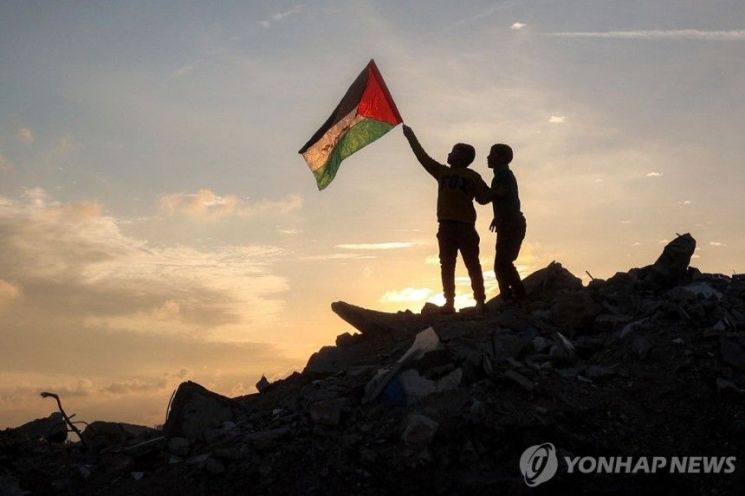 A boy waving the Palestinian flag on top of the rubble in a Gaza Strip refugee camp on the 17th (local time). Photo by Yonhap News.
According to foreign media including CNN, Israel approved the ceasefire plan at the full cabinet meeting following the security cabinet meeting the previous day.
The full cabinet meeting, which began the previous day, extended for more than six hours past the Sabbath and was ultimately approved despite opposition from some hardliners within the cabinet. Accordingly, the Gaza war will enter the first phase of the ceasefire on the 19th. Both sides plan to halt hostilities for six weeks and discuss a permanent ceasefire while exchanging hostages held by Hamas and Palestinian detainees held in Israel.
Preparations for the implementation of the ceasefire are also progressing smoothly. According to major foreign media including CNN, Egypt’s state-run Al Kahera News cited a senior local official reporting that a joint operations room will be established in Cairo to monitor the implementation of the Israel-Hamas ceasefire and hostage release. The official stated, "All necessary measures for the implementation of the agreement, including the formation of a joint operations room in Cairo to oversee the agreement’s execution, have been agreed upon."
The operations room will monitor compliance with the terms of the agreement, involving representatives from Israel, Hamas, and mediators including Egypt, Qatar, and the United States.
Relief supplies, which had been effectively blocked under Israeli control, are also expected to be normalized.
The Egyptian Ministry of Foreign Affairs urged the rapid, safe, and effective distribution of humanitarian aid the previous day, reporting that relief trucks are waiting on the Egyptian side beyond the separation barrier in southern Gaza.
The United Nations Relief and Works Agency for Palestine Refugees (UNRWA) also announced that it has prepared relief supplies sufficient for 4,000 trucks to enter Gaza, and the United Nations World Food Programme (WFP) stated it has prepared enough food to feed over one million people for three months.
During the war, Gaza’s humanitarian situation worsened due to Israeli military operations, entry controls into Gaza, and looting by armed gangs.
Philippe Lazzarini, UNRWA Commissioner-General, said, "Once aid starts pouring into Gaza, these conflicts can be alleviated. However, clearly, orderly and unobstructed access for people is also necessary."
However, even as the ceasefire approached, Israeli airstrikes continued, causing casualties. According to major foreign media including CNN, Palestinian authorities reported on the 17th that since the ceasefire agreement was announced on the 15th, 117 people have died and 266 have been injured in Gaza due to Israeli airstrikes. Among the deceased, 30 were children.
© The Asia Business Daily(www.asiae.co.kr). All rights reserved.

















