HCOCIA: "Issues of Investigative Authority and Jurisdiction Resolved"
Arrest-Related Documents Total Over 150 Pages
Six to Seven Prosecutors Expected to Attend Warrant Hearing
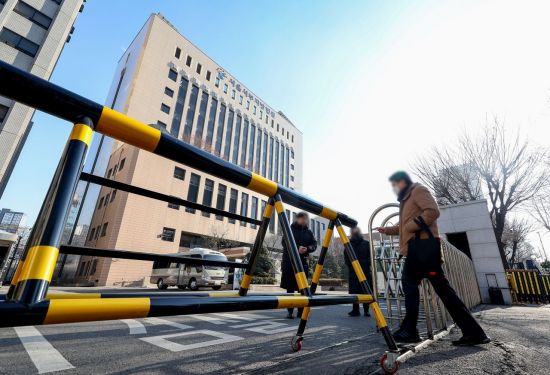
The High-ranking Officials' Crime Investigation Agency (HCOCIA) filed an arrest warrant for President Yoon Seok-yeol on the 17th. This comes 45 days after the 'December 3 Emergency Martial Law Incident' and two days after President Yoon was arrested. This is the first time in constitutional history that an arrest warrant has been filed against a sitting president.
At around 5:40 p.m. that day, the HCOCIA announced that it had filed an arrest warrant with the Seoul Western District Court against President Yoon on charges of leading a rebellion and obstructing the exercise of official duties through abuse of power.
An HCOCIA official explained the reason for filing the arrest warrant with the Western District Court, stating, "We considered the jurisdictional provisions of Article 31 of the HCOCIA Act and the usual practice of filing arrest warrants with the court that issued the arrest warrant." They added, "We judged that the issues of investigative authority and jurisdiction were resolved as the objection and the arrest appropriateness review requested by President Yoon were dismissed."
The arrest warrant document totals about 150 pages and was prepared by compiling investigation materials shared from the National Police Agency's National Investigation Headquarters and key suspect interrogation records shared from the Prosecutor's Special Investigation Headquarters at the joint investigation headquarters level. Six to seven HCOCIA prosecutors, including the chief prosecutor, are expected to attend the pre-arrest suspect interrogation (warrant substantive examination).
Specific charges applied to President Yoon
President Yoon is accused of conspiring with former Minister of National Defense Kim Yong-hyun (detained and indicted) to incite a riot for the purpose of disturbing the national order by declaring an unconstitutional and illegal emergency martial law on the 3rd of last month. The charges include declaring unconstitutional and illegal emergency martial law despite the absence of signs of war, armed conflict, or equivalent national emergencies; issuing an illegal martial law proclamation that banned political activities of the National Assembly; mobilizing martial law troops and police to block the National Assembly and obstruct the resolution to lift the emergency martial law. He is also accused of attempting to arrest and detain key figures such as Woo Won-sik, Speaker of the National Assembly who did not meet arrest conditions, Lee Jae-myung, leader of the Democratic Party, Han Dong-hoon, former leader of the People Power Party, and staff of the Central Election Commission.
The Seoul Western District Court, where the arrest warrant was submitted, is expected to soon set a date for the pre-arrest suspect interrogation (warrant substantive examination), confirm the positions of the HCOCIA and President Yoon's side, and then decide whether to issue the warrant. The hearing is expected to be held on the 18th. The main criteria for issuance include whether the charges are sufficiently substantiated and concerns about flight risk or evidence tampering.
Positions of the HCOCIA and President Yoon
The HCOCIA stated that although no statements related to the charges were obtained during the investigation immediately after President Yoon's arrest on the 15th, they believe the charges are sufficiently substantiated. Key commanders of the martial law troops and police, including former Minister Kim, are currently on trial in detention, and all have testified that they acted under President Yoon's orders. Since President Yoon, identified as the ultimate person responsible for the emergency martial law incident, refused to make any statements during the investigation and has been uncooperative by not responding to additional investigation requests, concerns about evidence tampering if released are expected to be emphasized.
On the other hand, President Yoon's side argues that the emergency martial law was a lawful act of presidential governance and therefore cannot be subject to judicial review, and that the charge of rebellion itself does not hold. They also contend that the HCOCIA's warrant request is improper due to lack of investigative authority and deny any risk of flight or evidence tampering. They are likely to continue to argue that the warrant request to the Seoul Western District Court is a jurisdictional violation, as was the case with the arrest warrant. Previously, the HCOCIA also filed the arrest warrant with the Western District Court citing residential jurisdiction.
Procedures following the arrest warrant request
It is uncertain whether President Yoon will attend the warrant substantive examination. Earlier, Yoon Gap-geun, a lawyer for President Yoon, stated that while they would not cooperate with the HCOCIA's illegal investigation, "they will comply with procedures conducted by the court." However, there is also a possibility that President Yoon may not attend the hearing citing the legality of the Western District Court's jurisdiction or security issues. If President Yoon refuses the hearing, the court may proceed with a written review only or conduct the hearing with only the prosecutor and defense counsel present before deciding on the issuance.
The HCOCIA requested President Yoon to appear three times as a suspect, but when he did not respond, they obtained an arrest warrant from the Western District Court. After two attempts to execute it, President Yoon was arrested at 10:33 a.m. on the 15th at the presidential residence in Hannam-dong, Yongsan-gu, Seoul.
On the day of his arrest, President Yoon underwent his first interrogation at the HCOCIA for 10 hours and 40 minutes but did not answer questions and did not sign or seal the interrogation record. Early in the investigation, he stated that "emergency martial law is a presidential authority under the Constitution, and the president judged the various conditions for its enforcement," adding that "it is not a matter for judges or prosecutors to decide"?this was the extent of his remarks.
Subsequently, he did not respond to additional summons from the HCOCIA and filed a request for an arrest appropriateness review with the court, claiming "illegal arrest," but it was dismissed.
© The Asia Business Daily(www.asiae.co.kr). All rights reserved.
![Clutching a Stolen Dior Bag, Saying "I Hate Being Poor but Real"... The Grotesque Con of a "Human Knockoff" [Slate]](https://cwcontent.asiae.co.kr/asiaresize/183/2026021902243444107_1771435474.jpg)
















