World Economic Outlook
Growth Forecast for This Year Remains at 2.7%
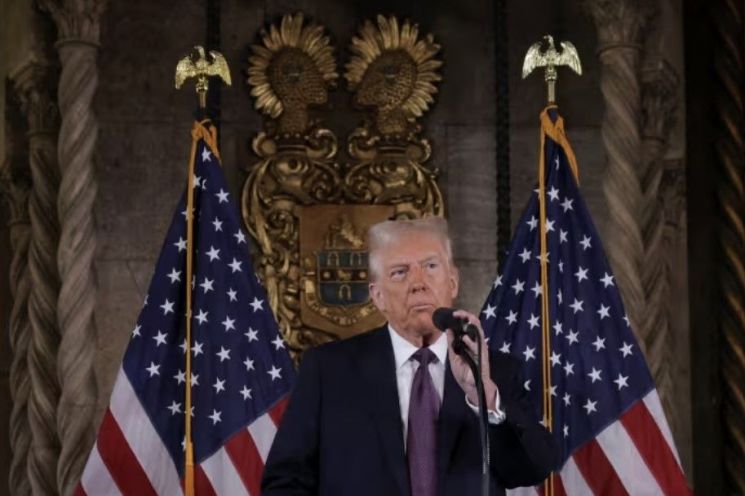
The World Bank (WB) maintained its global economic growth forecast for this year at 2.7%, the same as the previous projection. However, it identified the universal tariffs proposed by the second Trump administration as a downside risk to the global economy, warning that if these tariffs trigger a trade war, the growth rate could be up to 0.3 percentage points lower than the current forecast.
In its "Global Economic Prospects" report released on the 16th (local time), the WB projected this year's global economic growth rate to be 2.7%, the same as last year's (2.7%) and the previous forecast made in June. The WB publishes global economic forecasts twice a year, in January and June.
The WB forecasted that "this year, the global economy will maintain stable growth supported by lower inflation rates and easing monetary policies in both advanced and emerging/developing economies."
However, it also expected "growth to remain relatively low compared to the pre-COVID-19 pandemic period (2010?2019, 3.1%) due to insufficient offsetting of damages caused by consecutive external shocks over the past few years."
The report assessed that downside risks to growth continue to dominate this year. These downside risks include increased policy uncertainty, negative changes in trade policies, the spread of geopolitical risks, rising inflation, economic slowdowns in major countries, and natural disasters caused by abnormal weather.
The report also projected that the global economy will maintain a 2.7% growth rate next year. For advanced economies, the report forecasted economic growth rates of 1.7% this year and 1.8% next year. Among advanced economies, the United States is expected to grow by 2.3% this year and 2.0% next year, while Japan is projected to grow by 1.2% this year and 0.9% next year.
The WB anticipated that "while the U.S. will see a gradual slowdown in growth due to signs of weakening labor markets and consumer sentiment, the Eurozone will experience growth recovery through improvements in investment and trade, and Japan will see growth recovery through capital investment and consumer spending improvements."
Regarding the U.S., the report projected that if the "2017 Trump tax cuts," which are set to expire this year, are extended and other economic conditions remain unchanged, the U.S. economic growth rate could be 0.4 percentage points higher next year. However, the global spillover effects of this are expected to be minimal.
Emerging and developing economies are expected to grow by 4.1% this year and 4.0% next year. Among these, China is projected to grow by 4.5% this year and 4.0% next year.
The WB stated, "The economic growth rate of developing countries is expected to remain stable at around 4% over the next two years," but added, "this is weaker than the pre-COVID-19 pandemic period and insufficient to promote progress needed to alleviate poverty and achieve broader development goals."
Furthermore, the average economic growth rate of developing countries has declined from 5.9% in the 2000s to 5.1% in the 2010s and 3.5% in the 2020s. This decline is attributed to sluggish investment, weakened productivity growth, increased debt burdens, and protectionism. The WB warned, "The next 25 years will be more challenging for developing countries than the past 25 years."
The report also anticipated that if the universal tariffs promised by President-elect Donald Trump, who will take office on the 20th, are implemented, the global economic growth forecast will be lowered.
According to the WB's simulation, if the second Trump administration imposes a 10% universal tariff and other countries do not retaliate, this year's global economic growth rate would be 0.2 percentage points lower than the forecasted 2.7%. However, if other countries respond with proportionate retaliatory tariffs, escalating into a tariff war, the growth rate could drop by as much as 0.3 percentage points.
The WB explained, "These simulation results align with other studies analyzing the impact of U.S. tariff increases." It cited a study indicating that if U.S. tariffs increase by 10% and other countries impose retaliatory tariffs, the U.S. Gross Domestic Product (GDP) could decline by up to 0.9%.
© The Asia Business Daily(www.asiae.co.kr). All rights reserved.

















