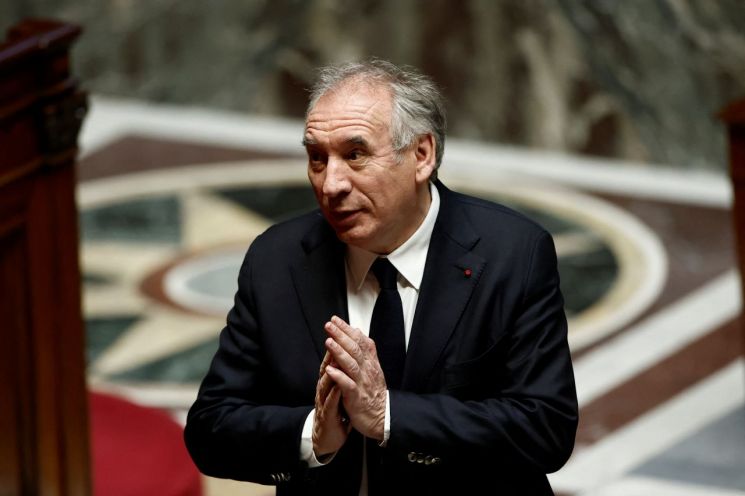
The newly formed French government led by Fran?ois Bayrou overcame its first no-confidence crisis in parliament on the 16th (local time).
The French National Assembly voted on a no-confidence motion against the Bayrou government, submitted by three left-wing parties, but it was rejected as only 131 members voted in favor, far short of the required quorum of 288 votes. The votes in favor came from the far-left party La France Insoumise (LFI), the Greens, and the Communist Party, which had submitted the motion.
The three parties submitted the no-confidence motion, arguing that their demands, including the suspension of pension reform, were not reflected in the new government's policy plan announced by Prime Minister Bayrou on the 14th. They demanded the suspension or repeal of the pension reform passed in 2023, which extended the retirement age from 62 to 64. However, Prime Minister Bayrou proposed renegotiations with labor unions, employer organizations, and social groups instead.
Alongside these three parties, the Socialist Party, which formed the New Popular Front (NFP) left-wing coalition in last year's early general election and became the largest force in parliament, did not participate in submitting the no-confidence motion and voted against it as the party line. This effectively represents a split within the NFP.
Since becoming head of government last month, Prime Minister Bayrou has been negotiating to gain support in the no-confidence vote by making some policy concessions to the relatively moderate Socialist Party among the left-wing parties. The proposal to renegotiate the pension reform was also a card to persuade the Socialists. Regarding the Socialists' solo action on this day, Jean-Luc M?lenchon, leader of LFI, criticized on X (formerly Twitter), saying, "The Socialist Party is dismantling the NFP," and added, "The Socialists are surrendering alone, while the other three groups will continue the fight."
Although the Bayrou government has passed its first parliamentary hurdle, a second challenge remains regarding the 2025 budget. France has yet to pass the 2025 budget. Last year, under Prime Minister Michel Barnier in the second half of the year, a austerity budget was submitted to the National Assembly, but opposition parties, rebelling against it, passed a no-confidence motion against the government for the first time in 62 years, leading to the dissolution of the entire cabinet earlier this month.
The fate of the Bayrou government remains uncertain. The far-right National Rally (RN), another parliamentary faction that joined forces with the left-wing coalition to dissolve the previous Barnier government, has stated that it will again initiate a no-confidence motion if its demands are not reflected in the budget. Since the early general election in July last year, France has been in a 'hung parliament' situation where no party holds an outright majority, resulting in extreme division.
© The Asia Business Daily(www.asiae.co.kr). All rights reserved.
![Clutching a Stolen Dior Bag, Saying "I Hate Being Poor but Real"... The Grotesque Con of a "Human Knockoff" [Slate]](https://cwcontent.asiae.co.kr/asiaresize/183/2026021902243444107_1771435474.jpg)
















