Despite Bank of Korea's Rate Freeze, Market Interest Rates Fall
Strong Signal for Next Month's Rate Cut Triggers Preemptive Market Response
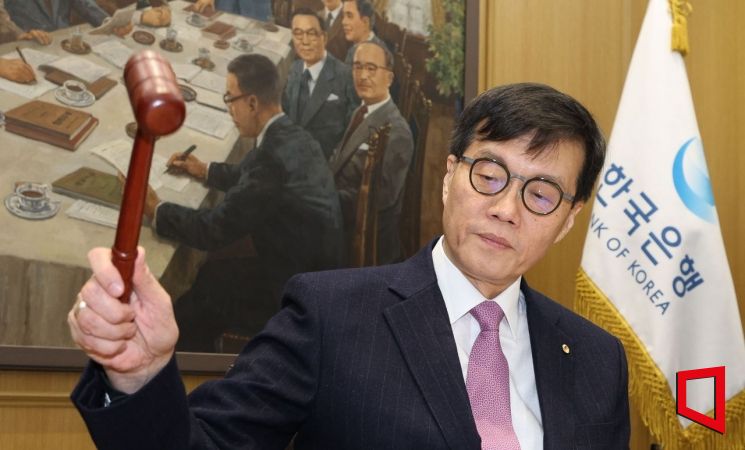 Lee Chang-yong, Governor of the Bank of Korea, is striking the gavel at the Monetary Policy Committee plenary meeting held at the Bank of Korea in Jung-gu, Seoul, on the morning of the 16th. 2025.01.16 Photo by Joint Press Corps
Although the Bank of Korea kept the base interest rate unchanged in January, it strongly hinted at a rate cut in February, leading market interest rates to react with a preemptive decline.
On the 16th in the Seoul bond market, the yield on 3-year government bonds closed at 2.626% per annum, down 0.049 percentage points from the previous trading day. The 10-year bond yield fell by 0.058 percentage points to 2.802% per annum.
It is considered unusual that market interest rates fell despite the Bank of Korea's Monetary Policy Committee maintaining the base rate at the current level of 3.00% per annum. This is interpreted as many investors expecting the Bank of Korea to resume cutting rates in February after holding the rate steady in January due to concerns over a high exchange rate. Considering the current base rate of 3.00%, the market appears to anticipate one or two additional rate cuts.
The Bank of Korea expressed concerns that the domestic economy might worsen more than expected due to domestic political turmoil and the inauguration of U.S. President Donald Trump.
Bank of Korea Governor Lee Chang-yong stated at a press briefing the previous day, "After the martial law, various data show that domestic demand indicators such as consumption and construction have fallen more sharply than expected," adding, "There is a possibility that the fourth-quarter growth rate (quarter-on-quarter) could drop by as much as 0.2% further."
Governor Lee also forecasted that this year's economic growth rate would be worse than expected. He explained, "Due to the unexpected expansion of political risks, this year's growth rate is likely to fall below the November forecast of last year (1.9%)."
As it becomes highly likely that the Bank of Korea will revise its growth forecast downward, the possibility of a base rate cut in February has significantly increased.
Kim Sang-hoon, a researcher at Hana Securities, commented, "The Bank of Korea's Monetary Policy Committee hinted at a downward revision of the growth forecast in the February economic outlook, with the key point being the expansion of the background from exports to domestic demand," adding, "The January Monetary Policy Committee meeting result was effectively a freeze equivalent to a cut."
An Ye-ha, a researcher at Kiwoom Securities, also explained, "Considering Governor Lee's announcement of a downward revision of the Bank of Korea's growth forecast and the diagnosis of increased downside risks to the economy, the January Monetary Policy Committee could be described as having effectively implemented a rate cut."
The expectation that rates could be cut once more in the first half of the year following February is also a factor contributing to the decline in market interest rates. Jo Young-moo, a research fellow at LG Economic Research Institute, predicted, "Including February, the base rate will fall by a total of 0.50 percentage points through two cuts in the first half of the year."
© The Asia Business Daily(www.asiae.co.kr). All rights reserved.

![Clutching a Stolen Dior Bag, Saying "I Hate Being Poor but Real"... The Grotesque Con of a "Human Knockoff" [Slate]](https://cwcontent.asiae.co.kr/asiaresize/183/2026021902243444107_1771435474.jpg)















