Bank of Korea Holds Base Rate at 3% on the 16th
Real Estate Experts: "Cautious Sentiment to Continue After Impeachment Crisis"
"Bank Lending Rates Do Not Necessarily Follow Base Rate... Stance of Financial Authorities Is Key"
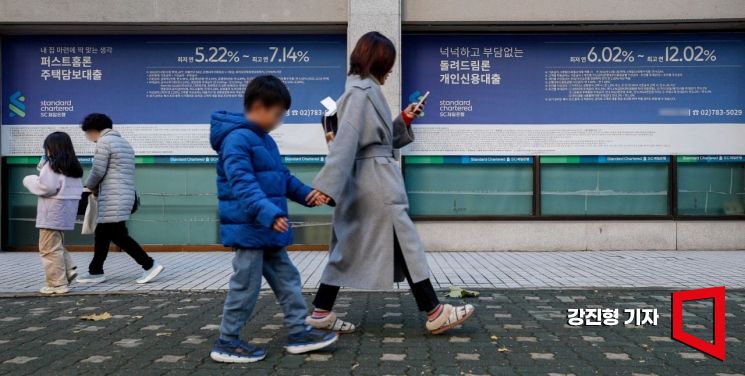 On the 21st, a notice about personal credit loan and mortgage loan interest rates is posted at a commercial bank in Seoul. Photo by Jinhyung Kang aymsdream@
As the Financial Monetary Policy Committee of the Bank of Korea kept the base interest rate steady at 3% per annum on the 16th, the domestic real estate market, which had been expecting a rate cut, is anticipated to adopt a more cautious stance. The Bank of Korea froze the rate considering the instability of the won-dollar exchange rate, domestic and international economic uncertainties, and the possibility of a slowdown in U.S. rate cuts.
Real estate experts commented, "The mortgage loan rates at commercial banks do not necessarily follow the same trend as the base interest rate, so the decision to hold the base rate steady will not have a significant impact on the real estate market." However, they also forecasted that "due to political uncertainties amid the impeachment crisis, the market has entered an adjustment phase, and the cautious stance is expected to continue."
However, since real estate transaction volumes increased and prices rose during the summer just before the second phase of the stress Debt Service Ratio (DSR) was implemented in September last year, it is advised to closely monitor the real estate market situation ahead of the planned third phase of stress DSR implementation in July this year.
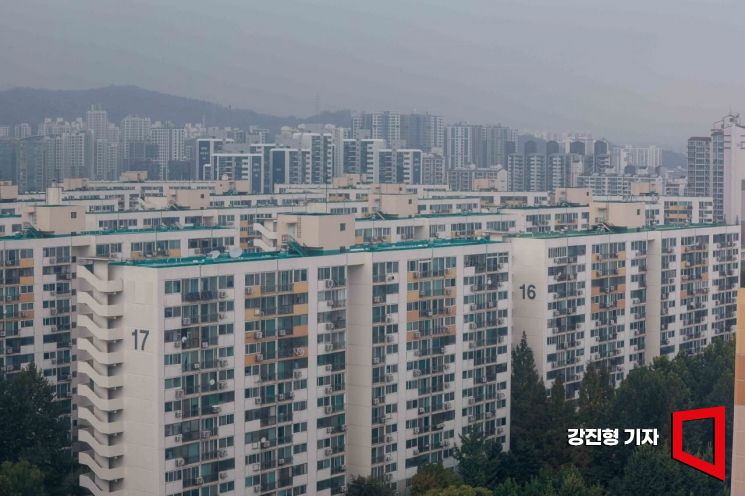 On the 15th, Seongsan Sijeong Apartment in Seongsan-dong, Mapo-gu, Seoul. Seongsan Sijeong Apartment is a complex completed in 1986, consisting of 33 buildings with up to 14 floors and 3,710 households. Photo by Jin-Hyung Kang aymsdream@
Shin Yongsang, Senior Research Fellow at the Korea Financial Research Institute, said, "This base rate freeze will deepen the cautious sentiment, which is expected to last until the first half of the year." He added, "This rate freeze can also be interpreted as maintaining a policy stance to strengthen household debt management from a soundness perspective," and "Even if transactions occur, they will likely be centered around policy loans for the time being."
He continued, "Currently, the U.S. also seems reluctant to lower its base rate, and considering this, it will be difficult for the Seoul real estate market to heat up anytime soon," adding, "Although banks have lending capacity at the beginning of the year, it will be challenging for mortgage loans to increase significantly compared to last year." He also noted, "At the moment, the stance of financial authorities is more important than that of the Bank of Korea," and "The financial authorities still appear to maintain a conservative position regarding loan regulations."
Kim Hyoseon, Senior Specialist at NH Nonghyup Bank, said, "Currently, due to the sluggish economy, the Bank of Korea chose to freeze the rate as a response measure, but mortgage loan rates have a more sensitive impact on real estate market participants than the base rate," pointing out, "Last year, even though the base rate was cut twice consecutively, loan rates did not decrease proportionally."
Kim added, "Even if the base rate is frozen this time, its market influence is expected to be limited," diagnosing that "it will serve more to reinforce the cautious sentiment emerging after the impeachment crisis." He also said, "However, there is a scenario where the Bank of Korea might cut the base rate before political uncertainties are resolved and before the third phase of stress DSR implementation in July reduces loan limits," predicting, "If that happens, the real estate market could revive earlier than expected."
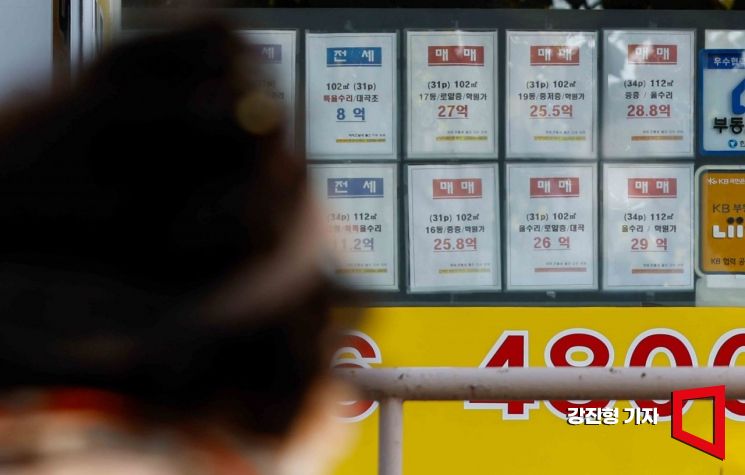 On the 24th, as apartment transactions shrink due to loan regulations and other factors, listings continue to accumulate. Sale and jeonse (long-term lease) flyers are posted at an apartment complex real estate in Gangnam-gu, Seoul. Photo by Kang Jin-hyung
Kwon Youngsun, Team Leader of the Real Estate Investment Advisory Center at Shinhan Bank, also said, "Since the loan regulations were tightened in September last year, the cautious stance has continued, and the base rate freeze will not change the market situation." He added, "Currently, market demand is significantly contracted," and "After this freeze, banks are unlikely to lower the additional interest rates substantially, so the effect of lowering loan rates will be minimal."
Team Leader Kwon said, "Interest rates are pointing towards a downward direction, and ultimately it is a matter of speed, but in the current real estate market, the problem is that bank additional interest rates are higher than the base rate," emphasizing, "The stance of financial authorities is crucial." He predicted, "However, transaction volumes might increase before the third phase of stress DSR implementation," and "If the base rate is cut and loan rates decrease accordingly, real estate transaction volumes in Seoul could rise."
Ham Youngjin, Head of the Real Estate Research Lab at Woori Bank, said, "At the beginning of the year, the resumption of household loans by financial institutions and the reduction of prepayment penalties have improved the mortgage loan environment, but the combination of the impeachment crisis, economic downturn, and winter off-season has limited the warming of the cooled housing market."
He added, "Once the transaction market and housing prices start to contract, it is difficult to shift to an upward trend without a movement in buyer sentiment," and "Improvement in real estate transaction turnover will likely have to wait until at least the spring moving season."
© The Asia Business Daily(www.asiae.co.kr). All rights reserved.



















