Bank of Korea Keeps Base Rate Unchanged at 3.00% per Annum
High Exchange Rate Cited as Main Reason for Rate Freeze
Growth Forecast for This Year Expected to be Revised Downward
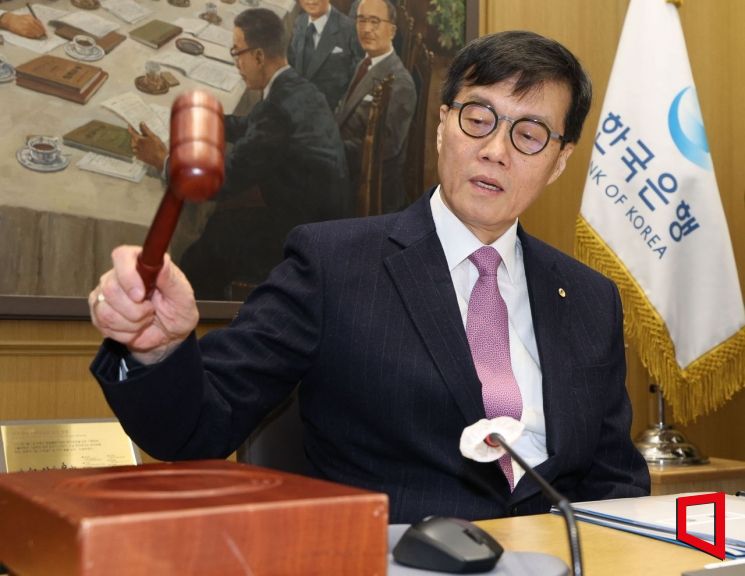 Lee Chang-yong, Governor of the Bank of Korea, is striking the gavel at the Monetary Policy Committee plenary session held at the Bank of Korea in Jung-gu, Seoul, on the morning of the 16th. 2025.01.16 Photo by Joint Press Corps
The Monetary Policy Committee of the Bank of Korea announced on the 16th that it will keep the base interest rate unchanged at the current level of 3.00% per annum.
In the monetary policy direction statement released that day, the committee explained the reason for holding the rate steady as "an increase in downside risks to growth due to unexpected political risks and heightened exchange rate volatility."
It added, "Given the increased uncertainty in economic outlook and foreign exchange markets depending on future domestic political developments and changes in major countries' economic policies, it was judged appropriate to maintain the current base interest rate level while further monitoring changes in domestic and external conditions."
The domestic economy is expected to experience a slower recovery in domestic demand than anticipated due to a slowdown in export growth and weakened consumer sentiment. The growth rates for last year and this year are likely to fall short of the November forecast (2.2% for 2024 and 1.9% for 2025). There is high uncertainty regarding the future growth path related to changes in domestic political situations, government economic response measures, and the policy direction of the new U.S. administration.
The Monetary Policy Committee decided to operate monetary policy by maintaining the Bank of Korea’s base interest rate at the current level of 3.00% until the next monetary policy decision. While inflation remains stable and household debt growth is slowing, downside risks to growth have increased due to unexpected political risks, and exchange rate volatility has risen. Given the increased uncertainty in economic outlook and foreign exchange markets depending on future domestic political developments and changes in major countries' economic policies, it was judged appropriate to maintain the current base interest rate level while further monitoring changes in domestic and external conditions.
The global economy shows differentiated economic trends by country, with increased uncertainty in growth and inflation outlooks due to the direction of economic policies of the new U.S. administration, the pace of Federal Reserve rate cuts, and political situations in major countries. Influenced by these factors, the international financial market has seen increased volatility in key price variables, such as the continued strength of the U.S. dollar and rising long-term government bond yields. Going forward, the global economy and international financial markets are expected to be affected by the implementation of the new U.S. administration’s economic policies, monetary policies and political situations in major countries, and geopolitical risks.
Domestically, export growth rate increased somewhat in December, but consumer recovery weakened and construction investment remained sluggish. Employment continued to slow, with a decrease in the number of employed persons. Going forward, the domestic economy is expected to see a slower recovery in domestic demand than anticipated due to a slowdown in export growth and weakened consumer sentiment. The growth rates for last year and this year are likely to fall short of the November forecast (2.2% for 2024 and 1.9% for 2025), and there is high uncertainty regarding the future growth path related to changes in domestic political situations, government economic response measures, and the policy direction of the new U.S. administration.
Domestic inflation remained stable. In December, the consumer price inflation rate rose to 1.9% due to increases in petroleum prices, but the core inflation rate (excluding food and energy) slightly decreased to 1.8%. Short-term inflation expectations remained in the high 2% range. Inflation is expected to continue on a stable path due to low demand pressures, but the elevated exchange rate is likely to act as an upward factor. Uncertainty has increased regarding international oil price movements and domestic and foreign economic trends.
In financial and foreign exchange markets, the won-dollar exchange rate rose sharply due to increased domestic political uncertainty and the possibility of the U.S. Federal Reserve adjusting the pace of rate cuts. Stock prices were significantly adjusted but rebounded this year, while long-term government bond yields declined amid concerns over economic slowdown. Household loans continued to slow due to decreased housing transactions, and nationwide housing prices turned downward.
The Monetary Policy Committee will continue to operate monetary policy with attention to financial stability while monitoring growth to ensure that inflation stabilizes at the target level over the medium term. Although domestic inflation remains stable, downside risks to growth have increased due to political risks, and uncertainty in economic outlook has grown. From a financial stability perspective, the slowdown in household debt is expected to continue for the time being, but attention is needed regarding the impact of increased exchange rate volatility on inflation and financial stability. Therefore, future monetary policy will closely monitor domestic political developments and changes in domestic and external economic policies, as well as the resulting trends in inflation, household debt, and exchange rates, to determine the timing and pace of any additional base rate cuts to mitigate downside growth risks.
© The Asia Business Daily(www.asiae.co.kr). All rights reserved.
![Clutching a Stolen Dior Bag, Saying "I Hate Being Poor but Real"... The Grotesque Con of a "Human Knockoff" [Slate]](https://cwcontent.asiae.co.kr/asiaresize/183/2026021902243444107_1771435474.jpg)
















