BYD to Launch Three Models Including Ato 3, Seal, and Sea Lion 7 Within the Year
Mid-size SUV Priced in the 30 Million KRW Range... Competing on Price Competitiveness
Xiaomi Also Enters Korean Home Appliance Market... Showcasing Robot Vacuums and TVs
'Cost-effectiveness' and 'Connectivity'... "Separate Servers Operated in Korea"
BYD, emerging as the world's largest electric vehicle manufacturer, unveiled its compact SUV Ato 3 in South Korea for the first time on the 16th. BYD plans to start accepting pre-orders for the Ato 3 and launch full-scale sales by mid-next month.
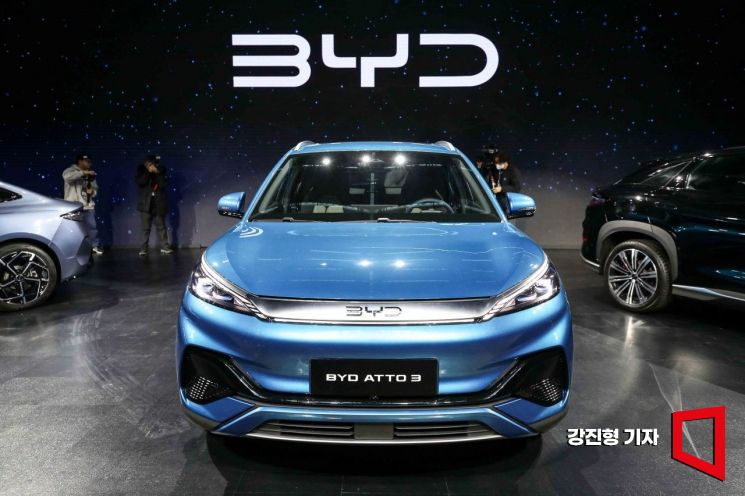 On the 16th, the BYD Atto 3, officially launched in Korea, was unveiled at the 'BYD Brand Launch Media Showcase' held at Incheon Sangsang Platform.
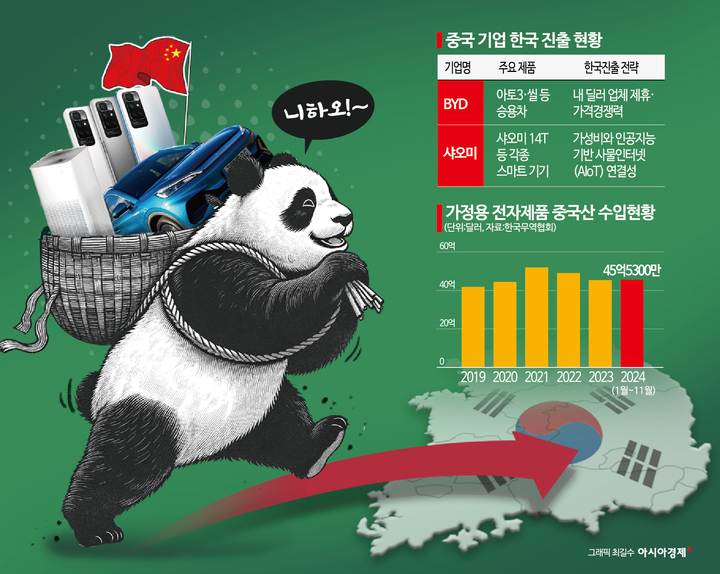
Following the day before when Chinese IT company Xiaomi revealed products to be launched domestically, BYD also officially announced its entry into the Korean market, signaling the strong intent of leading Chinese automotive and IT companies to target Korea. Notably, the overall evaluation is that they have secured product competitiveness not only by emphasizing price competitiveness but also by integrating advanced technologies, which is expected to have a considerable impact on related domestic industries.
Targeting Korea with Mid-size SUV Electric Vehicles Priced in the 20 Million KRW Range
BYD Korea held a press conference at Incheon Sangsang Platform to introduce its passenger car brand's domestic launch, revealing models, sales plans, and annual targets. The vehicles unveiled include the compact SUV Ato 3, the mid-size sedan Seal, and the mid-size SUV Sea Lion 7. The pricing was set aggressively. The launch price of the Ato 3 is 31.5 million KRW, and considering government subsidies, the actual purchase price drops to the 20 million KRW range. The higher trim Ato 3 Plus is priced at 33.3 million KRW.
Considering that the Ato 3 was first launched in Japan at 4.5 million yen (approximately 42 million KRW) and in Germany starting from 37,990 euros (about 57 million KRW), this reflects a strong determination to capture the Korean market. The Seal and Sea Lion 7, which will be released sequentially, are known to be priced in the 40 million KRW range. Since they are equipped with LFP (Lithium Iron Phosphate) batteries, which have a low recycling rate, subsidies are expected to be lower than those for domestic vehicles.
BYD plans to open 12 service centers sequentially through domestic dealers and offer various benefits to customers, including a 6-year/150,000 km warranty (8 years/160,000 km for high-voltage batteries), four free inspections, and six years of free towing. Internally, the annual sales target for Korea this year is reportedly set at around 10,000 units. Among existing imported car brands, only about five or six, including BMW, have surpassed 10,000 units.
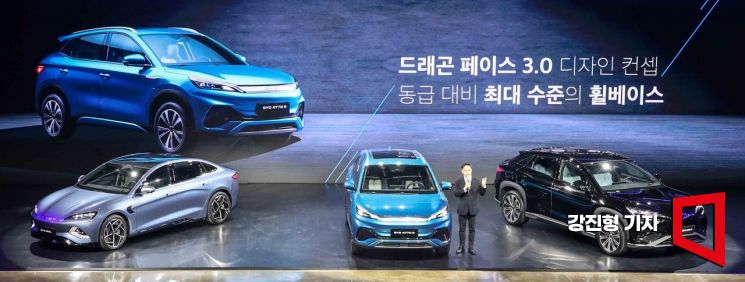 On the 16th, the upcoming BYD vehicle was unveiled at the 'BYD Brand Launch Media Showcase' held at Incheon Sangsang Platform. Photo by Kang Jin-hyung
Jo In-cheol, head of BYD Korea's passenger car division, emphasized, "BYD is writing a new chapter in mobility with a clear vision and a DNA of technological innovation. Since many customers are anxious due to vague prejudices, we will meet customers directly at the closest point to provide accurate information about electric vehicles."
Ryu Xueliang, General Manager of BYD Asia-Pacific Automotive Sales Division, stated, "From today onward, we will continuously introduce the best new energy vehicles to Korea with the best technology. We will contribute to all consumers and the development of Korea's green economy."
BYD's electric vehicle launch, coinciding with Xiaomi's new product unveiling the day before, is seen as the beginning of a Chinese product offensive. Yang Jin-soo, head of the Mobility Industry Research Office at HMG Management Research Institute, said at a seminar the previous day regarding BYD's entry into Korea, "Although there is a perception that domestic consumers have a negative view of Chinese brands, it can change significantly depending on how the business is conducted and how relationships with domestic customers are built."
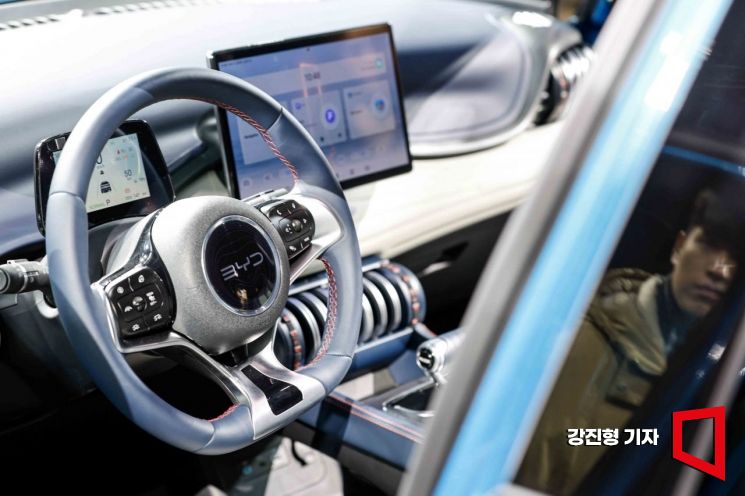 On the 16th, the interior of the BYD Atto 3, officially launched in Korea, was revealed at the 'BYD Brand Launch Media Showcase' held at Incheon Sangsang Platform. Incheon - Photo by Kang Jin-hyung
From TVs to Robot Vacuums... Xiaomi Appliances Also Enter Korea
Johnny Wu, CEO of Xiaomi Korea, said at a press conference on the 15th, "We want to show all of Xiaomi's AI-based Internet of Things (AIoT) products to Korean users," adding, "They are designed to be organically connected and operate together from smartphones to various smart home devices to make users' daily lives more convenient."
Xiaomi introduced products in five categories: smartphones, TVs, wearables such as watches and earbuds, robot vacuum cleaners, and portable batteries. Sales will begin sequentially from that day through the official website, Coupang, Naver, and others. Wu stated, "We will deeply understand users and genuinely empathize with their lifestyles to provide products and services. We plan to strengthen service capabilities and establish partnerships with Korea's industry leaders in various ways."
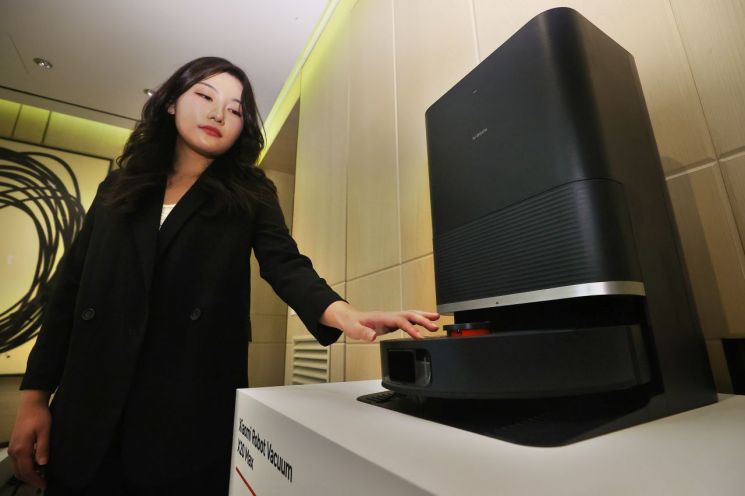
Xiaomi emphasized 'cost-effectiveness (performance relative to price)' and 'connectivity' as strengths. The first product introduced, the premium smartphone Xiaomi 14T, features a camera co-developed with Germany's luxury camera brand Leica and incorporates Google's artificial intelligence (AI) technology. The triple camera system with Leica optical technology provides vivid colors even in dark environments and helps ordinary users create cinematic videos through 'Movie Mode.'
Various AI features such as real-time translation, voice-to-text conversion, and automatic editing of recorded videos to assist in creating short-form content are also included. Despite being a high-spec AI phone, the price is reasonable. Kiko Song, head of Xiaomi East Asia Marketing, emphasized, "The Xiaomi 14T is sold in Europe for 649 euros (about 970,000 KRW), but it was launched in Korea at 599,800 KRW."
Xiaomi also highlighted the security of its proprietary operating system, HyperOS, and emphasized that user data does not go to China, likely in response to concerns about cybersecurity and personal information protection. There is concern that if data is transmitted to servers in China, government agencies could request the data under Chinese law, potentially infringing on privacy. A Xiaomi official at the press conference said, "We clearly separate domestic and overseas servers. Data coming from overseas is processed on servers in Singapore and does not go to China."
© The Asia Business Daily(www.asiae.co.kr). All rights reserved.



















