Appearing in Court for the '10-Year Tobacco Lawsuit' to Argue Directly
As a Respiratory Medicine Specialist, Stresses the Causal Link Between Smoking and Lung Cancer
"It is scientifically and medically proven that tobacco is a direct cause of respiratory diseases such as lung cancer. Since tobacco significantly contributes to the occurrence and aggravation of diseases, tobacco companies must bear at least minimal responsibility."
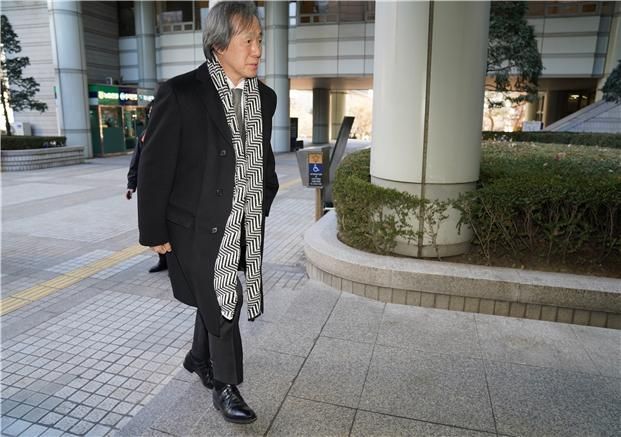 Jeong Gi-seok, Chairman of the National Health Insurance Service, is entering the Seoul High Court in Seocho-gu, Seoul on the 15th to attend the 11th hearing of the tobacco lawsuit appeal against KT&G Corporation, Philip Morris Korea Inc., and BAT Korea Co., Ltd. Photo by National Health Insurance Service
On the 15th, during the appeal trial of the damages lawsuit filed by the National Health Insurance Service (NHIS) against tobacco companies over a decade ago, held at the Seoul High Court Civil Division, Jeong Gi-seok, the chairman of NHIS and a respiratory medicine specialist, personally presented the argument as the plaintiff representative.
Previously, in April 2014, NHIS filed a lawsuit demanding 53.3 billion KRW in compensation from tobacco companies including KT&G, Korea Philip Morris, and BAT Korea, claiming reimbursement for additional medical expenses incurred due to smoking. However, NHIS lost in the first trial, which lasted over six years. The first trial court stated, "It cannot be ruled out that the diseases were caused by factors other than smoking, such as individual lifestyle, genetics, surrounding environment, and occupational characteristics," and did not recognize a causal relationship between smoking and the diseases.
NHIS appealed this decision, and starting from the first appeal trial in June 2021, the Seoul High Court Civil Division 6-1 (Presiding Judges Kim Je-uk, Lee Kyung-hoon, and Kang Kyung-pyo) held the 11th hearing on this day. Chairman Jeong argued, "Smoking is a clear carcinogen," and "Not holding tobacco companies accountable would be a serious error that denies the health rights of society as a whole."
He emphasized the causal relationship between smoking and lung cancer, stating, "Professors and general physicians researching respiratory diseases were all surprised by the first trial result," and "It is a truth taught to students in textbooks that smoking causes lung cancer." He also stressed, "The World Health Organization (WHO) classifies even secondhand smoke as a Group 1 carcinogen," and "Smoking is clearly a direct and the most critical carcinogen."
During the hearing, both sides debated the issue of causality between smoking and the onset of lung and laryngeal cancers. The key issues included ▲ the epidemiological causal relationship between smoking and diseases such as lung cancer ▲ assessment of individual causality for the defendants ▲ recognition of the causal relationship between the defendants' illegal acts and the onset of diseases such as lung cancer.
Chairman Jeong stated, "We classified and submitted 1,467 individuals among the defendants who had no risk factors for cancer other than smoking to provide additional evidence against the first trial ruling," and "This case is based on sufficient epidemiological and medical evidence combined with individual cases, and South Korea, as a leading medical country, should be recognized belatedly." He continued, "Even dying patients cannot quit smoking due to nicotine addiction and secretly smoke in hospital rooms," and argued, "Tobacco companies must be held responsible for concealing the addictive nature of tobacco and delaying its disclosure."
Chairman Jeong appealed to the court, saying, "Not holding tobacco companies accountable for the addiction and diseases caused by tobacco would be a serious error that denies the health rights of not only the victims but society as a whole," and "We ask for the belief that the state protects its citizens." He emphasized, "If the court issues the same ruling as before, it would be equivalent to saying 'manage smoking moderately,'" and "This is not the message to convey to the public in a country where 60,000 people die annually from tobacco and 3.5 trillion KRW of health insurance funds are spent."
© The Asia Business Daily(www.asiae.co.kr). All rights reserved.

















