Only Two Prestigious Families Rooted in Jeolla Province Possess the Artifact
Unclear Origins, Associations, and Historical Background Raise Suspicions
Experts Point Out: "It Does Not Match Historical Records"
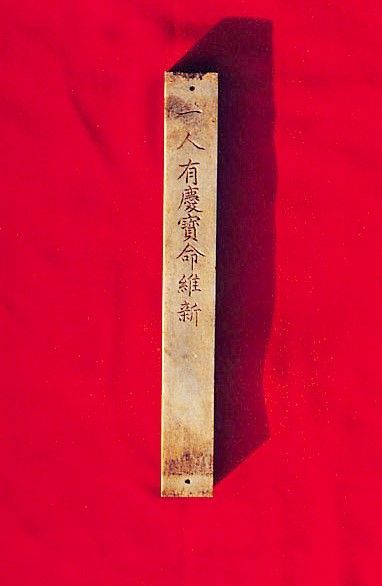
The "Okhol," once considered a national treasure-level cultural artifact due to its exclusive possession by only two prestigious families rooted in Gwangju and Jeonnam around the Joseon Dynasty, has recently become the subject of an unexpected authenticity controversy. Given the historical background, the actual existence of the Okhol is highly unlikely, and some suggest it may actually be part of another artifact, such as an Okchaek. There are growing calls for a re-examination of this Okhol.
According to historians, a "hol" (笏) was a kind of "notepad" used by officials during royal ceremonies or national rituals in which they would write down the king's orders or their own thoughts and policies to present before the king.
During the Joseon Dynasty, the type of hol used depended on rank: officials of rank 1 to 4 used an "Ahol" (made of elephant ivory), while those of rank 5 to 9 used a "Mokhol" (made of wood). "Okhol" refers to a hol made of jade, and it is known that only two families, A and B, possess such an item not only in Korea but also in China and Japan.
Recognizing its rarity, the Okhol owned by family A was designated as Jeonnam Tangible Cultural Property No. 40 on September 24, 1974. It has also been confirmed that family B is currently undergoing the process to have their Okhol designated as a cultural property as well.
The issue is that the origins, associations, and historical background of these Okhols remain unclear.
Officially, the Okhol of family A is said to have been first bestowed by King Jungjong, but the first record of its existence appears in the family A genealogy written in the 1870s. At that time, a person with the surname Heo possessed the Okhol of family A for unspecified reasons, and records show that family A reclaimed ownership through what would be considered a "lawsuit" today. However, even then, the term "Okhol" was not used; it was simply referred to as an "Okpae" (jade tablet).
Moreover, the Okhol bears the inscription "Il-in-yu-gyeong-bo-myeong-wi-sin" (一人有慶寶命維新), meaning "It is a joyous and auspicious event to continue the noble royal lineage." This phrase exactly matches the inscription found on a jade book bestowed by King Seonjo (October 19, 37th year of his reign) to his queen consort Inmok Wanghu to celebrate her pregnancy.
Historically, the content of the inscription and the time the Okhol was supposedly bestowed do not match.
The Okhol owned by family B is similar. It is inscribed with "Seonjo Bokyu Hasai U Chun" (宣組伏惟下賜李遇春), meaning "King Seonjo bestows (the Okhol) to Lee Uchun."
At first glance, the giver and recipient of the Okhol seem clear. However, there are claims that the Okhol of family B originally only had "Seonjo Bokyu" inscribed, and the phrase "Hasai Uchun" may have been added later. In fact, the structure and form of the two inscriptions are visibly and distinctly different. Furthermore, there are no records indicating when the Okhol was received.
Notably, both Okhols owned by these two families are identical in size, measuring 27.4 cm in length and 3.4 cm in width, and are vertically long rectangles with holes drilled at the top and bottom.
Some experts point out that this is not seen in typical hols, but rather resembles the size and shape of an Okchaek. An Okchaek is a type of document made by engraving texts into jade plates, which are then bound together, used for royal appointments, honorific titles, posthumous titles, and imperial edicts. Holes are typically drilled in the lower part of the Okchaek for easy binding, and their length is usually around 25 cm.
Regarding this, a representative of one of the families stated, "Considering the various forms and records of the Okhol, it may not have been used as a hol in the literal sense. However, since it is registered as a regional cultural property, we cannot make hasty conclusions. A more precise re-examination is necessary."
© The Asia Business Daily(www.asiae.co.kr). All rights reserved.

















