Analysis of Survey Results from Four-Year University Presidents
Interest in 'Tuition Fee Increases' Up 12 Percentage Points from Last Year
77% Show Interest in 'Financial Support Projects'
Interest in 'tuition fee increases' among presidents of four-year universities nationwide has significantly increased compared to the previous year. In particular, 75% of the presidents responded that the financial condition of their universities will worsen over the next five years compared to the present.
The Korea Council for University Education (KCUE) announced the analysis results of the '2025 KCUE University Presidents Survey' on the 15th. The survey was conducted from May 5 to 26 targeting presidents of 192 member universities, with 140 presidents (response rate 72.9%) participating.
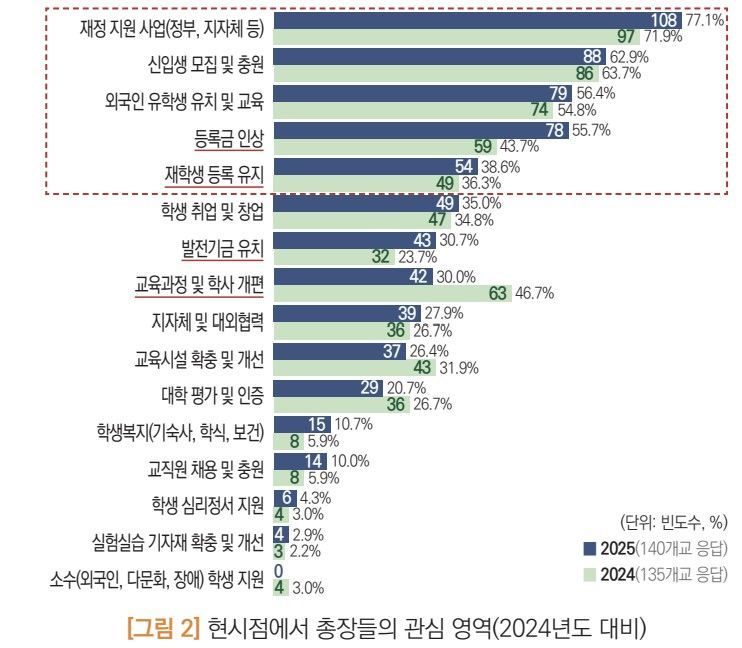
The priority areas of interest for university presidents were highest for 'financial support projects (government, local governments)' at 77.1% (108 respondents). This was followed by 'freshman recruitment and enrollment' at 62.9% (88 respondents), 'attracting and educating international students' at 56.4% (79 respondents), 'tuition fee increases' at 55.7% (78 respondents), and 'retention of enrolled students' at 38.6% (54 respondents).
In particular, interest in financial support projects increased by 5.2 percentage points due to the full-scale introduction of RISE (Regional Innovation-Centered University Support System) this year. Additionally, responses regarding tuition fee increases rose by 12.0 percentage points compared to the previous year. Fundraising for development funds increased by 7.0 percentage points, and retention of enrolled students rose to fifth place.
Presidents anticipated that the financial condition of their universities would worsen over the next five years compared to the present. A total of 105 universities (75%) expected deterioration. Among them, 61 universities (43.6%) expected slight deterioration, and 44 universities (31.4%) expected severe deterioration. Conversely, 27 universities (19.3%) expected to maintain the current state, and 8 universities (5.7%) expected a more stable condition than now.
Among all types, national and public universities most expected deterioration at 81.8% (27 out of 33 universities). By region, non-metropolitan metropolitan cities (21 out of 27 universities) and provincial-level universities (49 out of 63 universities) showed 77.8%, and by size, small-scale universities showed 76.8% (43 out of 56 universities) expecting deterioration.
The main reason for financial deterioration was 'increased management and operation costs due to inflation,' cited by 91 universities (86.7%), ranking first regardless of establishment type, region, or university size. This was followed by 'difficulty in student recruitment and retention' in second place, and 'increased financial investment for education' in third. National/public, metropolitan, and large-scale universities showed different patterns for the second and third rankings compared to the overall results.
Presidents most frequently (43 universities) responded that continuous and stable expansion of financial support, including the extension of the Higher Education and Lifelong Education Support Special Account Act, is necessary. Other suggestions included bold granting of autonomy and deregulation (39 universities), and customized specialization policies and support by establishment type, region, and size (20 universities).
© The Asia Business Daily(www.asiae.co.kr). All rights reserved.
![Clutching a Stolen Dior Bag, Saying "I Hate Being Poor but Real"... The Grotesque Con of a "Human Knockoff" [Slate]](https://cwcontent.asiae.co.kr/asiaresize/183/2026021902243444107_1771435474.jpg)

















