Sharing the Results of the Southeastern Advanced Cancer Treatment Hub Study
Discussing Strategies for Expanding Essential Medical Services and Regional Development in Gijang-gun
On the 9th, Busan’s Gijang-gun and the Southeast Regional Radiation Medical Center held a medical policy meeting at the Gijang-gun Office to discuss essential medical issues in Gijang-gun and the establishment of an advanced cancer treatment hub in the southeastern region.
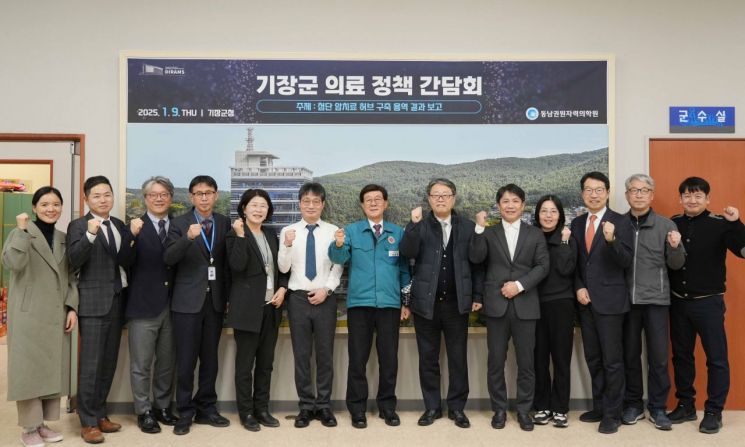 Gijang-gun and the Southeast Regional Radiation Medical Center are holding a medical policy meeting for Gijang-gun and taking a commemorative photo. Photo by Gijang-gun
The meeting was attended by key officials including Jeong Jong-bok, the mayor of Gijang-gun; Lee Chang-hoon, director of the Southeast Regional Radiation Medical Center; and Choi Byung-moo, head of the Gijang-gun Public Health Center. Professor Kim Tae-hyun from Yonsei University Graduate School of Public Health presented the results of a feasibility study on the establishment of the southeastern cancer treatment hub. This study was conducted with funding from the Ministry of Science and ICT.
Professor Kim Tae-hyun stated, “Analysis of accumulated clinical and research data, along with surveys conducted among local residents and expert groups, revealed that the Southeast Regional Radiation Medical Center’s physical accessibility is a weakness, while its excellent clinical capabilities and treatment of a high number of severe diseases are its greatest strengths.”
He added, “The importance of essential medical services is emerging, and since Gijang-gun is both a medically underserved area and a region with a growing population, there is a need to expand the number of hospital beds. Therefore, the number of beds and the scale of clinical departments at the Southeast Regional Radiation Medical Center must be increased. In particular, there should be a phased development strategy aligned with the southeastern radiation medical convergence cluster project and the bio-health hub project currently being established in the background.”
Professor Kim also said, “The number of beds should be expanded to about twice the current size, reaching 500 beds, and clinical departments should be reinforced to complete essential medical functions. Expanding the screening center is appropriate for the early detection of severe diseases such as cancer.”
He continued, “The medical center was established not only to fulfill the role of public healthcare but also to serve as a core research institution linked to local industries to promote the development of the nuclear power plant-dense region. It must play various roles as an institution that can induce production, attract talent in medical science, and create added value for the region. To this end, advanced equipment such as proton therapy machines should be introduced to become a mecca for radiation therapy, and the radiation emergency medical center’s functions should be expanded to complete a special disaster management system tailored to the region’s characteristics.”
Mayor Jeong Jong-bok said, “I agree that physical expansion is necessary for joint regional development, safety assurance, and the expansion of essential medical services. We expect the center to provide even better medical care through advanced equipment, talent attraction, and expansion of clinical departments, and to timely treat cancer patients, severe patients, and cardiovascular and cerebrovascular emergency patients to create a safe Gijang-gun.”
Mayor Jeong added, “The issue is cost, but we hope that through explanations to the Ministry of Science and ICT and the National Assembly, and by recognizing this as a joint task and sharing the process, progress can be made. Gijang-gun will also actively seek ways to cooperate by delivering opinions through legal reviews and listening to residents’ views.”
Director Lee Chang-hoon of the medical center said, “After more than a year of conducting the feasibility study, the future direction and goals of the medical center have become clearer. Although most essential departments are currently established at the center, there are still areas lacking. As seen in the study results, expanding beds and clinical departments is a prerequisite to completing essential medical services. We hope that by steadily achieving this step by step, the medical center will establish itself as a public resource driving regional development.”
The Southeast Regional Radiation Medical Center plans to share the results of this study with the local community to build consensus on securing essential medical services in Gijang-gun and its role as a southeastern cancer treatment hub. It will also prepare detailed implementation plans to help Gijang-gun and Busan become a world-class radiation medical city.
© The Asia Business Daily(www.asiae.co.kr). All rights reserved.
![Clutching a Stolen Dior Bag, Saying "I Hate Being Poor but Real"... The Grotesque Con of a "Human Knockoff" [Slate]](https://cwcontent.asiae.co.kr/asiaresize/183/2026021902243444107_1771435474.jpg)











