"High Satisfaction Among User Households,
Strong Demand from Households on the Waiting List"
Seoul City announced that the pilot project for Filipino domestic workers, which started in September last year, is currently being used by 185 households and is operating stably.
The city explained on the 15th that the Filipino domestic worker pilot project, now on its 135th day, experiences cancellations from 2 to 3 households per month, with 795 households on the waiting list. The number of households using the service increased from 142 at the launch to 185 currently. By household type, there are 102 single-child households (55.2%), 75 multi-child households (40.5%), and 8 households with pregnant women (4.3%).
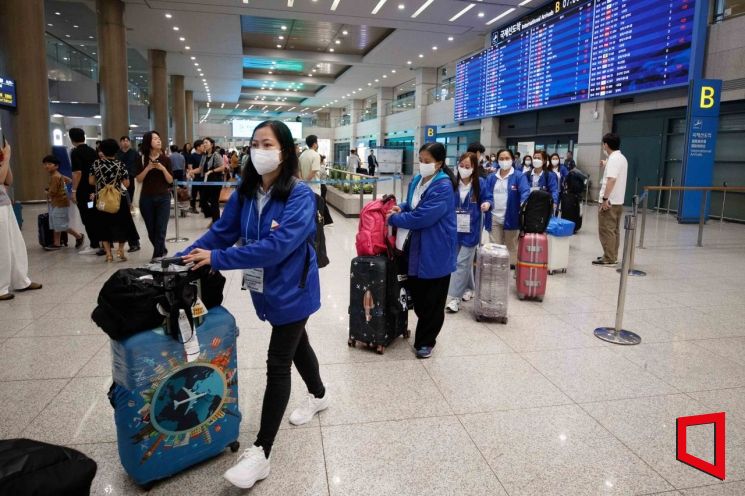 Filipino workers participating in the pilot project for foreign housekeeping managers are arriving through Incheon International Airport on the 6th. Photo by Airport Photographers Group
The city stated that the satisfaction level of the households using the service is high. Reviews included comments such as "They are diligent, cheerful, and love children," "I can communicate with my child in English," and "They strictly adhere to time and sincerely care for the children."
During the pilot project period, a total of 35 households canceled the service, with 24 cancellations occurring in the first month of service commencement, and thereafter an average of 2 to 3 cancellations per month due to customer circumstances. Specific reasons for cancellation include 28 cases due to household circumstances, 25 cases due to simple change of mind or inability to adjust time, 1 case of overseas relocation, and 2 cases related to household children’s issues. Reasons related to the domestic workers include 2 cases of quitting, 2 cases of insufficient Korean language skills, 2 cases of inadequate infant care skills, and 1 case of personal circumstances.
Seoul City explained that it is providing various rest locations for domestic workers, addressing the rest issues that were problematic after the pilot project started. For 15 domestic workers who provided services to two households per day and had difficulty finding rest places, nearby facilities such as Seoul Youth Center, libraries, museums, and community centers were introduced. Currently, among 49 domestic workers, 37 use accommodations, and 12 use the households they serve as rest and meal spaces.
The average monthly salary of Filipino domestic workers is 2.07 million KRW. Working hours average 40 hours per week, with the possibility of working up to 52 hours per week depending on the worker’s preference. A city official stated, "Young people who want to enjoy Korean culture and life in Seoul sometimes prefer 30 hours per week rather than long working hours."
With the pilot project ending at the end of next month, the city plans to decide on future directions through discussions with the Ministry of Employment and Labor. They will comprehensively consider the original purpose of reducing childcare burdens for dual-income and working women households, the high satisfaction of user households, and the steady waiting list in their consultations.
At the end of last year, based on data collected from certified domestic service agencies in the district during the nationwide domestic worker demand survey by the Ministry of Employment and Labor, the city submitted a figure of 952 workers.
© The Asia Business Daily(www.asiae.co.kr). All rights reserved.
![User Who Sold Erroneously Deposited Bitcoins to Repay Debt and Fund Entertainment... What Did the Supreme Court Decide in 2021? [Legal Issue Check]](https://cwcontent.asiae.co.kr/asiaresize/183/2026020910431234020_1770601391.png)















