Joint HQ Executes Second Arrest Warrant
President Yoon Transported to HCID in Security Vehicle
Yoon Delivers Video Message Before Departure: "Illegal Arrest"
Supporters Weep and Lie Down in Protest
President Yoon Suk-yeol, accused of being the 'leader of a rebellion,' faced the unprecedented situation on the 15th of being arrested as a sitting president. The Joint Investigation Headquarters (Joint HQ) breached the third line of defense within two and a half hours, and the Presidential Security Service effectively surrendered.
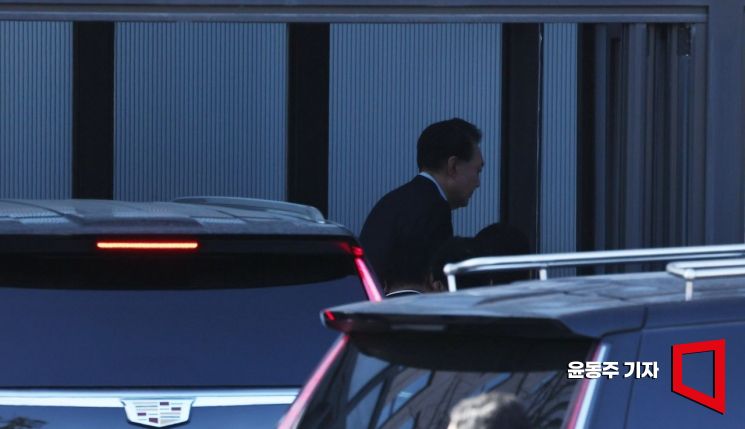 President Yoon Suk-yeol is arriving at the Gwacheon Corruption Investigation Office building on the 15th. Photo by Yoon Dong-ju
The High-ranking Officials' Crime Investigation Division (HCID), which has been investigating President Yoon's alleged rebellion charges, secured his custody on the 15th through the execution of a second arrest warrant. Shortly after his arrest, President Yoon left his residence in Hannam-dong, Seoul, at around 10:35 a.m. in a security vehicle and was transported to the HCID office at the Government Complex Gwacheon in Gwacheon, Gyeonggi Province. This marked the first time in constitutional history that a sitting president was arrested by an investigative agency on criminal charges.
Immediately after the arrest became known, President Yoon addressed the public in a statement titled "A Message to the People," saying, "To prevent an unfortunate bloodshed, I have decided to comply with the HCID summons despite the investigation being illegal." However, he added, "This does not mean I acknowledge the HCID's investigation." President Yoon lamented, "Regrettably, the law in this country has completely collapsed," and criticized, "I am truly appalled to witness the illegal, illegal, illegal acts being carried out and the coercive procedures being enforced based on invalid warrants."
With President Yoon's arrest by the HCID, the agency must complete his interrogation and decide whether to request an arrest warrant within the 48-hour limit of the arrest warrant's validity. Currently, the likelihood of requesting an arrest warrant is high. Since President Yoon's side has previously declared a policy of non-cooperation with the HCID investigation, including exercising the right to remain silent, there is a possibility that after a formal interrogation, the process of requesting an arrest warrant and prosecution could proceed rapidly.
The execution of the arrest warrant by the HCID and police began early in the morning at around 4:20 a.m. Although the HCID initially prepared for a prolonged operation lasting two nights and three days, the process was unexpectedly swift. The police deployed 1,200 personnel from the National Investigation Headquarters (NIH) Special Investigation Unit and the metropolitan investigation units of Seoul, Southern Gyeonggi, Northern Gyeonggi, and Incheon. The HCID assigned 40 prosecutors and investigators. The Presidential Security Service set up six layers of vehicle barricades at the first line of defense near the residence entrance and assembled staff there. At around 5:10 a.m., the HCID and police presented the arrest and search warrants to President Yoon's legal team, but Yoon's lawyer, Yoon Gap-geun, argued, "There are no exceptions under Articles 110 and 111 of the Criminal Procedure Act in the warrant. This is an illegal execution and constitutes rebellion," resisting the warrant. In response, the police repeatedly broadcast warnings stating, "If you obstruct the execution of the warrant, you may be arrested on the spot for obstructing official duties."
At approximately 5:45 a.m., the police and HCID attempted forced entry at the residence entrance. About 30 members of the People Power Party and President Yoon's lawyers formed a human chain to block the arrest, shouting "Stop them," "Catch them," and "This is a coup," holding out for over an hour. The HCID and police also sent investigators to the Maebongsan mountain hiking trail behind the residence to attempt a flanking maneuver. The arrest team gathered at the Maebongsan trail around 6 a.m. The Security Service also deployed personnel on the Maebongsan side to attempt a detour. Although the Security Service leadership initially announced a hardline response, a rift emerged among frontline Security Service staff as awareness spread that they could be prosecuted for obstructing special official duties.
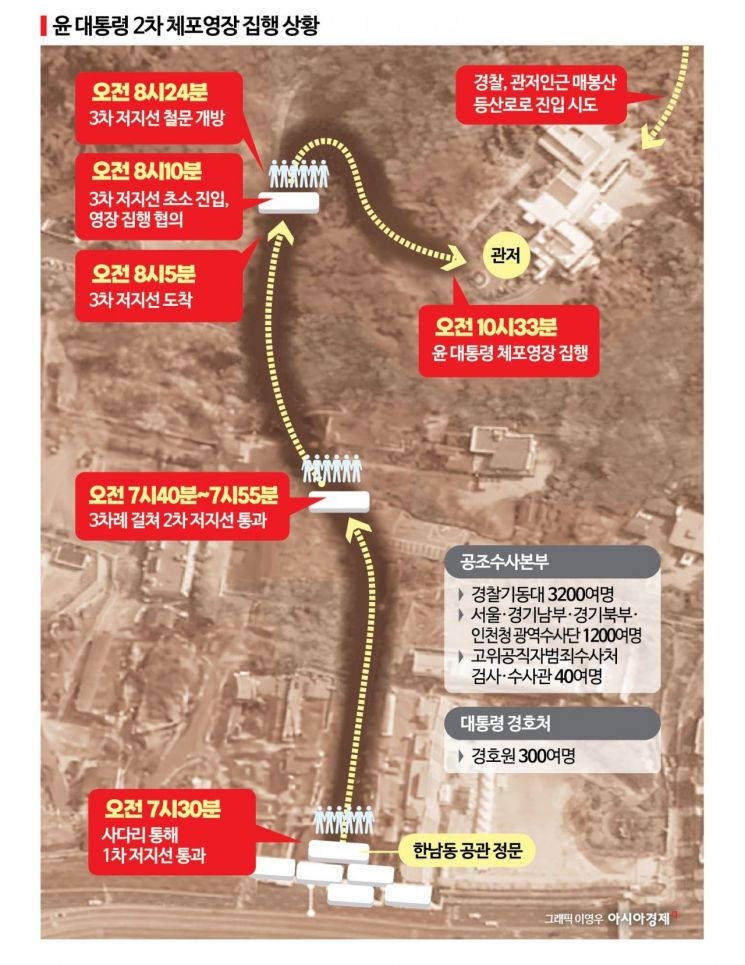
In a press briefing, the HCID stated, "Unlike during the first execution, there were no personnel actively blocking the execution or Security Service staff. There was virtually no physical confrontation today." It was reported that many Security Service staff remained in the waiting area inside the residence and did not actively respond. At around 8:24 a.m., the HCID and police opened the third line of defense's iron gate and allowed the warrant execution investigation team vehicles to enter. As President Yoon's arrest became imminent, Chief Presidential Secretary Jeong Jin-seok and lawyer Yoon Gap-geun claimed they would voluntarily appear, but after discussions with the HCID, it was decided to proceed with the execution of the arrest warrant.
Meanwhile, in front of the residence, President Yoon's supporters reacted emotionally each time news spread that the HCID and police had breached the lines of defense. Those gathered in front of the Hannam-dong presidential residence wept around 8:40 a.m., shouting, "What is this?" Some lay down on the main road in front of Hannam Elementary School in protest. Conversely, supporters who had held an all-night rally in front of the Lutheran Church prayed with their hands clasped.
On the other hand, those in favor of impeachment praised the HCID and police, saying, "They are doing well," and cheered as police and HCID vehicles left the residence. There were no clashes between participants of conservative and progressive group rallies, and no arrests were made at the scene. Approximately 3,200 personnel from 54 riot police units under the Seoul Metropolitan Police Agency were deployed near the residence. They guarded the area in groups spaced at regular intervals from the residence entrance to around Hangangjin Station, about 700 meters away. Additionally, about 160 police buses were deployed, blocking two of the five lanes on Hannam-daero toward Yaksu Station and triple-blocking the residence access road near the International Lutheran Church. Tow trucks and special vehicles intended for dismantling barricades and removing iron gates were also seen on site.
© The Asia Business Daily(www.asiae.co.kr). All rights reserved.


















