Coexistence of Industry and Environment, Responding to the Climate Crisis
Pursuing Carbon Neutrality and Securing Corporate Competitiveness
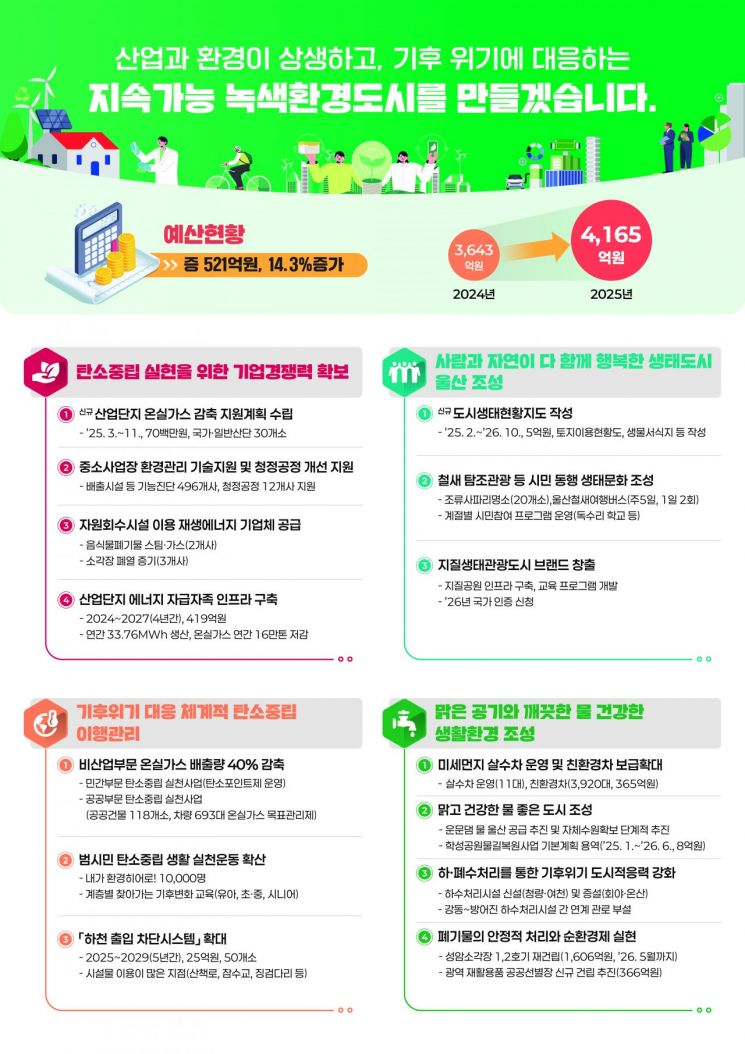
On the 15th at 11 a.m., Ulsan City announced its major environmental tasks for 2025 at the City Hall Press Center and will promote 14 key projects across four major areas to realize a ‘Sustainable Green Environmental City Ulsan’ that fosters coexistence between businesses and the environment and responds to the climate crisis.
The four major areas are ▲ securing corporate competitiveness to achieve carbon neutrality ▲ creating an ecological city Ulsan where people and nature are happy together ▲ systematic carbon neutrality implementation management to respond to the climate crisis ▲ creating clean air, clean water, and a healthy living environment.
Ulsan City has allocated a budget of 416.5 billion KRW for the environmental sector this year, a 14.3% increase compared to last year, and will proceed with projects in the four major areas.
1. Securing Corporate Competitiveness to Achieve Carbon Neutrality
To establish effective support measures for reducing greenhouse gases in industrial complexes, a ‘Greenhouse Gas Reduction Support Plan for Industrial Complexes’ will be developed.
By analyzing the operational status, conditions, and greenhouse gas emission characteristics of each industrial complex, the currently ongoing greenhouse gas reduction support projects targeting industrial complexes will be systematically managed to ensure effective support.
For small and medium-sized workplaces, consulting will be conducted to strengthen carbon neutrality and environmental management capabilities, and projects supporting environmental management technology and clean process improvement for small and medium workplaces will be promoted.
Supply of renewable energy using resource recovery facilities will also continue. Biogas and steam generated from food waste and municipal waste treatment facilities will be continuously supplied to companies, leading efforts for stable waste treatment and renewable energy utilization.
An energy self-sufficiency foundation project for industrial complexes will also be carried out. Ulsan City will invest 41.9 billion KRW over four years from last year through 2027 for this project.
Private investment is expected to expand to about 200 billion KRW in the future. Targeting the Ulsan Mipo National Industrial Complex, the plan is to establish renewable power facilities, high-efficiency equipment, and an integrated energy management online system to secure the environmental competitiveness of the industrial complex, producing 330,000 MWh of electricity annually and reducing 160,000 tons of greenhouse gases.
2. Creating an Ecological City Ulsan Where People and Nature Are Happy Together
From February this year to October next year, 500 million KRW will be invested to create an urban ecology status map.
Various ecological statuses such as mammals, birds, fish, and insects will be surveyed throughout Ulsan City, linked with geographic information systems, and then used as basic data for eco-friendly and sustainable urban management, including ecological land use and environmental management.
By promoting a bird safari, bird information will be provided at 20 famous spots, and a Ulsan migratory bird travel bus will operate twice daily, five days a week, along with seasonal citizen participation programs (such as Eagle School), to foster an ecological culture where citizens can enjoy and participate.
Additionally, a foundation will be established for the 2026 Ulsan National Geopark certification. This includes installing geological landmark signboards, visitor centers, launching a website, producing promotional materials, and developing educational programs related to geological resources to create the brand of Ulsan as a geological ecological tourism city.
3. Systematic Carbon Neutrality Implementation Management to Respond to the Climate Crisis
Greenhouse gas emissions from non-industrial sectors will be reduced by 40% by 2030. For example, the private sector will operate a carbon point system that provides incentives based on greenhouse gas reduction rates for individual households, apartment complexes, and vehicles, with an investment of 940 million KRW.
The public sector will implement a greenhouse gas target management system (covering 118 public buildings and 693 vehicles) and a greenhouse gas emissions trading system targeting 23 environmental infrastructure facilities to reduce carbon emissions.
A citywide carbon neutrality lifestyle practice campaign will also be promoted. Through the Ulsan Environmental Hero app, 10,000 ‘I am an Environmental Hero!’ participants will be recruited, and climate change education tailored to different groups will be conducted to spread a carbon-neutral practice atmosphere in daily life throughout the region.
To respond to the climate crisis and prevent sudden casualties, the ‘River Access Blocking System’ will be expanded. With an investment of 2.5 billion KRW by 2029, access blocking systems will be expanded and established at 50 locations with heavy facility use, such as walking trails, submerged bridges, and stepping stones.
4. Creating Clean Air, Clean Water, and a Healthy Living Environment
To secure citizens’ ‘right to breathe’ clean air, water spraying vehicles to reduce fine dust will be operated intensively during yellow dust occurrences and summer. A budget of 36.5 billion KRW will be invested to supply eco-friendly electric vehicles (2,920 units) and electric two-wheelers (1,000 units), continuously striving to improve Ulsan’s air quality.
Projects to provide citizens with stable and clean water supply will also be promoted. Major projects include a comprehensive plan to secure clean water and a phased water supply project from Unmun Dam to Ulsan.
The restoration project of the waterway in Hakseong Park will also be actively promoted. In 2025, a feasibility study and basic plan will be established, and flood prevention measures for the frequently flooded Saechi area and revitalization plans for the local commercial district will be prepared.
Expansion of sewage treatment facilities will continue. New treatment plants will be established in Cheongnyang and Yeocheon areas, and the Hoeya and Onsan treatment plants will be expanded due to population growth and increased factory wastewater in the national industrial complex. Systematic management of sewage pipelines, including maintenance of aging pipelines and expansion of sewage pipes, will also be carried out.
The reconstruction of the aging Seongam Incineration Plant Units 1 and 2 will proceed without delay. By May 2026, 160.6 billion KRW will be invested to stably process waste generated in the region. Additionally, a new public recycling sorting center will be constructed to increase the recycling rate of recyclable materials.
An official from Ulsan City said, “In accordance with the government’s national carbon neutrality green growth basic plan, our city also plans to proactively respond by promoting various projects to practice carbon neutrality,” adding, “We will actively respond to the climate crisis and create a sustainable green environmental city Ulsan where citizens can live more safely and healthily.”
© The Asia Business Daily(www.asiae.co.kr). All rights reserved.
![Clutching a Stolen Dior Bag, Saying "I Hate Being Poor but Real"... The Grotesque Con of a "Human Knockoff" [Slate]](https://cwcontent.asiae.co.kr/asiaresize/183/2026021902243444107_1771435474.jpg)
















