A technology has been developed that predicts the likelihood of a user developing depression by utilizing biometric data collected from wearable devices.
KAIST announced on the 15th that Professor Daewook Kim's research team from the Department of Brain and Cognitive Sciences collaborated with Professor Daniel B. Forger's team from the Department of Mathematics at the University of Michigan in the United States to develop this technology.

The technology developed by the joint research team can predict depression-related symptoms such as sleep disorders, feelings of depression, loss of appetite, overeating, and decreased concentration in shift workers based on the user's activity level and heart rate data collected by a smartwatch.
According to the World Health Organization (WHO), a promising new direction for treating mental illnesses focuses on the circadian clock located in the hypothalamus of the brain, which directly affects impulsivity, emotional responses, decision-making, and overall mood, as well as sleep stages.
However, measuring intrinsic biological rhythms and sleep states requires the cumbersome process of drawing blood every 30 minutes throughout the night to measure changes in melatonin hormone levels and conducting polysomnography. Hospitalization is inevitable for these measurements. Additionally, if insurance does not cover the costs, the expense can reach approximately 1 million KRW.
Wearable devices have attracted attention as useful tools that can resolve these issues. They offer the advantage of being able to check and collect real-time heart rate, body temperature, and activity levels without spatial constraints. However, current wearable devices have the limitation of providing only indirect information about biomarkers required in medical settings.
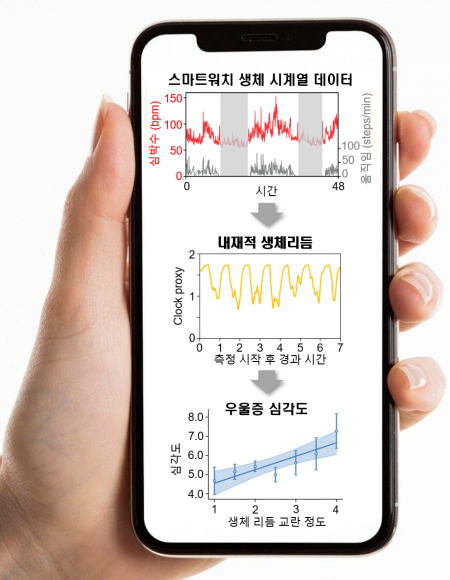
On the other hand, the joint research team developed a filtering technology that accurately estimates the phase of the circadian clock, which changes moment by moment, from time-series data such as heart rate and activity levels collected from smartwatches, implementing a digital twin that precisely depicts the brain’s circadian rhythm. This can be used to estimate circadian rhythm disruptions.
In fact, the joint research team collaborated with Professor Srijan Sen from the Neuroscience Institute at the University of Michigan and Professor Amy Bohnert from the Department of Psychiatry to verify the potential use of the circadian clock digital twin in predicting depression symptoms.
The collaborative research team conducted a large-scale prospective cohort study involving 800 shift workers. The results confirmed that the circadian rhythm disruption digital biomarker developed by the joint research team can predict six symptoms, including mood for the next day and representative symptoms of depression such as sleep problems, appetite changes, decreased concentration, and suicidal thoughts.
Professor Daewook Kim said, “The achievement of this study is that by using mathematics, we have provided a clue to applying wearable biometric data, which had been used fragmentarily, to actual disease management.” He added, “Through this research, the joint research team proposed a continuous and non-invasive mental health monitoring technology, which is expected to present a new paradigm in mental health management by eliminating the inconvenience of patients with depression symptoms having to take proactive actions such as contacting counseling centers to receive help.”
Meanwhile, this research was conducted with support from the KAIST New Faculty Research Support Program, the U.S. National Science Foundation, the U.S. National Institutes of Health, and the U.S. Army Research Office MURI program.
© The Asia Business Daily(www.asiae.co.kr). All rights reserved.


















