Presidential Secretariat, National Security Office, Ministry of National Defense, and 17 Other Agencies
Records Produced or Received Related to the Emergency Martial Law Declaration
Excluded from Review by the Records Evaluation Committee During the Prohibition Period
The National Archives of Korea has issued a decision prohibiting the disposal of records related to the emergency martial law to the Presidential Secretariat, the Presidential Security Service, the Ministry of National Defense, and others. This follows a request from the High-ranking Officials' Crime Investigation Division (PCC) investigating the December 3 emergency martial law incident to impose a disposal ban. However, suspicions of disposal and concealment of emergency martial law evidence remain, and difficulties are expected during the investigation process based on these records.
On the 15th, the Ministry of the Interior and Safety's National Archives announced this information in the official gazette and notified the relevant institutions.
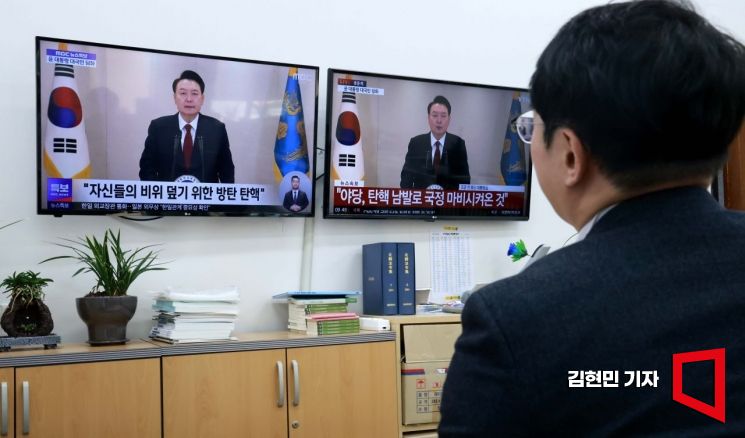 On the 12th, party officials at the Democratic Party office in the National Assembly are watching President Yoon Seok-yeol's fourth public address regarding the December 3 emergency martial law situation. Photo by Kim Hyun-min
The institutions subject to the disposal ban include 20 organizations such as the Presidential Secretariat. These include the Presidential Secretariat, the National Security Office, the Presidential Security Service, the Presidential Archives, the National Intelligence Service, the Ministry of National Defense, the Ministry of the Interior and Safety, the Joint Chiefs of Staff, the Defense Counterintelligence Command, the Intelligence Command, the Army Headquarters, Air Force Headquarters, Navy Headquarters and their subordinate units, the Capital Defense Command, the Army Special Warfare Command, the National Police Agency, the Seoul Metropolitan Police Agency, the Gyeonggi Nambu Provincial Police Agency and their subordinate police stations, the National Assembly Secretariat, and the National Election Commission.
The records subject to the disposal ban are public records produced or received in connection with the President's declaration of emergency martial law on December 3, 2024, under the Act on the Management of Public Records. The disposal ban period is five years from the date of the announcement. Accordingly, records subject to the disposal ban will be excluded from review by the Records Evaluation Committee and other follow-up measures will be implemented.
Last month on the 15th, the PCC requested the National Archives to impose a disposal ban on materials related to the December 3 emergency martial law incident. The purpose was to provide the National Archives with the authority to prevent institutions related to the emergency martial law from arbitrarily disposing of materials. Previously, the National Archives had requested each institution to preserve meeting minutes, measures taken by each ministry, CCTV footage, and other materials. It also conducted an inspection of records management practices for 12 institutions, including the Ministry of National Defense, the Ministry of the Interior and Safety, the National Intelligence Service, the National Police Agency, and the Seoul Metropolitan Police Agency.

However, it is not easy for investigative agencies to properly secure key evidence related to the emergency martial law incident. During the previous inspection, concerns were raised that if the institutions subject to inspection concealed documents produced before and after the emergency martial law without registering them, it would be difficult for the National Archives to ascertain the facts, and the inspection itself might be merely a formality.
A representative example is the minutes of the "State Council meeting immediately before the martial law," which is key evidence to verify whether the emergency martial law met procedural requirements. The Constitutional Court ordered President Yoon Seok-yeol's side to submit the State Council meeting minutes related to the martial law, but President Yoon's side did not submit the relevant documents. The Presidential Archives also stated that it cannot disclose whether it has inspected the management status of emergency martial law-related records for three institutions including the Presidential Secretariat or confirmed the existence of the State Council meeting minutes.
© The Asia Business Daily(www.asiae.co.kr). All rights reserved.


















