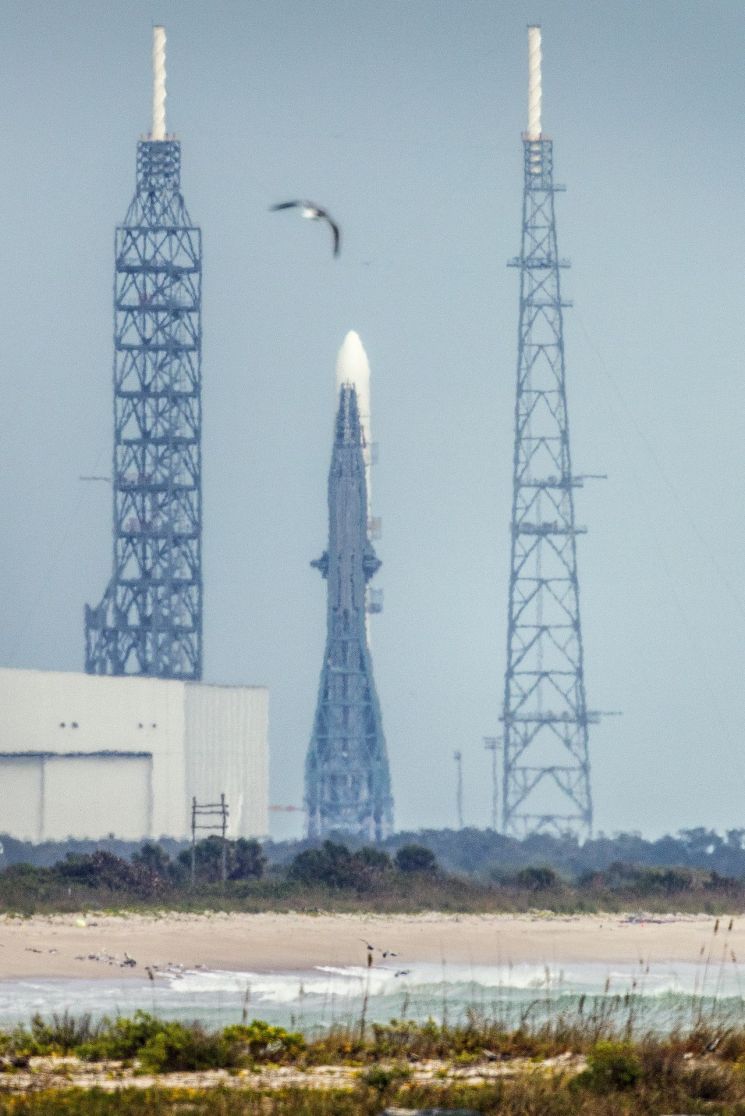
Blue Origin, the space company led by Amazon founder Jeff Bezos, will launch its first reusable rocket into orbit on the 16th (local time).
On the 14th, Blue Origin announced via X (formerly Twitter) that the reusable rocket "New Glenn" is scheduled to launch at 1 a.m. Eastern Time on the 16th (3 p.m. Korean time). New Glenn is a large rocket developed by Blue Origin since 2012, a two-stage rocket standing 98 meters tall with a diameter of 7 meters. It is larger than SpaceX's main rocket, the Falcon 9, founded by Tesla CEO Elon Musk, but smaller than the Mars spacecraft "Starship," which is over 100 meters tall. It can carry a payload of up to approximately 45 tons to low Earth orbit below 2,000 km, about twice the capacity of the Falcon 9.
New Glenn will make its third attempt at a test launch from the U.S. Space Force base at Cape Canaveral, Florida. The launch was originally scheduled for the 10th but was postponed to the 12th due to weather, then delayed again to the 13th. However, on the 13th, it was postponed once more due to system issues.
For this first launch, New Glenn will carry Blue Origin's self-developed orbital vehicle, "Blue Ring." Blue Ring will check communication functions and other systems for six hours. Blue Origin plans to recover the first-stage booster, separated from New Glenn, by landing it on the drone ship "Jacklyn" stationed in the Atlantic Ocean.
If Blue Origin successfully places this reusable rocket into orbit, it will become the second space company to do so after SpaceX. The New Glenn launch is attracting attention as it could create a competitive landscape in the private space market led by SpaceX.
Meanwhile, on the 15th, SpaceX will conduct the seventh test flight of Starship at its Starbase launch facility in southern Texas. This Starship will conduct a test flight of about 66 minutes with the second stage spacecraft, deploying 10 model Starlink satellites for internet service and testing the engine's reignition capability. The first stage Super Heavy booster will attempt recovery using the "chopstick arms" equipment, as was done in the test flight last October.
© The Asia Business Daily(www.asiae.co.kr). All rights reserved.

















