Amid 'Trumflation' Concerns, Strong Employment and Other Indicators
Fed's Prospects for Additional Rate Cuts This Year Diminish
US 10-Year Treasury Yield Nears 4.8%
Dollar Index Hits Highest in Over Two Years
Rising Inflation Expectations... Some Predict "End of Rate Cut Cycle"
US Treasury yields are fluctuating sharply, with the 10-year yield approaching 5% per annum. The value of the dollar has also surged to its highest level in over two years. Amid concerns over 'Trumflation' (inflation caused by Trump's policies), Americans' inflation expectations have risen, significantly diminishing the Federal Reserve's (Fed) prospects for additional rate cuts within the year. On Wall Street, there is even talk that the Fed might reverse course and raise rates this year.
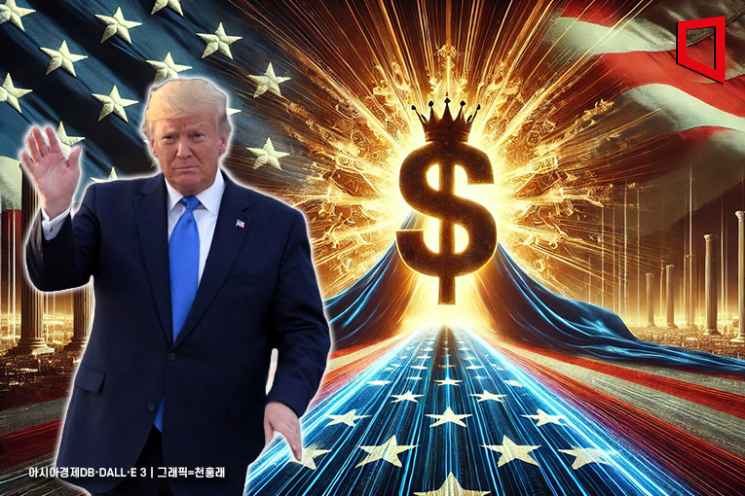
US 10-Year Treasury Yield Threatens 5%... Dollar Index Hits Highest in Over Two Years
According to the global bond market on the 13th (local time), the benchmark US 10-year Treasury yield rose by 2 basis points (1bp = 0.01 percentage points) from the previous trading day to 4.79%.
The US 10-year Treasury yield was in the mid-4.5% range at the beginning of the year but has surged recently due to strong economic indicators. On the 8th, it surpassed 4.7% intraday, marking the highest level since April last year, and has since pushed to new highs. If it breaks through 5%, it will be the first time since July 2007.
The 2-year Treasury yield, which is sensitive to monetary policy, is moving slightly down at around 4.39% compared to the previous day.
The value of the US dollar has also soared to its highest level in 2 years and 2 months. The Dollar Index, which measures the dollar's value against six major currencies, rose 0.24% from the previous trading day to 109.75, the highest since November 2022.
The main reasons for the rise in Treasury yields and the dollar are strong economic data including inflation and employment, as well as the economic policies of President-elect Donald Trump, who will take office on the 20th. In particular, Trump's policies on tariff increases and illegal immigration restrictions are expected to stimulate inflation, raising concerns that the Fed's additional rate cuts may be delayed. To make matters worse, inflation has recently rebounded. The Consumer Price Index (CPI) for December, to be released on the 15th, is expected to have risen 2.9% year-on-year, exceeding the previous month's figure of 2.7%.
Rising Inflation Expectations... Wall Street Predicts "End of Rate Cut Cycle"
Consumers' inflation expectations are also rising rapidly. According to the December consumer expectations survey released by the New York Federal Reserve on the same day, the median expected inflation over the next three years rose to 3% from 2.6% in the previous month. The median expected inflation one year ahead remained at 3%, unchanged from the previous month. The median long-term inflation expectation five years ahead fell from 2.9% to 2.7% during the same period. The University of Michigan survey released last week also showed a rising trend in inflation expectations. According to the January consumer confidence index released by the University of Michigan on the 10th, the one-year inflation expectation rose sharply to 3.3% from 2.8% in the previous month.
Employment also showed a surprising increase last month. According to the employment report released by the US Department of Labor on the 10th, nonfarm payrolls increased by 256,000 in December last year. This far exceeded market expectations (164,000) and the previous month's figure (212,000). The unemployment rate fell from 4.2% in November to 4.1%.
Wall Street is lowering expectations for rate cuts. After the employment data release, JP Morgan, Goldman Sachs, Citigroup, and Barclays pushed back the Fed's first rate cut this year from the first quarter to the second quarter. JP Morgan and Goldman Sachs reduced their forecasted number of rate cuts this year from three to two, while Barclays cut theirs from two to one. Bank of America (BoA), which had expected two rate cuts this year, revised its forecast to a rate freeze and even hinted at the possibility of rate hikes.
BoA stated, "Considering the tight labor market, solid growth, and inflation exceeding the Fed's target, we believe the current rate cut cycle by the Fed has ended," adding, "If the core Personal Consumption Expenditures (PCE) inflation rate remains near 3% and long-term inflation expectations become entrenched, the Fed may even raise rates."
The market is gripped by fears that the 'Trump Tantrum'?a surge in bond yields during Trump's first term?could recur. If Treasury yields surge and break the psychological resistance level of 5%, it is feared that global financial markets could experience a meltdown, including a sharp stock market decline.
Catherine Nixon, Chief Investment Officer (CIO) at Northern Trust, analyzed, "Currently, inflation and inflation expectations are rising and becoming sticky, causing bond yields to rise sharply," adding, "Stock investors' caution is beginning to increase further."
© The Asia Business Daily(www.asiae.co.kr). All rights reserved.

![Clutching a Stolen Dior Bag, Saying "I Hate Being Poor but Real"... The Grotesque Con of a "Human Knockoff" [Slate]](https://cwcontent.asiae.co.kr/asiaresize/183/2026021902243444107_1771435474.jpg)















