No Actual Obstruction of Warrant Execution
Many Say Charges Are Unlikely for Now
Still, Strong Warning Against Illegal Acts Needed
The so-called 'Baekgoldan,' an anti-communist youth group that has taken a stand to defend President Yoon Seok-yeol's residence, sparked controversy after holding a press conference at the National Assembly, leading some political parties to hint at filing charges against them. They argue that organizing a group to obstruct the execution of an arrest warrant constitutes a criminal act and should be punished under the 'crime of organizing a criminal organization.'
On the 9th, Yoon Jong-oh, floor leader of the Progressive Party, stated in a commentary, "The anti-communist youth group and Baekgoldan, who openly declared their intention to obstruct the execution of the arrest warrant, organized the group for criminal purposes," adding, "We are actively considering filing charges against the anti-communist youth group and Baekgoldan under the crime of organizing a criminal organization." On the 10th, Kwon Young-guk, leader of the Justice Party, also expressed his intention to file charges against the anti-communist youth group and its subordinate organization Baekgoldan under the same crime.
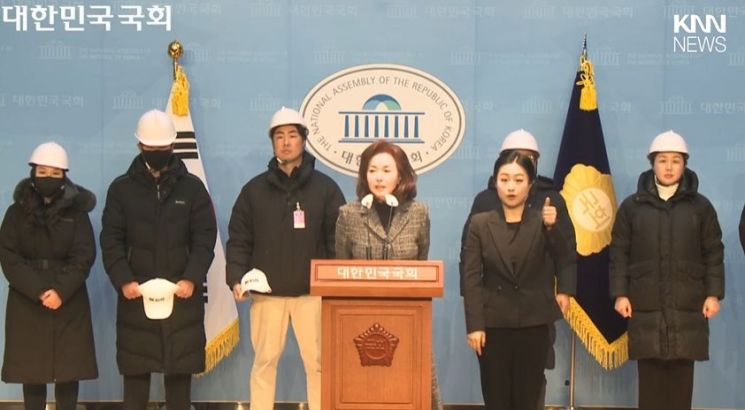 On the 9th, self-proclaimed members of the 'Anti-Communist Youth Group' held a press conference wearing white helmets at the National Assembly Communication Office in Yeouido, Seoul. Photo by National Assembly Broadcasting.
Baekgoldan is an organization under the anti-communist youth group, composed of young people in their 20s and 30s who hold rallies to defend President Yoon's residence. They appeared publicly on the 9th at a launch press conference held at the National Assembly, arranged by Kim Min-jeon, a member of the People Power Party.
Some argue that their act of forming a kind of 'vigilante group' to protect the president against the execution of the arrest warrant constitutes the crime of organizing a criminal organization. Kim Kyung-ho, a lawyer at the law firm Hoin and honorary professor at the Joint Military University, emphasized, "Baekgoldan is a group that openly declared its purpose to obstruct and interfere with the execution of President Yoon Seok-yeol's arrest warrant. If they use force to obstruct the lawful execution of the warrant, it could be considered a special obstruction of official duties, which is a serious crime punishable by imprisonment for one to ten years or more." He suggested that depending on the circumstances, the crime of organizing a criminal organization could be applied.
However, the prevailing view is that it is difficult to apply the charge of organizing a criminal organization and punish them under the current circumstances. So far, Baekgoldan has only held protests near the president's residence opposing the execution of the arrest warrant, and has not physically obstructed the execution of the warrant by the High-ranking Officials' Crime Investigation Office (HOCI). Therefore, applying the crime of organizing a criminal organization is seen as an excessive expansion of the punishment provisions. Theoretically, the crime of organizing a criminal organization can be established even if the intended criminal act is not actually carried out, but precedent has generally recognized it in cases involving organized crime groups committing heinous crimes. Also, the crime requires an organized command structure, and it is unclear whether Baekgoldan meets this criterion. Kwak Jun-ho, a lawyer at the law firm Cheong, explained, "Applying the crime of organizing a criminal organization at a stage where Baekgoldan has not directly obstructed the execution of the warrant or committed the crime of obstructing official duties is an overly broad interpretation of criminal law."
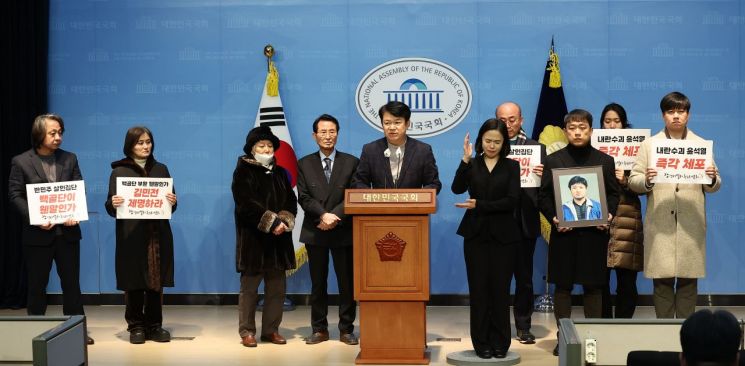 On the afternoon of the 0th, bereaved families of Baekgoldan victims, including the Gang Gyeong-dae Martyrs Memorial Project Association, held a press conference at the National Assembly Communication Office in Yeouido, Seoul, urging Assemblyman Kim Min-jeon to resign and apologize. Photo by Yonhap News
The consensus is also that the charge of riot, which involves groups gathering to commit assault and intimidation, cannot be applied. Yang Ji-yeol, a lawyer at the law firm Able, pointed out, "The charge of riot can only be applied if the violence or protest disrupts the peace of a local area to a significant degree," adding, "While they can be reported to investigative agencies, it is uncertain whether actual punishment is possible."
There are also claims that their actions to defend the president's residence cannot be regarded as incitement or propaganda for rebellion. The crime of incitement or propaganda for rebellion refers to acts that encourage riots aimed at undermining the national order. Yoo Seung-ik, a research professor at Handong University, said, "The crime of incitement for rebellion is established only if one supports or aids a rebellion that is currently underway," adding, "Whether the rebellion has ended or is ongoing since the lifting of martial law requires careful examination."
Those who have revived the anachronistic and undemocratic specter of Baekgoldan should be criticized and, depending on the case, severely punished. Through criticism such as 'Isn't this practically a criminal organization?' a warning that 'the line must not be crossed' should also be issued. However, at this point, claims that 'they can be punished under the crime of organizing a criminal organization' are somewhat premature.
© The Asia Business Daily(www.asiae.co.kr). All rights reserved.


















