Business Community Presents "Seven Key Tax Reform Tasks"
for Livelihood Economy Before Lunar New Year
The business community selected seven tax reform tasks to revive the frozen livelihood economy and urged the political circle to proceed with the legislative process for the amendment bill before the Lunar New Year holiday. They requested that even non-contentious bills be promptly processed before the holiday so that small business owners, self-employed individuals, and companies can engage in normal economic activities.
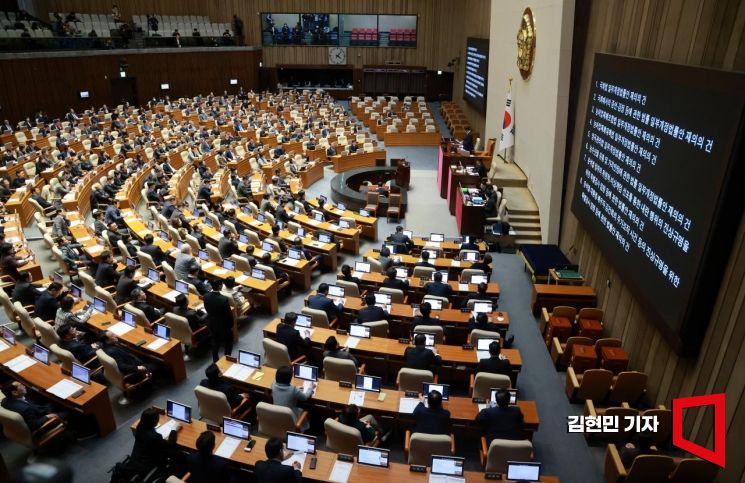 Speaker Woo Won-sik declared the rejection of all eight bills, including the double special prosecution bills such as the Special Investigation Act on Internal Insurrection and the Special Investigation Act on Mrs. Kim Geon-hee, during the plenary session of the National Assembly on the 8th. Photo by Kim Hyun-min
The Korea Economic Association presented eight urgent legislative bills, including the Value-Added Tax Act, Restriction of Special Taxation Act, and Customs Act, as the "Top 8 Tax Reform Tasks" on the 13th. They urged that at least the non-contentious bills on which the ruling and opposition parties have reached a consensus be processed quickly.
They also emphasized the urgency of amending the Restriction of Special Taxation Act to increase the credit card deduction rate for traditional markets. This bill aims to raise the deduction rate as well as extend the sunset clause for income deductions, but the bill's processing in the National Assembly has effectively stalled.
They stated that support policies for advanced industries such as semiconductors, which lack tax benefits and cash support compared to major countries, should also be promptly revised. They diagnosed that amending the Restriction of Special Taxation Act related to semiconductor investment tax credits is urgent. According to the Korea Economic Association, the ruling and opposition parties have tentatively agreed on measures such as establishing a new semiconductor category for investment tax credits, raising the integrated investment tax credit rate by 5 percentage points, applying higher tax credit rates for research and development (R&D) or commercialization facility investments, and extending the sunset clause for tax benefits on national strategic technology R&D and facility investments by 10 years, but follow-up implementation is slow.
They stressed the need to promptly include artificial intelligence (AI) and other technologies as national strategic technologies by amending the Restriction of Special Taxation Act. Although it was discussed last year to include AI and future transportation means (such as ships), the related amendment bill is currently pending in the National Assembly. The United States, Japan, and others support investment tax credits for land and buildings to establish future and advanced industry manufacturing facilities. Since inclusion in the national strategic technology sector is necessary to secure at least the investment tax credit level of competing countries, industry interest is high.
The amendment bill to extend the temporary investment tax credit for small and medium-sized enterprises and mid-sized companies is also stagnant. The ruling and opposition parties agreed to extend the application period of the temporary investment tax credit, which was temporarily applied in 2023, until the end of the year, but there has been no progress in passing the bill.
Additionally, they said that the 100% extension of the customs duty exemption rate for private aircraft parts (Customs Act), expansion of tax benefits on capital gains from asset transfers of workout companies (Restriction of Special Taxation Act), and prevention of tax evasion by foreign operators in shared accommodation (Value-Added Tax Act) should also be promptly revised.
Lee Sang-ho, head of the Economic and Industrial Headquarters at the Korea Economic Association, said, "To enable the public and companies to conduct normal economic activities, the National Assembly should at least promptly process the bills on which the ruling and opposition parties have reached a consensus before the Lunar New Year holiday."
© The Asia Business Daily(www.asiae.co.kr). All rights reserved.
![Clutching a Stolen Dior Bag, Saying "I Hate Being Poor but Real"... The Grotesque Con of a "Human Knockoff" [Slate]](https://cwcontent.asiae.co.kr/asiaresize/183/2026021902243444107_1771435474.jpg)
















