"Black box storage becomes difficult when both engines fail and power is lost"
"Complete power outage likely, as indicated by loss of ADS-B signal"
Auxiliary power source for CVR in emergencies is also difficult to install
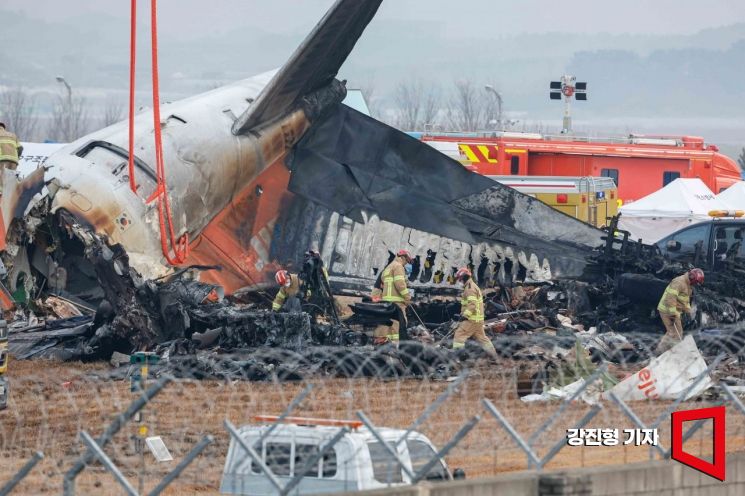 Firefighters are searching for fuel items at the site of the Jeju Air passenger plane collision and explosion accident that occurred at Muan International Airport, Jeonnam, 30 days ago. Photo by Kang Jin-hyung
The 'last 4 minutes of recording' from the black box, which should have determined the cause of the Jeju Air passenger plane disaster at Jeonnam Muan International Airport, has been confirmed missing. Experts believe that engine damage at the time of the accident likely led to this issue. If both engines fail to operate, power supply becomes difficult, which may cause the black box to stop functioning.
"Missing 4-minute recording... Possibility of both engines failing"
On the 13th, Professor Jung Yoon-sik of the Department of Aviation Operations at Catholic Kwandong University said, "It is highly likely that the black box was not recorded because power supply was cut off due to malfunction of both engines of the accident aircraft." He explained, "If even one of the two engines was operating normally, power would have been supplied smoothly, so the black box recording would not have stopped. The lack of power supply means both engines failed."
A professor who requested anonymity also said, "In a situation where bird strike is certain, both engines stopped and power was not supplied. It is unclear whether the engines failed one after another with a time lag, but power supply was cut off, and the Aircraft Dependent Surveillance-Broadcast (ADS-B), which sends the aircraft's position and speed externally just before the black box data storage stopped, also did not operate, indicating that the entire power supply was blocked."
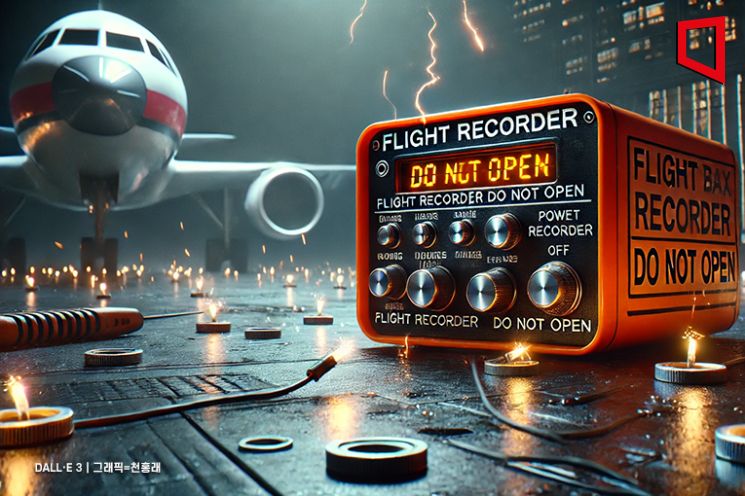
According to the Ministry of Land, Infrastructure and Transport's Aviation and Railway Accident Investigation Board (ARAIB), the black box, including the Cockpit Voice Recorder (CVR) and Flight Data Recorder (FDR), stopped operating at 8:58 a.m. on December 29 last year. Before it stopped working, at 8:57 a.m., the controller issued a bird strike warning, and at 8:59 a.m., the pilot declared a 'Mayday' and initiated a go-around. Afterwards, the aircraft attempted a belly landing and collided with the localizer (azimuth facility) concrete mound at 9:03 a.m. However, these records were not saved.
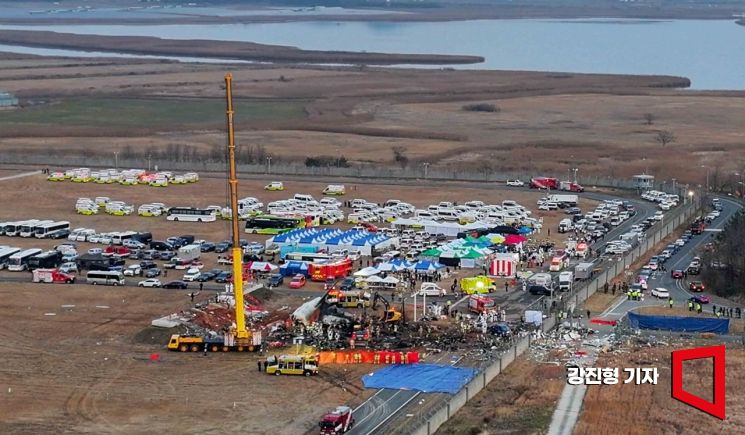 On the 29th, a Jeju Air passenger plane carrying 181 passengers collided with the outer wall of the runway while landing at Muan International Airport, causing a fire that resulted in a major disaster with most passengers dying. The wreckage of the aircraft is placed on the runway at Muan International Airport, Jeollanam-do. Photo by Kang Jin-hyung
ARAIB expressed that it is difficult to jump to conclusions about the cause of the black box malfunction. An ARAIB official said, "The cause of the missing last 4 minutes of recording is still under investigation," and added, "No results from ARAIB's investigation have been released yet."
CVR Auxiliary Power Source Difficult to Install on Accident Aircraft Model
Experts also pointed out that "it is natural that the accident aircraft's CVR does not have an auxiliary power source to supply emergency power." Professor Jung said, "The operational technical standards apply to recently introduced aircraft, and applying them to the accident aircraft model is practically difficult," adding, "Retrofitting older aircraft like the accident model involves significant cost burdens."
He continued, "Even if an auxiliary power source is installed on the accident aircraft's CVR, due to the aircraft's design characteristics, if power is cut off, the backup battery cannot supply power. To make this possible, not only must the auxiliary power source be installed, but other equipment must also be replaced to allow power transmission. At that point, it is better to use a different aircraft model."
According to the Ministry of Land, Infrastructure and Transport's 'Operational Technical Standards for Fixed-Wing Aircraft,' aircraft introduced after January 1, 2018, must have an auxiliary power source that automatically supplies 9 to 11 minutes of power to the CVR in emergencies.
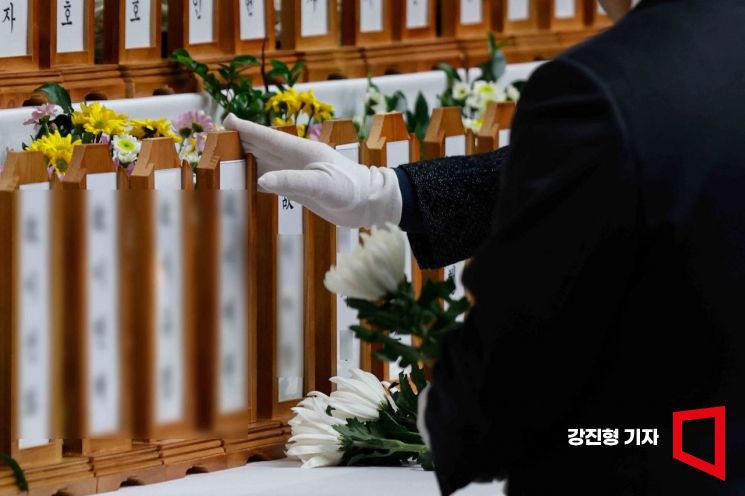 Amid the Jeju Air passenger plane disaster that resulted in 179 deaths, a mourner visiting the joint memorial altar set up at Muan Sports Park near Muan International Airport in Jeollanam-do on the 30th touches the memorial tablet of the victims. Photo by Kang Jin-hyung
A professor who requested anonymity said, "Older aircraft like the accident model have an Auxiliary Power Unit (APU) that the pilot can start to resupply power if it is cut off, but this accident happened in a sudden situation within 3 to 4 minutes, so it would have been difficult for the pilot to start the APU."
Meanwhile, the representatives of the bereaved families stated at a press conference on the 11th, "We will continue the on-site search for three more days based on good weather conditions, and if not a single fragment is found, the families will declare the end of the search." It was reported that on the 11th and the previous day, snow flurries in Jeonnam Muan prevented the search from being conducted.
© The Asia Business Daily(www.asiae.co.kr). All rights reserved.
![Clutching a Stolen Dior Bag, Saying "I Hate Being Poor but Real"... The Grotesque Con of a "Human Knockoff" [Slate]](https://cwcontent.asiae.co.kr/asiaresize/183/2026021902243444107_1771435474.jpg)


















