Compared to September Last Year, Apartment Sale Listings in Gyeonggi Province Increase by 9% in January
Noticeable Backlog of Listings in Key Areas of Gyeonggi
Guri, Goyang, Paju Rise by 13-15%
Uiwang, Hanam, Seongnam Rise by 13-17%
As the real estate market enters a correction phase, a backlog of apartment sales is becoming prominent in key areas of Gyeonggi Province. These areas were popular among actual residents mainly due to connections with the Seoul Metropolitan Express Railway (GTX) lines, subway extensions, and proximity to Seoul's Gangnam district. Sellers aiming to capitalize on development prospects by selling homes at high prices and buyers seeking affordable and livable homes in a market frozen since the impeachment crisis have failed to find a price agreement, leading to an expected accumulation of listings for the time being.
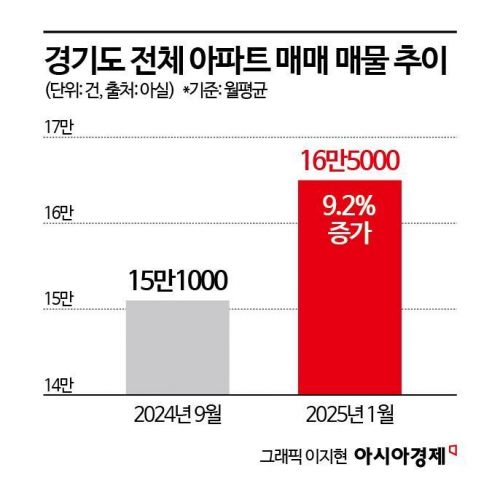
According to the real estate big data platform 'Asil' on the 13th, the number of apartment sale listings in Gyeonggi Province as of the 10th (monthly average basis) was about 165,000. This is approximately 9% higher than the 151,000 listings recorded in September last year when housing prices were still rising. In particular, sales listings in northern Gyeonggi areas that attracted attention due to various favorable factors?such as Guri City, Deogyang-gu in Goyang City, Paju City, and Gimpo City?and southern Gyeonggi areas including Uiwang City, Hanam City, and Seongnam City's Sujeong-gu and Jungwon-gu surged by 10 to 17% during the same period.
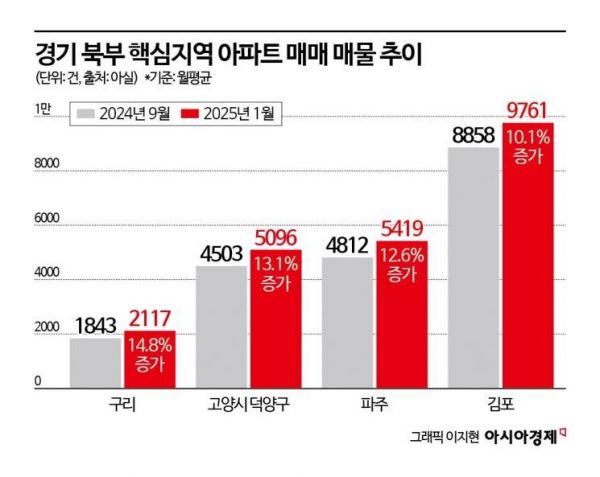
In the northern region, Guri, benefiting from the extension of Line 8, saw an increase in sales listings of about 15% (from 1,843 to 2,117). Deogyang-gu in Goyang City, close to Seoul and connected to GTX-A Daegok Station, increased by approximately 13% (from 4,503 to 5,096). Paju, where the opening of GTX-A Unjeong Central Station reduced travel time to Seoul to 21 minutes (Unjeong Central Station to Seoul Station), also rose by 13% (from 4,812 to 5,419). Even Gimpo, where discussions are underway for the extension of Line 2 following the extension of Line 5 and GTX-D connection, jumped 10% (from 8,858 to 9,761).
A KB Real Estate official said, "These areas have been alternative markets to Seoul, attracting real demand due to transportation benefits." He added, "Compared to the average listing increase rate of about 8% in northern Gyeonggi, the absorption of sales in these areas has stagnated." He also noted, "This phenomenon is also occurring in southern Gyeonggi," and "Compared to the southern region's average increase of about 9%, the backlog burden in popular areas has become heavier."
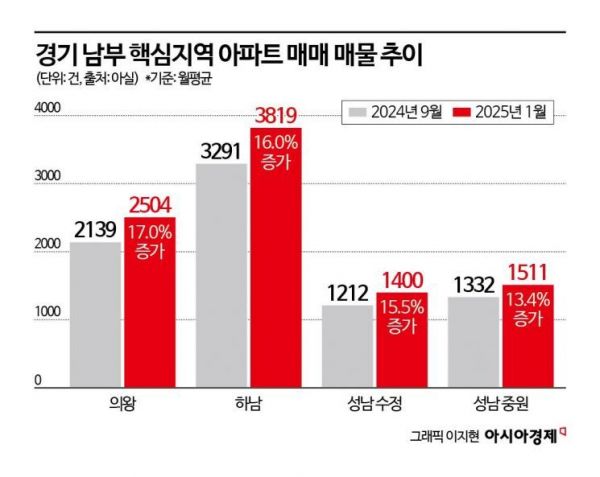
Uiwang, which attracted attention due to its proximity to Gwacheon and Seongnam and relatively affordable prices, showed a notably high increase in sales listings of 17% (from 2,139 to 2,504). Hanam City, where extensions of Lines 3 and 9 are being promoted, rose 16% (from 3,291 to 3,819). Seongnam's Sujeong-gu and Jungwon-gu, close to Gangnam, increased by approximately 16% (from 1,212 to 1,400) and 13% (from 1,322 to 1,511), respectively.
Kim Hyo-seon, Senior Real Estate Specialist at NH Nonghyup, analyzed, "These areas saw many buyers purchasing at high prices not only from actual demand but also investment demand during the rapid price surge period." He added, "However, currently, the GTX benefits are not as recognized as before, and even with many listings, transactions are not proceeding well." Kim predicted, "Although many listings are coming out, prices remain high, preventing sellers and buyers from reaching an agreement. Since older listings are also accumulating in Seoul, unless prices in Gyeonggi Province decrease, it will be difficult for transactions to increase again in the second half of the year."
Ham Young-jin, Head of Real Estate Research Lab at Woori Bank, also said, "Currently, due to the sharp drop in transaction volume, the backlog phenomenon is more evident in areas where sales were previously active." He forecasted, "If sellers are not very proactive in adjusting prices, the gap in appropriate asking prices will widen, leading to an increase in listings and unsold properties."
Meanwhile, according to the 'Weekly Apartment Price Trend for the First Week of January' released by the Korea Real Estate Agency, Gyeonggi Province recorded a -0.01% change, showing a smaller decline compared to the previous week (-0.02%).
© The Asia Business Daily(www.asiae.co.kr). All rights reserved.



















