A Visit to Yeongpung Electronics: Leading the Development of Domestic Components
Successful Localization of Core Technologies for Weapon Systems Exported Overseas
Yeongpung Electronics, founded in 1986, is also located within the industrial complex. Yeongpung Electronics produces core components such as 'drive power control devices' and manufactures domestically produced parts for ground, air, maritime, guided weapon systems, and space launch vehicles. With the increase in 'K-Defense' exports, the company has achieved sales exceeding 100 billion KRW for the first time since its establishment.
 Young Poong Electronics achieved sales exceeding 100 billion KRW for the first time since its founding, driven by increased exports of 'K-Defense'. (Photo by Young Poong Electronics)
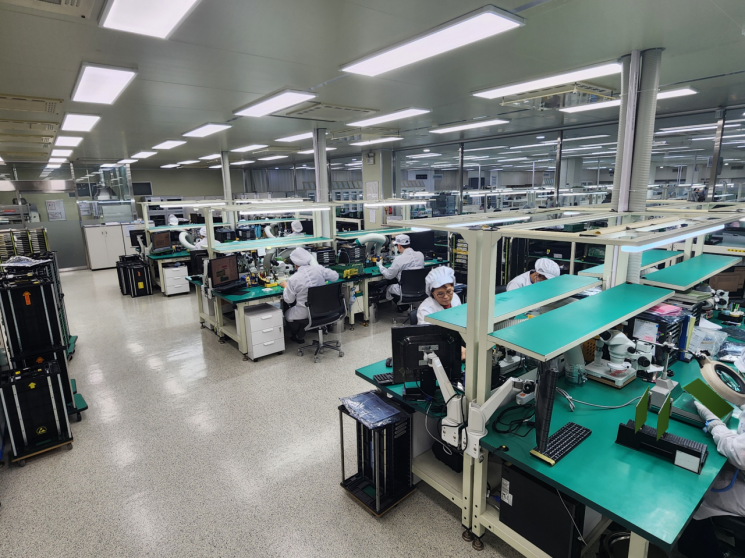 The assembly building, which produces major components, faces the biggest threats from static electricity and dust. To enter the factory, wearing sanitary clothing is mandatory. (Photo by Yeongpung Electronics)
Yeongpung Electronics produces output control units for the K-10 armored vehicle. The K-10 armored vehicle is an armored vehicle that supplies shells and propellant charges to the K-9 self-propelled howitzer. The K-10 armored vehicle must automatically load the ammunition it carries inside onto the K-9, and the output control unit is essential for this. It functions like a human arm. Unlike previous controllers that moved in 3 or 5 directions, it moves along 19 axes. This is a world-first technology.
Another key component supplied to ground weapons is the Power Distribution Unit (PDU). All weapon systems use electricity. The PDU is essential for supplying stable voltage and power to the system. The PDU is also installed in the Redback combat infantry tracked armored vehicle exported to Australia. The Australian side attempted to independently develop the PDU locally but eventually gave up.
They also produce aviation parts. A representative part is the integrated standby flight instrument. It displays the aircraft's attitude, speed, and more, and last year it was ranked as the top offset trade item by the Ministry of Trade, Industry and Energy. Offset trade refers to conditional transactions where related technology is transferred or materials are imported in return for weapon exports. It means it can be exported first when importing weapons from overseas. Previously, our aviation weapons used products from the British defense company Meggitt. However, with Yeongpung Electronics' successful localization, maintenance has become easier and prices have been reduced by more than 30%. Domestic products are already installed on 80 units of the domestic utility helicopter (KUH-1) 'Surion' and 20 units of the Marine Corps' Marinus.
Yeongpung Electronics plans to strengthen exports ahead of the second Trump administration. President Trump strongly pressured the European Union (EU) to increase defense cost-sharing throughout his term. In response, major EU countries have increased defense budgets and strengthened military cooperation. In November last year, UK Defense Secretary John Healey and German Defense Minister Boris Pistorius met and signed a defense treaty called the 'Trinity Agreement.' The two countries, which were enemies in both World War I and II, have joined hands. Yeongpung Electronics plans to utilize this niche market to directly supply parts.
They are also preparing for unmanned-manned combined weapon systems. Until now, various weapon systems used on the battlefield exchanged battlefield information in different ways. When unmanned-manned combined systems are used on the battlefield in the future, various networks will be formed. This is a 4.5-generation weapon system. Real-time communication is essential, and what is needed is a network switch. Previous generations used a hub method, which was insufficient for exchanging real-time photos and videos. This is already a core component used in domestic multipurpose unmanned vehicles.
They have also challenged the flight control system (FCS) market. The FCS is the brain of a drone. If communication with the control system is cut off or flight path information is lost, the FCS automatically returns the drone to its original takeoff point without any separate command. This is a top-level technology commercialized by only about five companies worldwide, including China's DJI. Many domestic drones use Chinese-made products. There are concerns about a rapid increase in wireless backdoor hacking threats that insert backdoors into IT equipment supply chains using Chinese components. However, even if the drone is Chinese-made, using a domestic FCS can avoid hacking threats. Yeongpung Electronics is preparing production targeting small and medium-sized drones under 150kg.

© The Asia Business Daily(www.asiae.co.kr). All rights reserved.
![Clutching a Stolen Dior Bag, Saying "I Hate Being Poor but Real"... The Grotesque Con of a "Human Knockoff" [Slate]](https://cwcontent.asiae.co.kr/asiaresize/183/2026021902243444107_1771435474.jpg)


















