1.1 Million Direct Jobs to Be Provided in Q1
Vice Minister Kim Minseok: "Seeking a Smooth Transition for Continuous Employment"
Easing Regulations on Standard Workplaces for the Disabled
Plans for Activating Retirement Pensions to Be Prepared in the First Half
Active Support for Semiconductor Special Act Discussions and Legislation
Safety Regulations for Mobile Robots to Be Revised in the First Half
The Ministry of Employment and Labor will expedite the execution of 70% of this year's budget in the first half of the year. Given the growing domestic and international uncertainties raising concerns about employment instability, the ministry will focus on job matching under the policy direction that "jobs are the livelihood." It will also promote labor reforms. Supervision of increasing wage arrears will be strengthened, and discussions on continuous employment, which began in earnest last year, will be accelerated.
On the 10th, the Ministry of Employment and Labor reported the '2025 Major Work Plan' with these details at the Government Seoul Office.
The ministry plans to focus on stabilizing jobs and livelihoods in the first half of the year while promoting continuous labor reforms based on the rule of law between labor and management as the core framework for the year's work. Specifically, efforts will be made to ▲concentrate capabilities on stabilizing jobs and livelihoods ▲upgrade customized services by target groups ▲continue labor reforms for future generations ▲establish a field-centered autonomous labor-management safety and health system ▲enhance public perception through infrastructure innovation.
Customized Job Support for Youth, Middle-aged, and Disabled
The ministry will mobilize all possible measures, including the execution of the job budget this year, to minimize job shocks. In this process, it decided to expedite 70% of this year's budget in the first half. Together with related ministries such as the Ministry of Health and Welfare and the Ministry of Culture, Sports and Tourism, it will provide 1.1 million direct jobs in the first quarter and hold the Korea Job Fair in March to help resolve job mismatches between youth and excellent small and medium enterprises.
To stabilize workers' livelihoods, efforts will be made to improve wage arrears. Since wage arrears tend to increase when the economy is poor, supervision of habitual arrears will be strengthened this year, and forced investigations will be pursued. Additionally, low-income workers who take loans for wedding or childcare expenses will receive interest support of up to 3%, and the living stabilization loan for industrial accident workers will be increased from 20 million KRW to 30 million KRW.
The ministry will also respond to employment changes due to industrial transitions such as petrochemical industries and coal-fired power plants. In the case of petrochemical industries, if designated as a preemptive response area, the criteria for recognizing support targets for employment retention subsidies for partner companies will be relaxed.
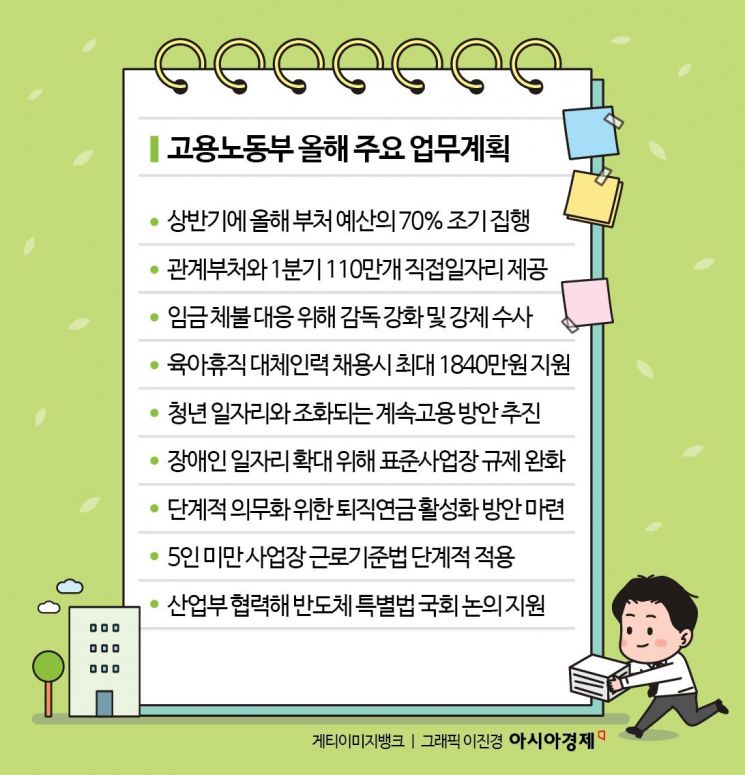
This year, efforts will also be made to provide customized support by target groups. To support 'rested' youth, the number of universities operating the 'Youth Employment All-Care Platform' will be expanded from 8 to 120. To reduce the childcare leave burden on small and medium enterprises, up to 18.4 million KRW will be provided to small and medium enterprises hiring replacement workers and their employees in cooperation with local governments and Shinhan Financial Group.
Continuous employment, which was actively discussed last year, will be promoted by collecting expert and field opinions and pursuing social dialogue to harmonize with youth jobs. To encourage voluntary continuous employment, the requirements for continuous employment incentives will be relaxed and supported.
Kim Min-seok, Vice Minister of Employment and Labor, said, "Continuous employment will be approached from the perspectives of youth job coexistence, strengthening labor-management choice, easing corporate burdens, and efficient human resource utilization," adding, "We are considering providing various options for a smooth transition."
In the process of expanding job opportunities for the disabled, a special provision under the Disabled Employment Act will be newly established to allow holding companies and medical corporations to establish subsidiary-type standard workplaces, thereby easing regulations on the establishment of standard workplaces. The ministry has drafted related legislation and submitted it to the National Assembly's Environment and Labor Committee.
Stepwise Mandatory Retirement Pension, Semiconductor Special Act Discussions
The ministry will support this year's National Assembly discussions related to the 'Labor Vulnerable Support Act' proposed on the 31st of last month. It will also promote the stepwise mandatory implementation of retirement pensions to ensure old-age income security and prevent wage arrears. Plans to activate retirement pensions will be prepared in the first half of the year through expert consultations and inter-ministerial coordination. The application of the Labor Standards Act to workplaces with fewer than five employees will be addressed through gradual and phased measures developed via social dialogue, considering field realities.

Following the Supreme Court ruling last month, the 'Guidelines for Labor-Management Guidance on Ordinary Wages' will be revised this month to resolve field uncertainties. Tax incentives will also be linked for companies prioritizing improvements in job and performance wage systems. The ministry will support National Assembly discussions on the 'Semiconductor Special Act,' which includes exemptions from the 52-hour workweek, in cooperation with the Ministry of Trade, Industry and Energy, and will create conditions for reforming working hour systems.
Vice Minister Kim said, "We will actively support the enactment of the Semiconductor Special Act," adding, "Once the special act is implemented, we will manage whether workers' consent is obtained, whether 11 hours of rest related to industrial safety is guaranteed, and how compensation is handled when overtime pay is waived in case of performance."
In establishing a field-centered autonomous labor-management safety and health system, to settle a self-regulatory prevention system, standard models for risk factor reduction will be developed for industries with frequent serious accidents such as building management and waste disposal. A risk assessment method for delivery workers will also be developed in the first half of the year.
For the increasing use of mobile robots in industrial sites, safety regulations including the installation of 'human detection devices' will be revised in the first half of the year. To promote the use of excellent smart safety equipment such as AI video recognition for forklifts, 35 billion KRW will be supported this year.
The ministry will provide AI-based counseling services to help all citizens easily understand labor-related laws and plans to continuously expand counseling areas. It will also enhance the employment24 platform by utilizing AI to improve job matching between employers and job seekers.
© The Asia Business Daily(www.asiae.co.kr). All rights reserved.



















