Mandatory Spending Dominates Federal Budget
Arbitrary Cuts Raise Questions of Feasibility
Elon Musk, CEO of Tesla, who had announced a major 'government slimming' as the head of the soon-to-be-established U.S. Department of Government Efficiency (DOGE), has taken a step back. He reduced the federal spending cut target from the original $2 trillion to $1 trillion, which had been criticized as unrealistic.
On the 9th (local time), during a live interview on X (formerly Twitter) with Mark Penn, chairman of the advertising firm Stagwell, Musk said, "We will try to achieve the $2 trillion cut, but that is the best-case scenario," adding, "If we aim for $2 trillion, we will have a good chance of achieving $1 trillion." Previously, Musk had claimed during a campaign event ahead of last October's election that federal spending could be cut by at least $2 trillion.
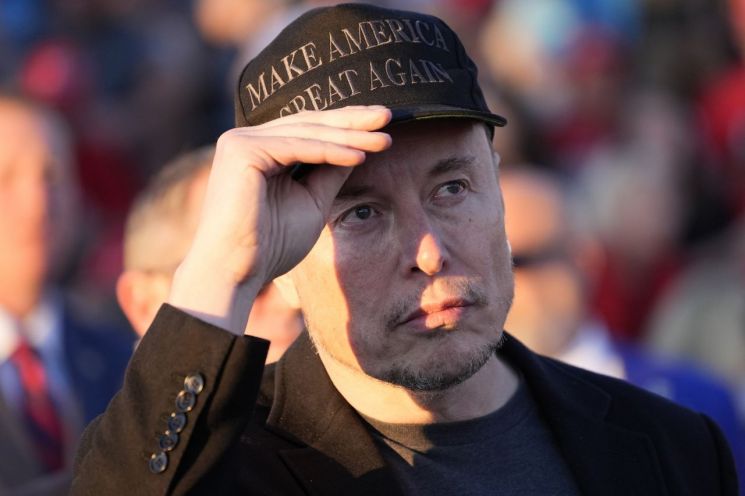 Elon Musk, CEO of Tesla, participated in the campaign rally of then President-elect Donald Trump held at the Butler Farm Show in Pennsylvania on October 5 last year (local time). Photo by AP Yonhap News
Musk further emphasized, "If we reduce the fiscal deficit from $2 trillion to $1 trillion and free the economy to achieve additional growth, the production of goods and services will keep pace with the increase in money supply, so there will be no inflation," adding, "This will result in tremendous outcomes." Although Musk halved his originally proposed spending cut target, this statement is interpreted as an attempt to ease concerns about the reduction of government spending, which drives overall economic demand.
As the head of the Department of Government Efficiency to be established under the Trump administration, Musk has proposed radical reforms such as consolidating government agencies and abolishing remote work for civil servants even before the department's launch, putting the political sphere on high alert. With Musk, known for his high work intensity and having let go of 80% of Twitter employees after acquisition, becoming a key figure in the next cabinet, anxiety about his 'downsizing storm' has spread throughout the public service. Vivek Ramaswamy, a former Republican presidential primary candidate and co-head of the Department of Government Efficiency, has also stated plans to fire all federal employees whose Social Security numbers end in an odd digit, cutting the workforce by 50%.
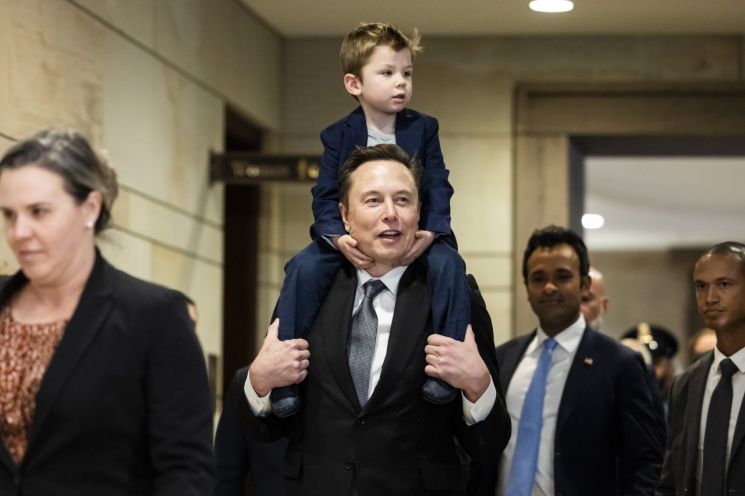 Elon Musk, CEO of Tesla, and Vivek Ramaswamy, former Republican presidential primary candidate, appointed as co-heads of the newly established Department of Government Efficiency (DOGE), visited the U.S. Congress on December 5 last year (local time) to meet with Republican senators. Photo by EPA Yonhap News
However, even Musk himself was widely regarded as unlikely to achieve the $2 trillion federal spending cut from the outset. The U.S. budget for fiscal year 2024 stands at $6.75 trillion (approximately 9,860 trillion won), of which over $5.3 trillion is mandatory spending on Social Security, Medicare, defense, and veterans' benefits, which the government cannot arbitrarily reduce by law. Trump also pledged not to cut social security benefits and other programs that would provoke strong voter backlash if tampered with hastily.
Bloomberg News explained Musk's halving of the spending cut target by stating, "Musk is not the only one to have recently withdrawn previous campaign promises," adding, "Trump also claimed on his first day in office that he could mediate peace between Ukraine and Russia, but recently told reporters realistically it could take six months."
The outlet further noted, "Republican Senator Rand Paul proposed reducing the budget by about 6% each year over the next five fiscal years, but even that did not pass Congress," and assessed, "Although the Republicans hold the majority in both houses of Congress, the margin is narrow, so bipartisan cooperation is necessary, making it unlikely that budget cuts will reach Trump's desk."
© The Asia Business Daily(www.asiae.co.kr). All rights reserved.
![Clutching a Stolen Dior Bag, Saying "I Hate Being Poor but Real"... The Grotesque Con of a "Human Knockoff" [Slate]](https://cwcontent.asiae.co.kr/asiaresize/183/2026021902243444107_1771435474.jpg)

















