Domestic researchers have succeeded in expanding the scope of application for biostructures and the areas where the biotemplating method can be applied. The biotemplating method refers to a technique that uses biological structures as templates to create functional structural materials, leveraging the functions of biological structures ranging from viruses to tissues and organs that make up the human body.
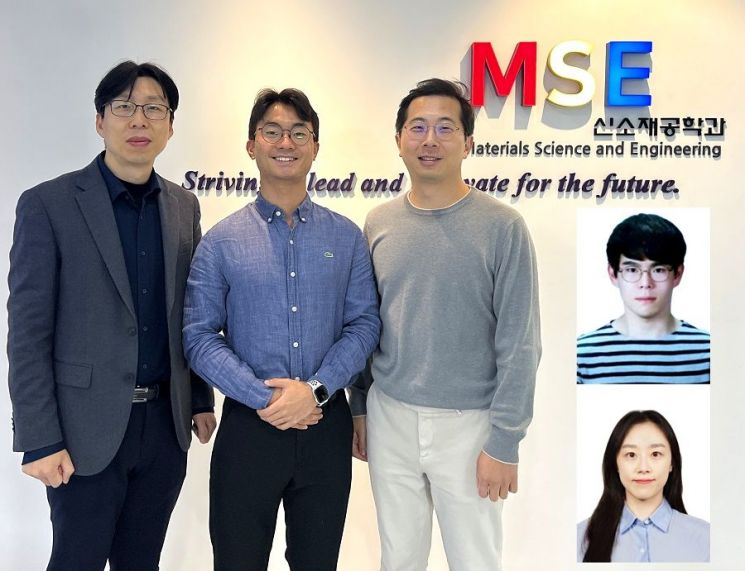 (From left) Professor Jeong Yeonsik, Department of Materials Science and Engineering, Doctoral Candidate Song Daehyun, Professor Jang Jaebeom, (From top right) Dr. Song Changwoo, Dr. Jo Seunghui. Provided by KAIST
KAIST announced on the 10th that a joint research team led by Professors Jae-Beom Jang and Yeon-Sik Jung from the Department of Materials Science and Engineering has developed a highly tunable biotemplating method by utilizing specific internal proteins within biological samples.
Biological structures possess complex characteristics that are difficult to artificially replicate. However, the biotemplating method has been applied in various fields because it directly utilizes biological structures for fabrication.
Previously, however, the method mainly utilized only the external surfaces of biological samples or faced limitations in producing functional nanostructures by exploiting the structure-function correlations of various biostructural templates due to limited numerical data and sample sizes.
The joint research team focused on overcoming these issues by utilizing various internal biological structures and discovering a biotemplating method with high tunability.
As a result, they succeeded in developing the ‘CamBio (Conversion to advanced materials via labeled Biostructure)’ biotemplating method, which can selectively synthesize nanostructures of various specific types and sizes from particular protein structures within biological samples composed of diverse proteins.
The CamBio method developed by the joint research team has the advantage of achieving high tunability of functional nanostructures producible from biological samples by integrating multiple manufacturing and biological technologies.
This method also demonstrated enhanced performance of functional nanostructures created via CamBio when used as substrates for surface-enhanced Raman scattering (SERS), a technique for detecting substances. SERS is a technology that uses light to detect very small amounts of material, based on the principle that specific substances on metal surfaces such as gold or silver react with light to amplify signals.
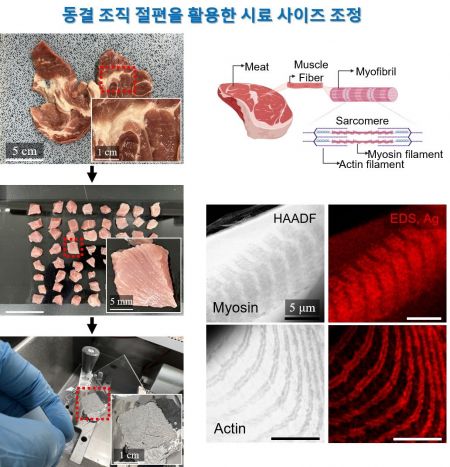 Diagram material for securing coordination through CapBio at the organizational level. Provided by KAIST
The joint research team confirmed that by repeatedly attaching antibodies to nanoparticle chains made using cytoskeletal proteins inside cells, they could more freely adjust the structure and achieve up to a 230% improvement in surface-enhanced Raman scattering performance.
Additionally, in the process of utilizing intracellular structures, they expanded the method by obtaining frozen sections of muscle tissue inside meat samples and successfully fabricated periodic band substrates composed of metal particles through the CamBio process.
The joint research team believes that fabricating substrates in this way not only allows for large-area production using biological samples but also enhances cost competitiveness.
The developed CamBio method is expected to become a biotemplating technique that can solve problems faced by various research fields by broadening the utilization range of biological samples.
Daehyun Song, a doctoral student in the Department of Materials Science and Engineering at KAIST and the first author, said, “We have comprehensively established a biotemplating method that can utilize various protein structures through CamBio. We expect that if this method is combined with cutting-edge biological technologies such as gene editing or 3D bioprinting, as well as new material synthesis technologies, its range of applications can be further expanded across diverse fields.”
Meanwhile, this research was conducted with support from the Ministry of Science and ICT’s Challenging Research and Development Program for Science and Technology, Leading Research Centers, and the National BioResearch Resources Advancement Project.
The research involved doctoral student Daehyun Song and researchers Changwoo Song and Seunghui Cho from the Department of Materials Science and Engineering at KAIST as first authors. The research results were published online on November 13 last year in the international journal Advanced Science.
© The Asia Business Daily(www.asiae.co.kr). All rights reserved.


















