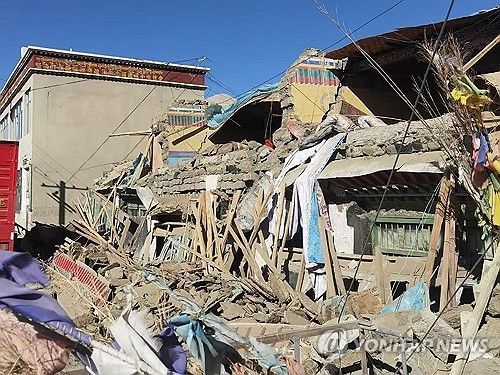
 On the 7th, an earthquake occurred in Gangjin, western Tibet Autonomous Region, China. Photo by Yonhap News
Local authorities announced on the 9th that the number of people displaced by the earthquake in Lhoka (Shigatse) City, Tibet Autonomous Region in western China has reached over 60,000.
The Tibet Autonomous Region People's Government stated in its third briefing that "As of 6 a.m. on the 9th, a total of 126 people have died due to the Lhoka earthquake, and the number of displaced persons is 61,500."
Earlier, Chinese authorities had reported 126 deaths as of 7 p.m. on the first day of the earthquake, the 7th. No additional deaths have been reported up to this day, two full days after the earthquake.
The Tibet Autonomous Region government indicated in the previous day's briefing that "rescue and search operations have already shifted to displaced persons' relocation and disaster recovery efforts," effectively signaling the end of rescue and search operations.
The number of injured, initially reported as 188 on the first day, increased to 337 in this briefing. As of 9 a.m. on the same day, a total of 337 people have received treatment, with 246 discharged after treatment. A Tibet Autonomous Region official stated, "Currently, 91 people are receiving treatment in hospitals (72 mild cases, 19 severe cases)," adding that "the care is gradually transitioning from emergency to general treatment."
The official also reported that a total of 27,248 houses were damaged by the earthquake, of which 3,612 houses collapsed. The number of collapsed houses increased by three compared to the announcement on the 7th.
He explained, "This earthquake was large in magnitude and intensity, with a shallow epicenter, and the surrounding area is densely populated with townships and villages, which caused relatively severe housing damage." Within 5 km of the epicenter, there are seven villages, and within 20 km, there are two townships.
The earthquake occurred at 9:05 a.m. on the 7th in Dingri County, Lhoka City. The China Earthquake Networks Center reported the magnitude as 6.8, while the United States Geological Survey (USGS) reported it as 7.1. The focal depth was 10 km. Aftershocks have continued for three days. According to the Tibet Autonomous Region, as of 9:15 a.m. on the day, a total of 1,211 aftershocks have occurred. There were 33 aftershocks exceeding magnitude 3, with the strongest aftershock measuring 4.4 in magnitude.
© The Asia Business Daily(www.asiae.co.kr). All rights reserved.

















