NSSC Approves Accident Management Plan
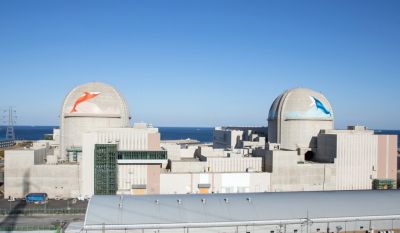 Exterior view of Shin Hanul Units 1 and 2 (Unit 1 on the left). Provided by Korea Hydro & Nuclear Power
A comprehensive response manual for all accidents at nuclear power plants, called the 'Accident Management Plan,' has been introduced to the Korean-type nuclear power plant (APR1400).
On the 9th, the Nuclear Safety and Security Commission (NSSC) held its 206th plenary meeting and reviewed and approved the 'Approval of APR1400 Nuclear Power Plant Accident Management Plan,' confirming that the accident management plans for Saeul Units 1 and 2 and Shin Hanul Units 1 and 2, APR1400 nuclear power plants, meet the licensing standards of the Nuclear Safety Act through a vote.
The accident management plan is a document that includes the scope of accident management covering design basis accidents, multiple failures, external disasters exceeding design basis, and severe accidents; management facilities; management strategies and implementation systems; management capability evaluation; and training plans. After the Fukushima nuclear accident in 2011, the Nuclear Safety Act was amended in 2015 to mandate nuclear power plant operators to submit accident management plans.
Accordingly, Korea Hydro & Nuclear Power (KHNP) submitted accident management plans for 28 nuclear power plants that are either in operation or under operation license review in 2019.
The Korea Institute of Nuclear Safety (KINS) prioritized the review of accident management plans for Saeul Units 1 and 2 and Shin Hanul Units 1 and 2 among them and confirmed that KHNP's accident management capability meets the licensing standards. The Nuclear Safety Expert Committee under the NSSC also confirmed the appropriateness of KINS's review results through a nine-month preliminary review.
This agenda was first reported at the 203rd NSSC meeting and passed after three subsequent discussions.
Jin Jaeyong, an NSSC commissioner appointed upon recommendation by the Democratic Party of Korea, continuously argued that KHNP should devise strategies to manage accidents even in the event of an aircraft collision with the nuclear power plant caused by terrorism.
In response, the NSSC Secretariat and KINS stated that it is impossible to calculate the probability of aircraft terrorism, there are no regulations reflecting this in the official notices, and since aircraft collision scenarios are already incorporated into the design, it is difficult to reflect them further in accident management.
As the two sides' arguments ran in parallel and consensus among commissioners became difficult, Chairman Choi Wonho declared a vote, and five out of six participating commissioners, excluding Commissioner Jin, approved the original proposal.
With the approval of the accident management plan, KHNP plans to expand safety facilities such as mobile power generation vehicles, as well as personnel and organizations to operate them, and conduct regular accident management training.
The NSSC plans to thoroughly verify the effectiveness of accident management strategies and the appropriateness of accident management evaluations for accident management plans of other nuclear power plants, such as Kori Units 2 to 4, and sequentially apply them on site after review.
Chairman Choi said, "With the approval of the accident management plan, a foundation has been established to systematically manage comprehensive accident management capabilities covering from initial events to prevention and mitigation of severe accidents," and added, "The regulatory agency must manage well to ensure that the accident management plan is well established in the field."
© The Asia Business Daily(www.asiae.co.kr). All rights reserved.

















