SK Hynix Tops Net Purchases
Trump Beneficiary Stocks in Defense and Shipbuilding Also Heavily Included
The stock that foreign investors bought the most as soon as the market opened this year was SK Hynix. Foreign investors also focused on bottom-fishing Samsung Electronics, which had been neglected despite its share buybacks last year, and purchased defense and shipbuilding stocks, which are considered beneficiaries of Trump’s policies. Attention is focused on whether the stock prices of these stocks will continue to rise, supported by foreign buying momentum.
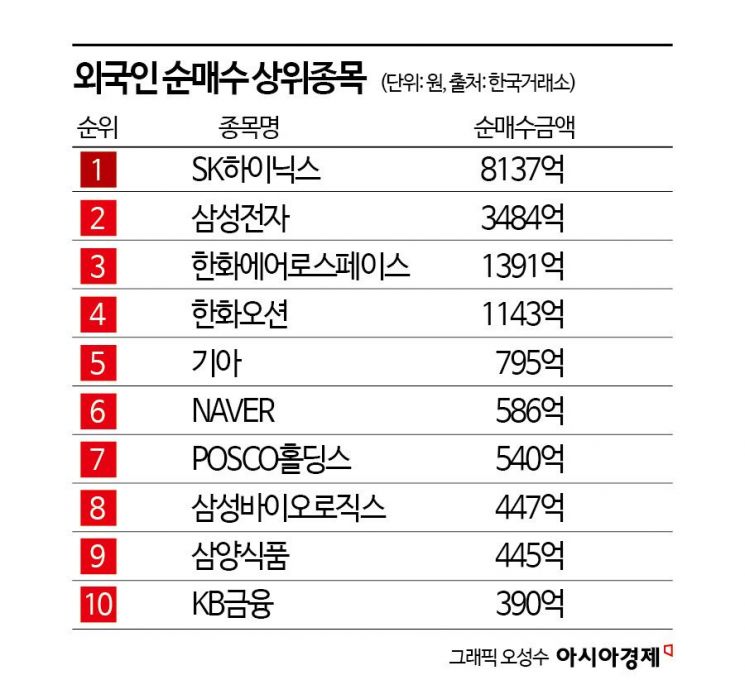
According to the Korea Exchange on the 10th, from January 2 to 9 this year, the stocks most net purchased by foreigners were SK Hynix (813.7 billion KRW) and Samsung Electronics (348.4 billion KRW). Foreign investors also heavily bought Hanwha Aerospace (139.1 billion KRW), Hanwha Ocean (114.3 billion KRW), Kia (79.5 billion KRW), NAVER (58.6 billion KRW), POSCO Holdings (54 billion KRW), and Samsung Biologics (44.7 billion KRW).
SK Hynix, which ranked first in foreign net purchases, closed at 205,000 KRW on the 9th, up 5.29% (10,300 KRW) from the previous session. The expansion of supply volume and price increase of high-bandwidth memory (HBM) are the driving forces behind the stock price rise.
Lee Min-hee, a researcher at BNK Investment & Securities, recently stated in a report, "SK Hynix posted an operating profit of 7 trillion KRW from HBM last year, and it is expected to earn 15 trillion KRW this year," raising the target price from 250,000 KRW to 310,000 KRW.
The actions of SK Group Chairman Chey Tae-won also pushed the stock price up. On the 8th (local time), Chairman Chey Tae-won met with Jensen Huang, CEO of NVIDIA, in the United States and said they discussed that the recent development speed of SK Hynix’s HBM is becoming faster than NVIDIA’s requirements.
Samsung Electronics was the stock most sold by foreigners last year, with net sales of 10.52 trillion KRW, ranking as the second largest in annual net sales. However, foreigners have switched to buying this year. This is due to the bottoming theory. The securities industry expects Samsung Electronics’ performance to hit the bottom in the first quarter and recover in the second half.
Park Yoo-ak, a researcher at Kiwoom Securities, said, "Samsung Electronics is expected to see a decrease in operating profit in the first quarter compared to the previous quarter. After this, DRAM and foundry will start leading the company’s performance rebound." He added, "DRAM is expected to rebound in performance from the second quarter due to the normalization of distribution inventory and the full-scale entry into the 5th generation high-bandwidth memory (HBM3e) business, and foundry will begin to reduce operating losses due to increased utilization rates of Exynos and image sensors (CIS)." Kim Sun-woo, a researcher at Meritz Securities, said, "Currently, Samsung Electronics is trading at an extremely low valuation due to concerns about poor performance and loss of memory competitiveness," and predicted, "Despite poor performance, the stock price is likely to rebound for the time being."
Hanwha Ocean and Hanwha Aerospace also received foreign investors’ attention. Shipbuilding and defense stocks are classified as beneficiaries of Trump’s policies. Since Donald Trump, the U.S. president-elect, mentioned shipbuilding as a cooperative industry with the U.S. last November, these stocks have emerged as leading stocks.
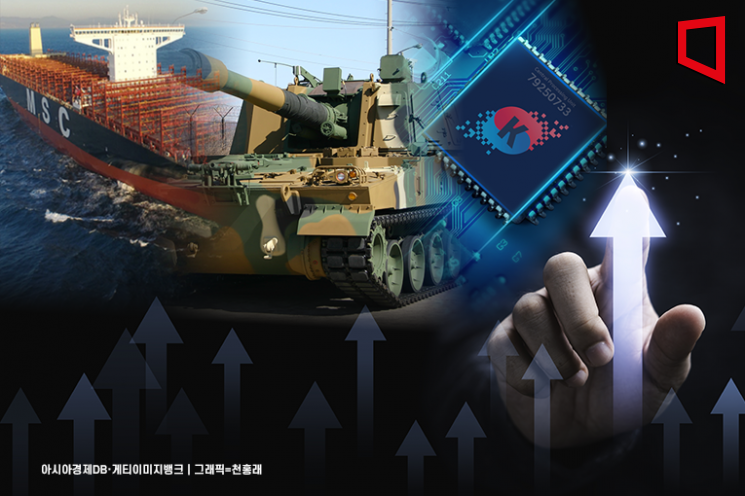
Defense stocks are expected to benefit from the declaration of "America First" by President Trump, as geopolitical conflicts are anticipated to increase.
Choi Kwang-sik, a researcher at Daol Investment & Securities, said yesterday, "This year, attention is focused on L-SAM (Long-range Surface-to-Air Guided Missile), which has completed system development and started mass production." He added, "Two Middle Eastern countries that have already purchased 'Cheongung' hope for the early deployment of L-SAM, and the Defense Acquisition Program Administration has granted prior export approval, making it a promising order pool." Based on strong exports, he raised the target price from 440,000 KRW to 500,000 KRW by revising upward the estimated performance for the fourth quarter of last year.
Kia was the fifth most purchased stock by foreigners. Kia is classified as a beneficiary of a high exchange rate but had struggled to rise due to sluggish domestic demand and concerns over Trump’s tariffs. However, after Hyundai Motor Group announced the largest-ever domestic investment on the 9th, the stock rose more than 2% on the 9th following a 1.92% increase on the 8th.
NAVER attracted buying interest as it is considered less affected by U.S. tariff threats after the inauguration of the second Trump administration. Additionally, foreigners also bought POSCO Holdings, which had been at the bottom due to concerns over policy backlash after Trump’s election, and bet on KB Financial, a representative value-up stock. They also added Samyang Foods, which has emerged as a leader in ramen, and Samsung Biologics, expected to benefit from U.S.-China tensions, to their portfolios.
© The Asia Business Daily(www.asiae.co.kr). All rights reserved.


















