News Sentiment Index Rebounds from Two-Year Low After Martial Law
Slight Recovery as Impeachment Bill Passes and Exchange Rate Stabilizes
Private Consumption Expected to Improve if Political Uncertainty Eases and Fiscal Measures Are Implemented
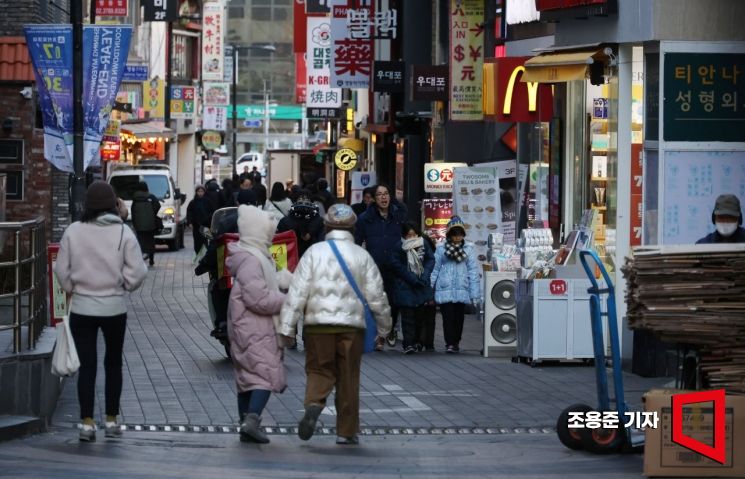 At the end of last year, the streets of Myeongdong in Jung-gu, Seoul, appeared quiet and sparsely populated. Photo by Jo Yongjun
Consumer sentiment, which had plummeted following President Yoon Suk-yeol's declaration of martial law, has recently shown signs of recovery. If the political situation does not deteriorate further and the government implements expansionary fiscal measures such as an additional supplementary budget, there is a possibility that private consumption will somewhat improve in the first half of the year.
According to data compiled by the Bank of Korea on the 10th, the News Sentiment Index stood at 93.2 this week, up about 7 points from last month's average of 86.0. The Bank of Korea's News Sentiment Index is a leading indicator of consumer sentiment, quantifying the economic mood reflected in news articles. A reading below 100 indicates that economic sentiment is more pessimistic than the long-term historical average.
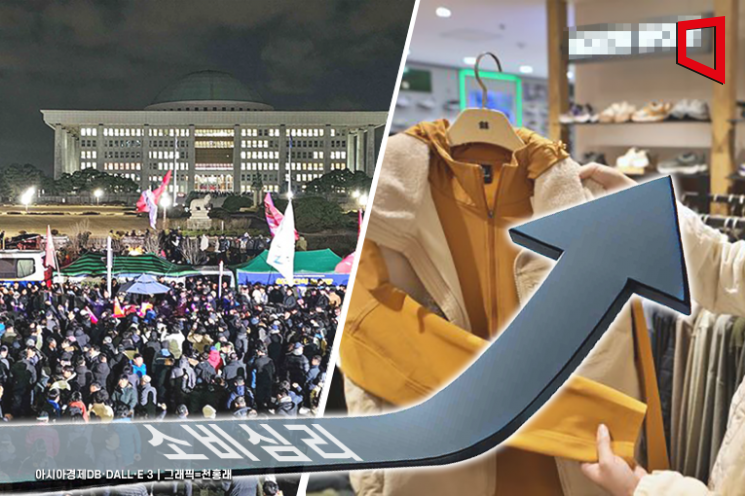
Until November last year, the News Sentiment Index remained above 100, but it dropped to 77 in mid-December after the martial law situation, marking its lowest level in two years since December 2022. Although there was a slight rebound after the National Assembly passed the impeachment bill against President Yoon Suk-yeol, the index remained in the 80s due to the continued high exchange rate and the Jeju Air disaster at the end of the year.
An official from the Bank of Korea stated, "The News Sentiment Index, which had sharply declined due to the combination of the martial law situation, the air disaster, and the high exchange rate, is showing signs of recovery at the beginning of the year. In particular, this week's rebound appears to be partly due to a decrease in the exchange rate, which had surged at the end of the year."
Consumer data, which had been suppressed since the martial law situation, is also gradually rebounding. Domestic credit card spending plummeted during the first week of December last year, when martial law was declared, but has been recovering since mid-December, particularly in major cities such as Seoul, Sejong, Busan, Jeju, and Gangwon.
According to the Nowcast survey, a real-time economic indicator from Statistics Korea, nationwide credit card spending in the third week of December last year increased by 2.8% compared to a year earlier. This marks a rebound from the -3.1% recorded in the second week, which was affected by the martial law situation. Jung Yeokyung, an economist at NH Investment & Securities, stated, "Although the Consumer Sentiment Index declined due to political instability, recent credit card spending has recovered to a solid level, suggesting that the further deterioration of private consumption is likely to be limited."
Government and political measures to boost spending are also expected to help revive consumer sentiment. To stimulate consumption, the government has designated the 27th, immediately before the Lunar New Year holiday, as a temporary public holiday. Such designations have been shown to effectively increase spending, including credit card usage. Ongoing discussions in the government and political circles about formulating a supplementary budget are also expected to support consumption. Both the government and the opposition parties continue to call for the early implementation of a supplementary budget.
Economist Jung emphasized, "If domestic political issues are resolved and the government implements additional fiscal policies, the capacity for private consumption in the first half of the year is expected to expand."
© The Asia Business Daily(www.asiae.co.kr). All rights reserved.