Seoul City Announces 'Regulation Abolition No. 3'
Flexible Operation of Mandatory Public Contribution Ratio
Increase in General Sale Volume to Enhance Project Feasibility
Fire and Disaster Included in Integrated Review...Permit Approval Time Reduced
In the future, when carrying out redevelopment and reconstruction projects in Seoul, if the maximum floor area ratio cannot be achieved due to height restrictions, the amount of public contributions such as rental housing will be reduced accordingly. Previously, the mandatory public contribution rate was 10%, but now it can be applied flexibly. If the public contribution rate decreases, the amount of general sale units can increase, improving project profitability and speeding up the project. Redevelopment sites located on hills, near schools, or close to mountains that faced height restrictions are expected to benefit.
"Contribute Publicly Only According to the Actual Secured Floor Area Ratio"
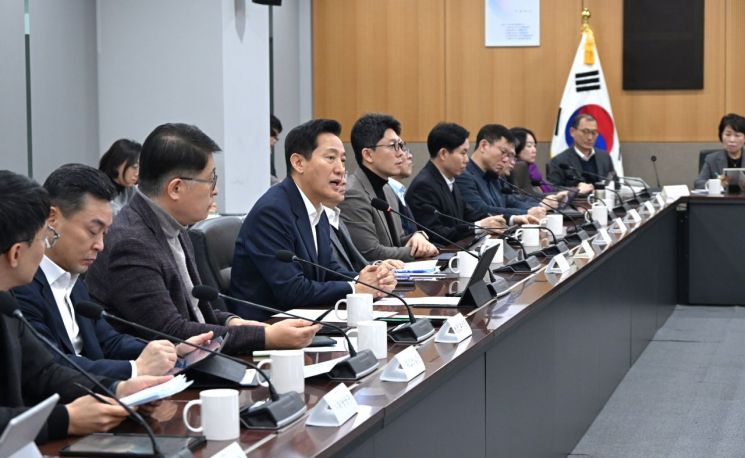 Seoul Mayor Oh Se-hoon is giving an opening remark at the "Regular Executive Meeting on Economic Regulation Abolition" held at Seoul City Hall on the morning of the 9th. (Provided by Seoul City)
On the 9th, Seoul City held the ‘Regular Executive Meeting for Economic Regulation Elimination’ chaired by Mayor Oh Se-hoon and announced this plan as ‘Regulation Elimination No. 3’. This came just four days after forming the ‘Construction Industry Regulation Elimination Task Force (TF)’ last month and consecutively releasing ‘Regulation Elimination Nos. 1 and 2’ last week. Seoul City stated, "We will immediately identify and implement two additional cases that can be improved right away."
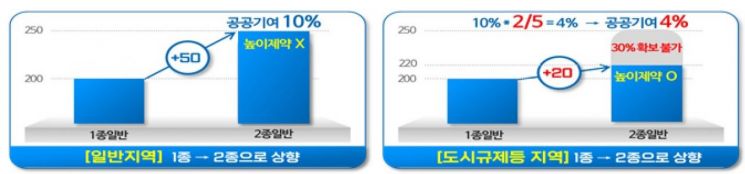
The third regulation elimination task is ‘Additional Relaxation of Public Contribution Rates for Redevelopment Projects in Urban Regulation Areas’. The main point is to ease the mandatory public contribution rate for urban regulation areas subject to height restrictions, such as high-altitude scenic districts, cultural heritage sites, school surroundings, and hilly areas.
The city will abolish the mandatory 10% public contribution rate applied when zoning is upgraded and instead set the public contribution rate proportionally to the actual additional secured floor area ratio. For example, if a zone is upgraded from Type 1 General Residential Area (statutory maximum floor area ratio 200%) to Type 2 General Residential Area (250%), but due to height restrictions the buildable floor area ratio is only 220%, then only 4% public contribution (corresponding to the 20% secured floor area ratio) is required. Assuming a project area of 40,000㎡, this would allow about 15 more units for general sale.
Currently, even if zoning is upgraded, it is difficult to secure the maximum floor area ratio due to height restrictions in these areas. Nevertheless, a uniform 10% of the total supply had to be contributed publicly. Since the number of floors of apartments must be lowered compared to redevelopment projects on flat land, but the public contribution such as rental housing remained the same, many projects failed to secure profitability and were canceled.
A Seoul city official said, "This will provide practical help to areas that repeatedly failed to be selected as candidates for the Rapid Integrated Planning due to low profitability caused by urban regulations," and added, "For poor areas where profitability remains low despite the application of the regulation elimination plan, additional public contribution relaxation will be considered through the Urban Planning Committee review."
Addition of Fire Safety and Disaster to Integrated Review Targets... "Permit Process Shortened by Over 2 Months"
The fourth regulation elimination task announced by the city is to include fire performance-based design evaluation and disaster impact assessment in the integrated review targets for existing redevelopment projects. Since January last year, the city has been operating integrated reviews covering seven fields related to project implementation approval: architecture, landscape, education, redevelopment plan (changes), traffic, environment, and parks. However, fire safety and disaster fields have been reviewed separately, requiring the association to undergo complicated review procedures again.
Including fire safety and disaster fields in the integrated review is expected to shorten the redevelopment project period by more than two months. Experts in fire safety and disaster will participate in the integrated review, enabling more efficient architectural planning.
Since the emergency economic meeting chaired by Mayor Oh at the end of last year designated regulation elimination as a core agenda, the city has shown strong determination to discover related issues. In particular, it has rapidly introduced various regulation elimination measures to revive the construction industry, which has been depressed due to rising labor and raw material costs despite its significant economic stimulus effect.
At the meeting, Mayor Oh also expressed his commitment to regulation elimination. He said, "If we are satisfied with the current situation and complacent, we cannot develop, and if citizens feel inconvenienced, all regulations must be reviewed from the ground up," emphasizing that regulation elimination is not a one-time task but a continuous effort.
© The Asia Business Daily(www.asiae.co.kr). All rights reserved.


















