Increase in Weekly Consumption Time and Decrease in Monthly Average Expenditure
Korea Culture and Tourism Institute, 2025 Content Consumption Forecast
This year, while the time that the public spends watching online video services (OTT) or YouTube is increasing, the amount of spending is rather decreasing, according to an analysis.

The Korea Culture and Tourism Institute announced on the 9th the first issue of the 2025 Content Industry Trends Brief titled "2025 Content Consumption Outlook," based on a survey conducted in December last year targeting 2,000 adults aged 20 to 64 nationwide.
The institute predicted that content consumption time will generally increase in 2025. While online content consumption such as OTT and YouTube is on the rise, notable growth is also expected in popular music concerts and book content. However, spending on content consumption is expected to decrease in most genres, indicating that consumers' wallets will become thinner.
The report forecasted that the average weekly content consumption time in 2025 will be 22.89 hours, a 3.86% increase compared to this year. Among these, OTT video content is expected to grow by 7.06%, popular music concerts by 7.02%, and books by 15.85%, driving major growth. In particular, the increase in OTT video content consumption is expected to be prominent among people in their 30s, and the usage time of YouTube and OTT among seniors aged 60 and above is also expected to rise.
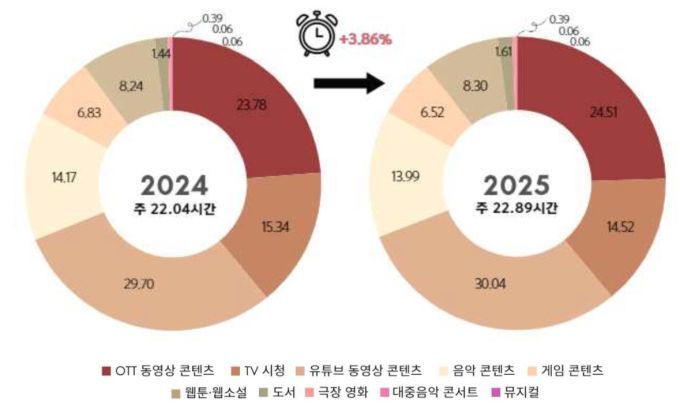 Average Weekly Content Consumption Time and Changes in Genre Proportions [Graph = Korea Culture and Tourism Institute]
On the other hand, TV viewing and game content consumption time are expected to decrease by 1.67% and 0.80%, respectively. This shows that younger generations are moving away from traditional TV platforms to online platforms such as OTT and YouTube. Additionally, game content consumption time is predicted to decrease across all age groups except those in their 20s, with spending expected to drop sharply by 16.79%.
In terms of spending, decreases are expected in most genres. The report projected that the average monthly content consumption expenditure in 2025 will be 29,603 KRW, a 1.55% decrease compared to this year. Spending on major online content such as OTT and YouTube is expected to decline by -0.04% and -0.14%, respectively, while webtoons and web novels are expected to decrease by -4.97%. Conversely, books (2.06%), popular music concerts (0.61%), and musicals (0.23%) are expected to see slight increases, indicating that consumer preference for cultural content will be maintained.
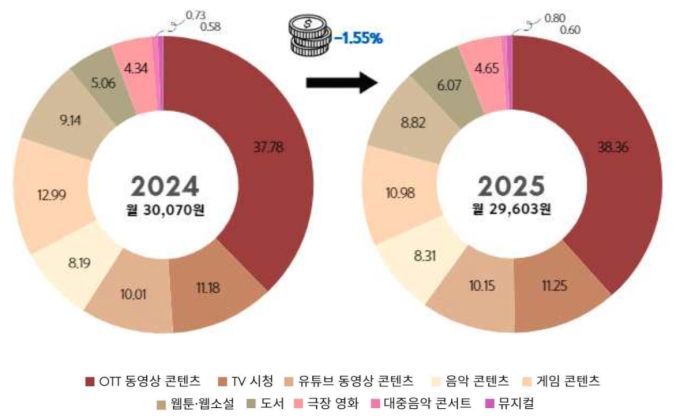 Average Monthly Content Consumption Expenditure and Changes in Genre Proportions [Graph = Korea Culture and Tourism Institute]
Notably, content consumption among high-income groups stands out. Spending on popular music concerts and musicals is expected to increase among high-income households, who are also projected to show strong spending power on offline content. Conversely, low-income households are expected to show a decline in spending on most content consumption, raising concerns about a clear polarization in content consumption due to economic disparities.
A remarkable change is the expansion of content consumption among seniors aged 60 and above. They are enhancing accessibility to digital content such as OTT, YouTube, music, and webtoons, narrowing the digital gap between generations. In particular, YouTube video content consumption time has increased across all age groups, with the usage rate among those aged 60 and above expected to grow the most significantly.
Lee Yong-kwan, head of the Hallyu Economy Research Team at the Korea Culture and Tourism Institute, analyzed, "Due to the impact of economic uncertainty domestically and internationally, consumer sentiment is shrinking, leading to a decrease in content consumption spending. In such circumstances, the fact that only the senior generation is positively forecasting content consumption indicates the increasing influence of the senior generation on the content industry."
© The Asia Business Daily(www.asiae.co.kr). All rights reserved.



















