Quantum Stocks Plummet Simultaneously
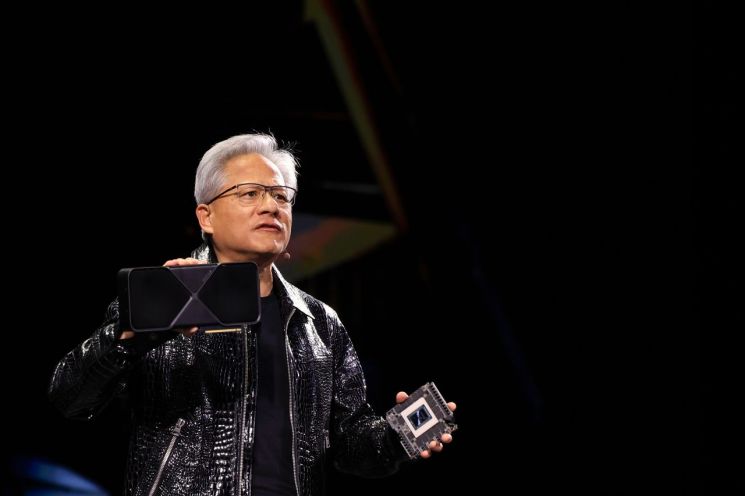
Jensen Huang, CEO of Nvidia, the 'AI (Artificial Intelligence) leader,' stated that it would take about 20 years for quantum computers to become commercialized, causing quantum computing-related stocks to plummet one after another. Some experts analyze that the head of Nvidia, who is inevitably facing a major impact in the computing business when quantum computers become commercialized, has issued a warning shot.
According to major foreign media including Bloomberg on the 8th (local time), Jensen Huang, visiting Las Vegas where 'CES 2025' is being held, responded to a question about the commercialization timeline of quantum computers at a meeting on the 7th, saying, "If you say 20 years until a useful quantum computer emerges, many people would believe it." He added, "If it takes 15 years, that would probably be considered early, and 30 years would be considered late."
MarketWatch explained, "CEO Huang also discussed that quantum computers are suitable for small data and large computing problems but are not suitable where large amounts of data are required." It added, "CEO Huang's remarks poured cold water on quantum stocks that had risen exponentially in a short period."
Quantum computers, based on the principles of quantum mechanics, can perform calculations at speeds overwhelmingly faster than conventional computers, drawing attention as a 'game changer.' This is because they can transform the industrial landscape across a wide range of fields such as AI, medicine, and encryption. Especially last month, big tech company Google announced the development of a quantum chip called 'Willow' that can solve calculations taking a decade in just five minutes, sharply increasing commercialization expectations inside and outside the market, and quantum computing-related startups' stock prices soared explosively as a result.
However, following Jensen Huang's remarks, quantum computing-related stocks plunged in the New York Stock Exchange that day. IonQ and Rigetti Computing shares fell by 39% and 45%, respectively. Other quantum computing-related stocks such as Quantum Computing (-43%), D-Wave Quantum (-36%), and Arkit Quantum (-31%) also dropped one after another. Ivana Delevska, Head of Investments at Spare Invest, evaluated that "the 15 to 20-year timeline is very realistic."
Some experts also analyze that Huang CEO issued a warning shot because he is inevitably facing a blow when quantum computers become commercialized. Nvidia has grown by dominating 80% of the AI chip market through graphics processing units (GPUs) used in high-performance computing, but there is an analysis that quantum computers, which process data at high speed, could replace GPUs. Richard Shannon, analyst at Craig Hallum, argued, "Quantum computing will have a disruptive impact on Nvidia's existing computing business, which benefits the most."
Quantum computing companies responded to Huang CEO's remarks. According to US economic media CNBC, Alan Baratz, CEO of D-Wave Quantum, said Huang CEO's claim was "completely wrong" and that "the company has already delivered commercialized quantum computers to several companies including Mastercard and NTT Docomo." He emphasized, "It is not 15 years, 20 years, or 30 years, but commercialized today."
However, MarketWatch reported, "It is still difficult to find meaningful profits in the quantum computing industry." According to FactSet, IonQ and Quantum Computing's annual revenue forecasts for last year were estimated at $41.6 million and $500,000, respectively. MarketWatch pointed out, "This amount is ridiculously small compared to the market capitalization of these companies."
© The Asia Business Daily(www.asiae.co.kr). All rights reserved.

















