Donald Trump, the President-elect of the United States, suggested that Greenland could be annexed by force, causing an uproar in the international community. Germany and France expressed concerns in unison, emphasizing territorial sovereignty, while the Republican Party defended Trump, recalling the past American dream of territorial hegemony.
On the 8th (local time), according to the BBC and others, Olaf Scholz, Chancellor of Germany, said regarding Trump’s remarks about Greenland, "The principle of inviolability of borders applies equally to all countries," emphasizing, "This is a fundamental principle of international law and a core component of what we call Western values."
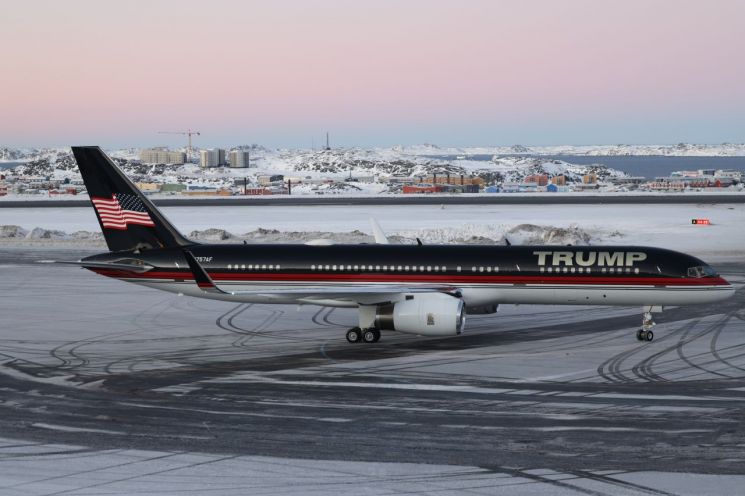 Donald Trump Jr., the eldest son of President-elect Donald Trump, is landing his private plane in Greenland, a Danish territory, on the 7th (local time). Photo by AP Yonhap News
Jean-Yves Le Drian, French Minister of Foreign Affairs, also appeared on Radio France Inter in the morning, stating, "Greenland is a Danish territory and clearly European territory," and emphasized, "The European Union (EU) will not tolerate any country in the world violating sovereign borders." Minister Le Drian believes that the United States will not invade Greenland but agrees that the international community has entered an era where the law of the strong prevails, stressing the importance of self-strengthening.
These concerns from major European countries stem from the territorial expansion ambitions revealed by President-elect Trump. At a press conference the previous day, when asked whether military or economic coercion would be excluded to secure control over the Panama Canal and Greenland, he said, "I cannot say that," leaving room for the use of force. He also threatened that if the people of Greenland voted for independence and annexation by the United States, and Denmark obstructed this, very high tariffs would be imposed.
Trump’s remarks became a hot topic even within American politics. The Republican House Foreign Affairs Committee shared on X (formerly Twitter) the front page of the conservative-leaning New York Post, which likened Trump’s claims about Greenland and the Panama Canal to the "Trump Doctrine," a play on the "Monroe Doctrine," saying, "It is not American to fear big dreams." The Monroe Doctrine, advocated by former President James Monroe, rejected territorial interference by external forces such as Europe and asserted American hegemony over the Americas. This was a defense of Trump’s ambitions toward Greenland and the Panama Canal as aligned with the spirit of territorial hegemony that led America’s heyday.
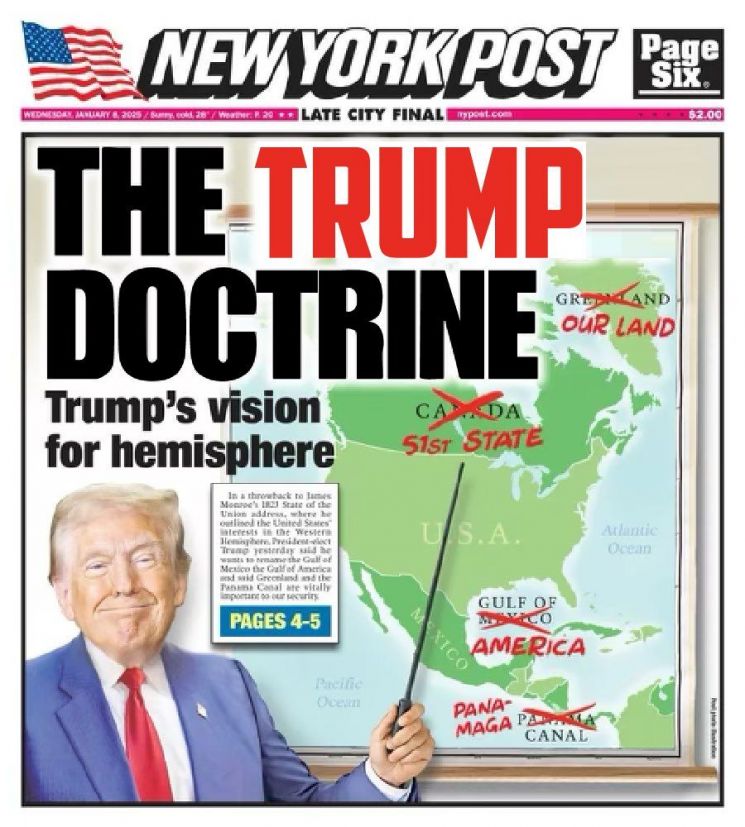 Front page photo of the conservative-leaning New York Post expressing President-elect Donald Trump's claims regarding Greenland and the Panama Canal as the "Donro Doctrine." Photo by X
Criticism poured in from the opposition. Hakeem Jeffries, Democratic House Minority Leader, told reporters, "What does last November’s election have to do with invading or forcibly occupying Greenland?" He pointed out, "Changing the names of Greenland, the Panama Canal, or the Gulf of Mexico to the United States is not important. The real issue is that America’s middle class is shrinking and living costs are rising." Secretary of State Antony Blinken also criticized the interest in Greenland, saying, "It is clearly not a good idea," and "We should not waste time on unrealistic plans."
Some speculate that the discord caused by Trump’s Greenland remarks could be a prelude to a split among NATO allies. This is in the same context as the recent friction between major world leaders and mainstream political circles caused by Elon Musk, Tesla CEO and a 'first buddy,' supporting far-right parties in Europe.
However, the EU has effectively avoided making a statement on this matter. At a regular briefing that day, Paola Pinno, Chief Spokesperson for the European Commission, said, "We are currently discussing something extremely hypothetical, so I do not want to comment specifically or compare it to the situation in Ukraine," but she did note that Article 42(7) of the Lisbon Treaty applies to Greenland. This clause, known as the 'mutual defense clause,' states that if one member state is subject to armed aggression, other member states will provide support using all possible means.
© The Asia Business Daily(www.asiae.co.kr). All rights reserved.


















