UNIST Professor Jeong Dong-il's Team Reveals Brain's Heuristic Strategy Using Others' Choices in Decision-Making
When visiting a Chinese restaurant for the first time and seeing other customers all eating Jjajangmyeon, even if I prefer Jjamppong, I hesitate whether to eat Jjajangmyeon.
In uncertain situations without information about the Chinese restaurant, people tend to follow others' choices. It has been computationally and neuroscientifically proven that this unconditional following of others in uncertain situations is an alternative strategy manifested in the brain.
A research team led by Professor Dongil Jeong from the Department of Biomedical Engineering at UNIST (President Jongrae Park), together with researchers from Virginia Tech in the United States, has published research analyzing how others' choices are reflected in individual decision-making under uncertainty.

Decision-making in social contexts is known to occur through a value judgment process that integrates personal preferences and others' choices. This study revealed what strategy the brain adopts when it cannot access personal preference information.
According to the research, the brain incorporates social information, such as others' choices, into decision-making through a 'heuristic' strategy. When value judgments based on personal preferences are impossible, the brain takes a shortcut by blindly imitating others' choices.
The research team demonstrated this through experiments involving patients with partial damage to the insula or dorsal anterior cingulate cortex (dACC) of the brain. The insula and dACC are considered to play important roles in processing uncertainty information.
Participants repeatedly played a game choosing between two options. Each option provided a reward with a fixed probability: one was a risky option with a wide reward range, and the other was a safe option with a narrow reward range.
In some trials, participants could make decisions after seeing other participants' choices, while in others, they had to decide independently without seeing others' choices.
As a result, participants with brain damage, as expected, were unable to evaluate value based on risk preference, and in social situations where they saw others' choices before deciding, the conformity effect?following others' choices?was more pronounced.
The research team explained that these findings could also apply to adolescents whose personal preferences are not yet established. Both uncertain situations and cases where personal preferences are unclear can be seen as situations where value judgments based on personal preferences are impossible.
Professor Dongil Jeong said, "This study explains why people without clear personal preferences sometimes are more sensitive and swayed by the opinions of those around them," adding, "To solve social problems such as addiction, it suggests that not only creating a better environment but also educational approaches to establish personal preferences are important."
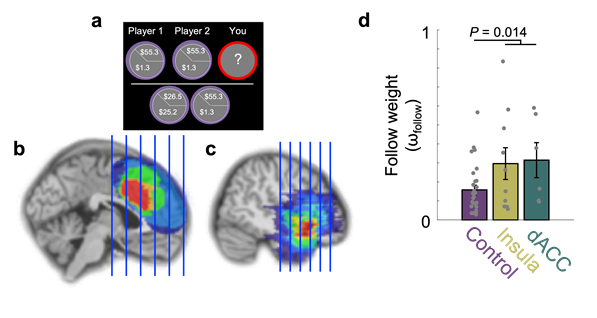 An experiment designed to reveal the mechanism by which information about others' choices is used in individual decision-making when value evaluation based on personal preferences is not possible. Provided by UNIST
This study was published on the 2nd of last month in PLoS Computational Biology, a journal of computational and systems biology.
© The Asia Business Daily(www.asiae.co.kr). All rights reserved.


















