As the number of lines passing through Seoul Station increases, the Korea Rail Network Authority has embarked on expanding the Seoul Station facilities. This measure aims to alleviate congestion caused by the growing number of users and to prevent safety accidents.
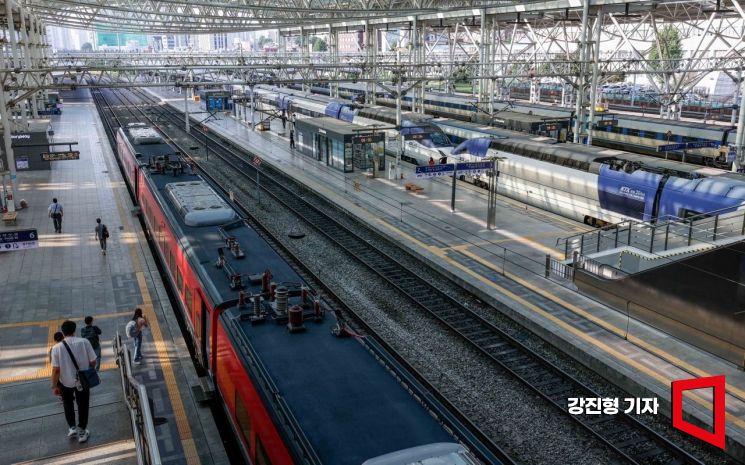
According to the Korea Rail Network Authority on the 9th, since January last year, the authority has been working on the design for expanding the connecting passageway of the high-speed rail concourse at Seoul Station. The plan involves widening the elevated connecting passageways between the concourse and platforms, as well as the space behind the Lotte Outlet, expanding the facility area from the existing 2,500㎡ to 6,500㎡. The design is scheduled to be completed by October this year. Construction is planned to begin in the first half of next year, with completion targeted by 2028.
As the number of lines passing through Seoul Station continues to increase, improving movement efficiency within the station has become a key challenge. The more lines added, the higher the transfer demand and congestion inside the station. According to boarding and alighting statistics by station compiled by Korea Railroad Corporation (KORAIL), Seoul Station had an average daily boarding of over 50,000 passengers on KTX and regular trains in 2023. The number of alighting passengers is at a similar level. Line 1 Seoul Station was also found to be used by an average of 100,000 passengers daily.
With the recent opening of the Metropolitan Area Express Railway (GTX) Line A, the floating population is expected to increase further. The Rail Network Authority opened the section from Unjeongjungang Station in Paju, Gyeonggi Province to Seoul Station last month, and the full line connecting Samsung Station, Suseo, and Dongtan is expected to open by 2028. Additionally, GTX-B, connecting Incheon National University Station (Incheon Songdo International City) to Maseok Station (Namyangju, Gyeonggi Province), and the Shinansan Line are also planned to pass through or terminate at Seoul Station. Currently, Seoul Station connects several rail lines including GTX-A, Seoul Metropolitan Subway Lines 1 and 4, Gyeongui-Jungang Line, Incheon International Airport Railroad, and the Gyeongbu Line, which serves KTX and regular trains.
The comprehensive development of the northern station area to transform Seoul Station into the "Gangbuk COEX" is also expected to increase the floating population. This project involves creating an international cultural complex on the underutilized railway land (30,000㎡) north of Seoul Station, consisting of five buildings ranging from six basement floors to a maximum of 39 floors above ground, with a total floor area of 340,000㎡. The groundbreaking ceremony was held last month, 16 years after the basic plan was established in 2008, with completion scheduled for 2029. The complex will include an exhibition hall and international conference center capable of accommodating about 2,000 people, as well as hotels, offices, and officetels. The total construction cost is 3 trillion KRW.
With the opening of new rail lines and various development benefits, the Rail Network Authority has also decided to renovate the aging Line 1 facilities at Seoul Station to enhance safety. Together with Seoul City and KORAIL, they will prepare the basic plan starting this year. Lee Seong-hae, Chairman of the Rail Network Authority, said, "This is an agreement among related organizations for safety and aesthetics," adding, "We will carefully monitor to ensure there are no issues related to the increasing density at Seoul Station."
© The Asia Business Daily(www.asiae.co.kr). All rights reserved.

















