Clear Increase in Gyeongju Visitors... 40 Million Visitors for 3 Consecutive Years
Foreign Sales Also Surge... Leading to Regional Economic Revitalization
Signs of the tourism industry in Gyeongju City, Gyeongbuk Province, South Korea's largest tourism and cultural city, entering a boom phase beyond recovery are being observed in various places after being stagnant due to COVID-19 and the economic recession.
According to Gyeongju City on the 8th, an analysis of tourism statistics and consumer spending from 2020 to the present shows that the number of visitors to Gyeongju and tourism industry sales have increased since the COVID-19 pandemic, positively impacting the revitalization of the local economy.
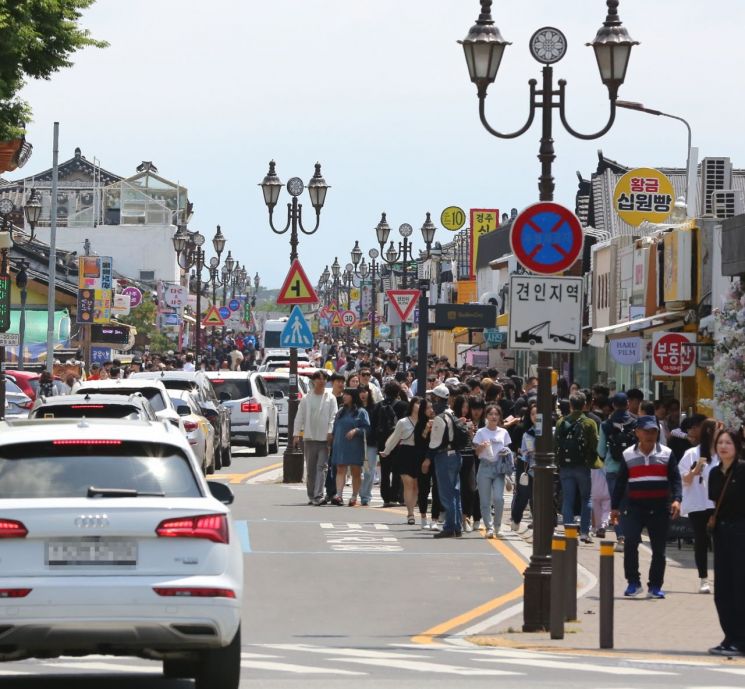 In Hwangridan-gil, Gyeongju City, tourists and cars are mingling, creating a "mountain of people and sea of cars" scene.
 [Photo by Gyeongju City]
According to statistics from the Korea Tourism Data Lab, the annual number of visitors to Gyeongju steadily increased from 35.92 million in 2020 to 39.51 million in 2021, 45.08 million in 2022, and 47.54 million in 2023.
Last year, the number reached 43.63 million by November, and it is expected to surpass 40 million visitors for the third consecutive year.
An analysis of tourists' residences shows that visitors are evenly distributed nationwide, including nearby regions such as Gyeongbuk (22.7% as of last year), Ulsan (20.2%), and Busan (12.4%), as well as Gyeonggi (8.8%) and Seoul (6.2%). This is attributed mainly to Gyeongju's excellent accessibility and convenient tourism infrastructure.
In 2023, the number of visitors by major tourist attractions was highest at Donggung Palace and Wolji Pond with 1.68 million, followed by Gyeongju World with 1.09 million, Bulguksa Temple with 480,000, and Daereungwon Tomb Complex with 430,000.
The number of visitors to major tourist sites, which had decreased in the early stages of the COVID-19 pandemic, gradually recovered, demonstrating Gyeongju's tourism competitiveness.
Sales in tourism-related industries have also continued to increase. Domestic sales, which were only 176.1 billion KRW in 2020, rose by 43% to 251.8 billion KRW in 2023.
Looking at tourism consumption in 2023 (based on credit card data), food and beverage businesses such as restaurants and coffee shops accounted for 141.4 billion KRW, or 56.1% of total sales, while leisure services such as amusement parks and sports facilities accounted for 50.7 billion KRW, or 20.2%.
Consumption by foreign visitors also increased significantly. The spending scale, which remained around 900 million KRW in 2020, soared more than tenfold to 9.5 billion KRW in 2023.
While this reflects sales fluctuations due to the pandemic, it is interpreted as a result of Gyeongju City's efforts to promote international exchanges and attract foreign tourists.
As of 2023, the main consumption sectors for foreign visitors were accommodation at 4 billion KRW (42.5%) and food and beverage at 3.7 billion KRW (39.6%).
Gyeongju City plans to continue revitalizing the local economy by establishing key policies based on statistics from the Korea Tourism Data Lab.
Mayor Jun Nak-young of Gyeongju said, "The recovery in tourism is a positive sign that breathes new life into the local economy," adding, "We will continue to prepare various support measures and innovative tourism policies to present an even more attractive Gyeongju to tourists."
© The Asia Business Daily(www.asiae.co.kr). All rights reserved.
![Clutching a Stolen Dior Bag, Saying "I Hate Being Poor but Real"... The Grotesque Con of a "Human Knockoff" [Slate]](https://cwcontent.asiae.co.kr/asiaresize/183/2026021902243444107_1771435474.jpg)
















