Announcement of the Ministry of SMEs and Startups' 2025 Work Plan
Goals Include Innovation, Scale-up, and Proactive Future Response
The government is focusing on mitigating management shocks and revitalizing the livelihood economy through domestic demand promotion. In particular, it will strengthen support for the three financial support packages for small business owners and inject policy funds into import and export companies to ease financial and exchange rate shocks.
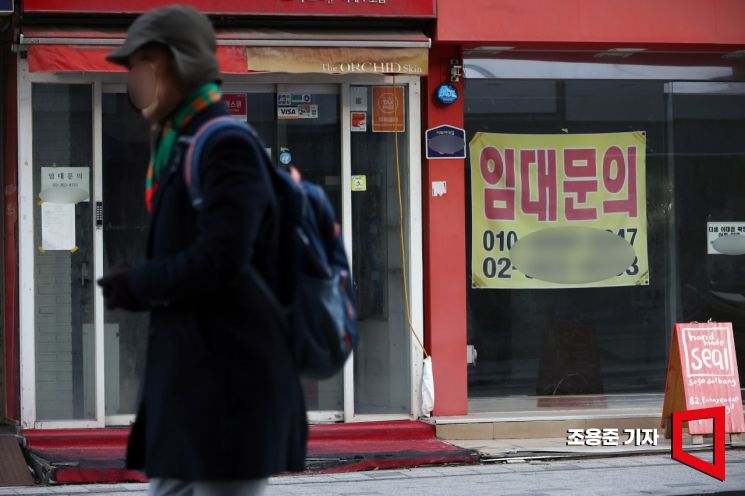 Amid domestic and international adversities such as economic recession and sluggish domestic demand, the number of small business closures is rapidly increasing. On the 26th of last month, vacant stores lined a commercial area in Sinchon, Seoul. Photo by Jo Yong-jun
The Ministry of SMEs and Startups announced the ‘2025 Ministry of SMEs and Startups Work Plan’ containing these policy directions on the 8th. The goals for this year are presented as ‘Revitalizing the Livelihood Economy,’ ‘Innovation and Scale-up,’ and ‘Proactive Future Response.’
Revitalizing the Livelihood Economy
First, support for the three financial support packages for small business owners will be expanded, including the supply of 3.2 trillion KRW in conversion guarantees, relaxation of repayment extension recognition requirements, and granting grace periods for refinancing loans. A ‘Somang (Small Business Owner Hope) Recharge Project’ will be implemented to provide additional loans to those who faithfully repay the three packages. Additionally, 30 ‘Small Business Debt Adjustment Centers’ will be established nationwide, and cooperation with rehabilitation courts will be strengthened to promptly assist small business owners with debt adjustment procedures. A fast-track exclusively for small business owners will be prepared to reduce the approximately 12-month bankruptcy and rehabilitation period.
In case of damage caused by sustained high exchange rates, up to 1.5 trillion KRW in policy funds will be provided to import and export companies affected. Using export vouchers, trade insurance and guarantee subscription fees necessary during the export process will also be supported up to a limit of 10 million KRW. Standards for agreements reflecting exchange rate fluctuations in payment for supplies will be presented, and consulting will be provided to enable principal and subcontracting companies to share exchange rate risks mutually.
To promote the recovery of the venture investment market, the Ministry of SMEs and Startups will swiftly implement a 1 trillion KRW fund-of-funds investment project in the first quarter and create new venture funds totaling 1.9 trillion KRW.
To supply a catalyst for domestic demand promotion, the Donghaeng Festival will be held four times annually, including twice in the first half of the year. To invigorate the rigid consumer sentiment, a 15% special discount and refund event for digital Onnuri gift certificates will be held around the Lunar New Year holiday. Onnuri gift certificates will be issued at a record scale of 5.5 trillion KRW, and the places where they can be used will be expanded.
The number of duty-free shops selling small and medium enterprise products at airports, which have a high sales inducement effect, will be increased from the existing three locations to six. The number of tenant companies will be expanded from 900 to 1,800. Along with this, the actual sales increase effect in the public procurement market will be maximized by excluding cases where products produced by large corporations or overseas companies are disguised as small and medium enterprise products and supplied by distribution SMEs.
An environment where online platforms such as delivery applications and small business owners can coexist will also be created. Through collaboration with the Fair Trade Commission, a full investigation and improvement of unfair terms and conditions disadvantageous to small business owners, mainly by oligopolistic delivery platforms, will be conducted. In addition, the pilot evaluation of win-win growth will be expanded to delivery platforms, and inclusion in the win-win growth index will be considered in the mid to long term. Up to 300,000 KRW will be supported for about 680,000 small business owners using delivery and courier services, and fixed cost burdens will be alleviated by lowering card fee rates according to the sales scale of small business owners.
Innovation and Scale-up
Innovative companies in new industries will be nurtured, and digital transformation (DX) of small business owners and SMEs will be promoted. Deep-tech startups with global competitiveness in ultra-gap fields such as system semiconductors and artificial intelligence (AI) will be strategically supported to level up from discovery to commercialization and listing. The top 10% startups in employment, sales, and investment will be identified, and scale-up will be pursued through systematic support such as business commercialization support through open innovation with anchor institutions by sector and technical advice for IPO preparation. A specialized program focusing on commercialization and product verification according to the technological characteristics of startups in five high-growth fields such as AI fabless and healthcare will also be prepared.
In addition, a ‘Deep Tech Value-up Program’ will be newly established to discover promising startups and support matching and cooperation based on large corporations’ demand. It was piloted last year with Hyundai Motor Company and will be expanded to eight large corporations this year. By expanding fund-of-funds investment and investment incentives from large and medium-sized enterprises, a domestic venture investment market worth 13 trillion KRW will be created, and a global fund will also be additionally raised by 1 trillion KRW to expand the cumulative total to 13 trillion KRW, supporting the growth of innovative companies.
To create an environment where excellent overseas talents can start businesses domestically, the issuance requirements for the ‘Startup Korea Special Visa’ will also be improved. Instead of formal requirements such as degrees and investment attraction achievements, evaluation will focus on business performance and innovation to promote the inflow of overseas talents into Korea. Along with this, the ‘(tentative name) K-Startup Silicon Valley Town’ will be established in Silicon Valley, where Korean entrepreneurship is easy, to serve as a public-private global startup and venture hub and a foothold for global expansion.
A ‘Smart Small Business Owner Roadmap’ considering the level of digital transformation will be prepared, and digitalization of 13,000 small business owners will be supported. A new ‘TOPS Growth Ladder Project’ promoting digitalization through collaboration with private online platforms will be created, and a support system considering the digital transformation level of small business owners will be established by the private sector discovering needs and the government and online platform companies providing support by growth stage. Efficiency in store management will be supported by distributing subscription-based service software (SW) capable of sales management and data analysis, and kiosks that are easy to use for the disabled and elderly will be widely distributed.
A small business export support program utilizing global online distribution networks will also be prepared. A new ‘(tentative name) ICON (Amazon X Raikon) Project’ will be established, where Amazon, a global distribution giant, provides close support in a package including strategic consulting, product development, and export.
SMEs will accelerate manufacturing innovation through ‘AI Transformation’ (AX) and DX. DX will be promoted through automation, intelligence, and autonomy of processes such as the introduction of manufacturing robots to about 1,700 manufacturing SMEs, smart factories based on manufacturing data, and autonomous factories applying digital twins. The ‘(tentative name) SME AI Diffusion Act’ and ‘(tentative name) Smart Manufacturing Industry Promotion Act’ will be enacted to promote AI utilization in SMEs and establish a legal basis for nurturing smart manufacturing specialized companies.
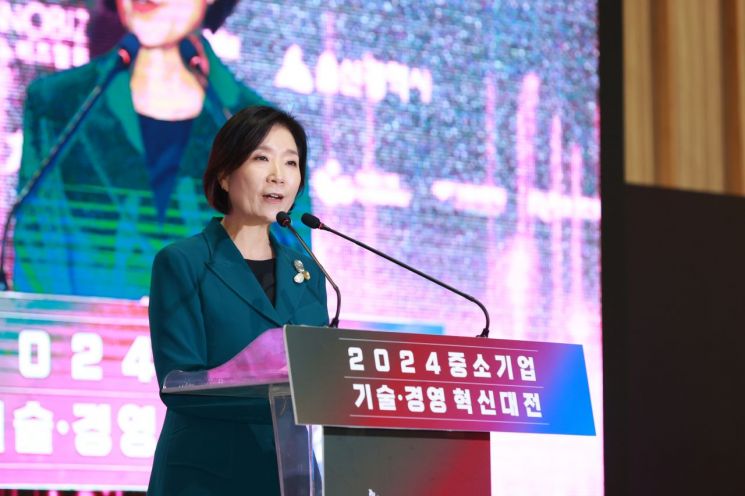 Minister Oh Young-joo of the Ministry of SMEs and Startups is delivering the opening address at the opening ceremony of the "2024 SME Technology and Management Innovation Exhibition" held at the Ulsan Exhibition and Convention Center on November 14 last year. Photo by Yonhap News
The three-track R&D for SMEs will also be fully activated. The supply of SME R&D in national strategic technology fields (12 fields including semiconductors and secondary batteries), currently at about 38%, will be expanded to over 50%. ‘Global Cooperation R&D,’ which supports commercialization R&D and resolution of technical difficulties for SMEs by utilizing technologies held by leading overseas research institutions, will also be promoted.
Policy finance by growth stage will be prepared to support growth from small business owners to SMEs and from SMEs to mid-sized companies. New scope criteria by SME industry, considering recent price and industrial changes, will also be prepared to ensure the growth ladder system operates smoothly.
Proactive Future Response
To activate tech service exports with low fixed costs and high added value, export vouchers will be newly introduced, and the ‘Global Smart Tech Bridge’ platform supporting matching and transactions with overseas technology demand companies will be fully operated. To promote exports of Hallyu strategic items such as K-Beauty, food, and content, a ‘K-Beauty Global Fund’ will be established, and the 160 million USD Korea-Saudi joint fund will be utilized to support entry into the Middle East game industry, expanding new market development for Hallyu-based content.
Along with this, customized responses to overseas export regulations will be strengthened. ESG (environment, social, governance) innovation will be induced throughout the supply chain between large corporations and cooperating SMEs, and support for recognition and linkage between domestic halal certification bodies and exporting SMEs will be expanded to enable SMEs to proactively respond to overseas export regulations.
New low-interest funds will be supplied to companies establishing and operating overseas subsidiaries, and the global business center, a base for overseas expansion, will be expanded. Cooperation with the ‘Global One Team Council,’ which involves 17 countries and 25 overseas diplomatic missions, will be strengthened to resolve difficulties faced by local SMEs.
To create regional commercial districts attracting people and capital, two new ‘Glocal Commercial District Projects’ will be designated and supported with up to 15.5 billion KRW over five years. Three new systems?commercial district planners, commercial district development funds, and commercial district investment associations?will be created for private-led rebuilding of commercial districts. The number of commercial district planners who plan and execute strategies for commercial districts will start at 250 this year and increase to 1,000 by 2027. Hundred-year markets with regional history and culture will be designated two to three times annually to become landmarks, and traditional markets will be nurtured where history and digital coexist by introducing the latest joint logistics services.
To prevent insolvency of SMEs due to CEO aging and lack of family successors, the ‘(tentative name) Business Succession Act’ for third-party mergers and acquisitions (M&A) will be enacted. The entire M&A-type succession process will be supported, including designation of business succession support centers, linkage with private M&A brokerage institutions, and subsidy support.
In collaboration with the Ministry of Education and the Ministry of Justice, a support system for foreign students including job training, employment matching, and visa conversion will be established. This will support all stages from attracting foreign students to employment and settlement, helping to alleviate manpower shortages in SMEs.
Minister Oh Young-joo of the Ministry of SMEs and Startups said, “External uncertainties will increase with the inauguration of the Trump administration, and the unstable domestic and international environment will pose even greater challenges, especially for SMEs and small business owners, who are the policy targets of the Ministry of SMEs and Startups.” He added, “The Ministry of SMEs and Startups will serve as a reliable pillar that small business owners and SMEs can rely on and trust.”
© The Asia Business Daily(www.asiae.co.kr). All rights reserved.


















