Hanyang University Wins 'Top Innovation Award'
Four Domestic Universities Receive 'Innovation Awards'
Research teams from domestic universities were recognized for their outstanding technological capabilities at CES 2025, the world's largest electronics and IT exhibition.
According to Hanyang University on the 10th, the Human-Computer Interaction (HCI) Game Lab at Hanyang University Graduate School was the only university research lab to receive the highest innovation award at CES 2025. The product exhibited by the Hanyang University Game Lab was the tinnitus digital therapeutic device (TD Square), which received the highest score in the 'Digital Health' category. TD Square is a tinnitus digital therapeutic device that combines auditory, visual, and tactile feedback systems with virtual reality (VR) technology to provide cognitive behavioral therapy. In virtual reality, patients can directly control and remove a tinnitus 3D sound avatar generated by generative AI, achieving relief from tinnitus symptoms.
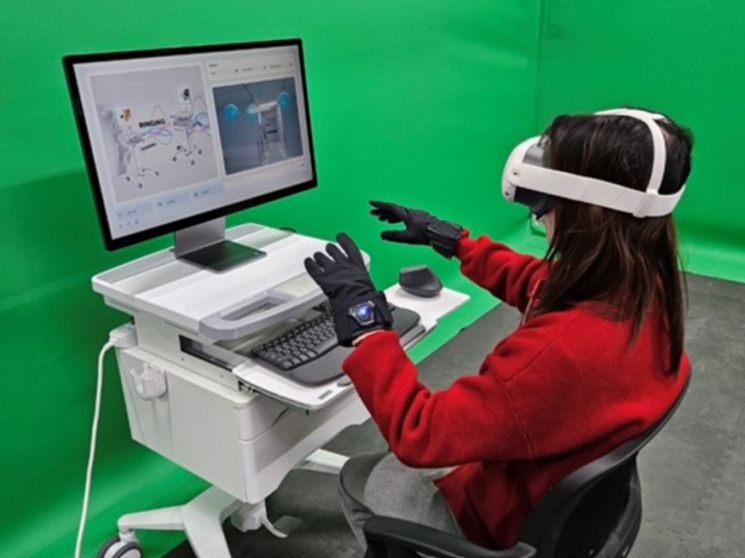 Demonstration of the digital therapeutic device by Lee Myung from the Human-Computer Interaction (HCI) Game Lab at Hanyang University. Provided by Hanyang University
This device provides a virtual environment that allows patients suffering from tinnitus to perceive the tinnitus location as if it is pulled outside the ear. Patients can manipulate the tinnitus avatar to correct misperceptions and alleviate tinnitus. Professor Kim Ki-beom, advisor of the Game Lab and professor of Healthcare Digital Engineering at Hanyang University, said, “TD Square is a project developed over five years, starting with an initial version in 2020, achieved through the cooperation and efforts of graduate students in the Hanyang University Game Lab. I want to share the meaning of this award with the lab students,” he said in his acceptance remarks.
The Consumer Technology Association (CTA), the organizer of CES, has a panel of over 110 judges who evaluate innovative technologies and products before the event each year to select CES Innovation Award winners. This year, competition was fiercer than ever with over 3,400 innovative technologies and products submitted, the largest number in history.
The CES Innovation Award is divided into the 'Best of Innovation Award' and the 'Innovation Award,' given to products with the highest scores in each category. Award-winning products are allowed to use the CES Innovation Award logo for marketing and benefit from exposure on the CES website.
Additionally, research teams from several domestic universities, including Korea University, Yonsei University, Sungkyunkwan University, and Ewha Womans University, also celebrated winning Innovation Awards.
At Korea University, three companies received Innovation Awards: Q-Simple Plus, led by Research Professor Noh Gwang-seok of the Ultra-Reliable Quantum Internet Research Center; Complexion, by Park Chi-ho, a master's student in the Graduate School of Advanced Technology Business; and Teramime, by Park Jae-jun, an undergraduate student in the Department of Health and Environmental Convergence. Q-Simple Plus introduced the QSIMunit-SC signal generator, which produces high-performance, precise quantum signals playing a key role in next-generation security and communication technologies. Complexion showcased the wearable technology MoveFreeKer, which analyzes users' movements and body shape data in real-time to help maintain optimal body balance and health. Teramime exhibited LESA Pass, an AI-converged next-generation multifactor authentication and command recognition solution, earning recognition for its technological capabilities. Korea University has participated in CES for four consecutive years since 2022 and operated its own dedicated pavilion for the first time this year.
Mitown, a startup founded by the Computer Graphics Lab at Yonsei University's College of AI Convergence, was highly rated for the reproducibility and efficiency of its neural rendering technology and won in the 'Fashion Tech' category. Neural rendering is an optimized hyper-realistic 3D reconstruction technology based on the '3D Gaussian Splatting method.' Unlike existing 3D industry solutions that rely on graphic designers for high-quality 3D modeling and rendering, Mitown's solution reduces production costs and time while maintaining high quality.
SolidView, a faculty startup from Sungkyunkwan University, was recognized for its technology in the 'Smart City' category. Founded jointly by Professors Choi Jae-hyuk and Jeon Jeong-hoon of the Department of Semiconductor Systems Engineering at Sungkyunkwan University, SolidView introduced the 'SL-2.2' LiDAR IC technology, which outputs 3D images at a resolution of 400X128, significantly improving resolution and detection accuracy. It combines ultra-compact design and single-chip architecture for power efficiency. This technology is expected to play a key role in commercializing autonomous driving and robotics technologies by drastically reducing volume and cost compared to existing mechanical LiDAR.
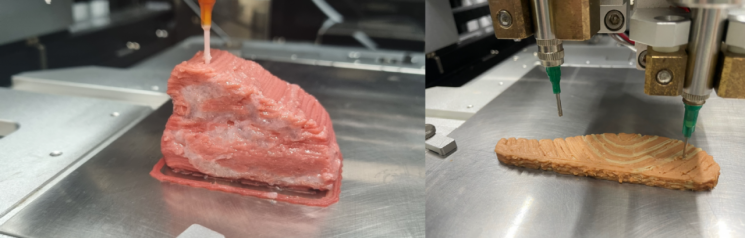 Photos of 3D printed beef steak and salmon steak that won the CES Innovation Award. Provided by Ewha Womans University
Startup Shupab, founded by Professor Lee Jin-gyu of Ewha Womans University's Department of Food and Biotechnology, along with Ewha-affiliated researchers, also won an Innovation Award for their 3D-printed alternative meat technology. 'Next Meat' is an alternative meat product reborn with excellent taste and texture by applying technologies such as muscle fiber weaving, chunk meat manufacturing, and marbling manufacturing to cultured cells from livestock and seafood. Next Meat differentiates itself from existing alternative meats by enabling customized production of highly preferred parts such as Korean beef tenderloin, sirloin, brisket, chuck flap tail, or the upper back part of salmon through 3D printing technology, achieving a texture close to real meat. Next Meat is highly regarded not only for mimicking the taste and texture of meat but also for considering sustainability by using materials that minimize environmental impact and employing eco-friendly distribution methods.
© The Asia Business Daily(www.asiae.co.kr). All rights reserved.


















