Inflated Flight Distance... If True, Bombing Japanese Territory
Trilateral Cooperation Among South Korea, US, and Japan Raises Doubts on North Korean Missile Evasion
Military Authorities: "No Second Peak Altitude"... Emphasis on Deception
North Korea claimed on the 6th, just two weeks before the launch of the 'Trump 2nd term,' that it successfully fired a new hypersonic medium-range ballistic missile (IRBM), but doubts about its credibility have been raised. If the missile had indeed flown 1500 km as North Korea claimed, it should have landed on Japanese territory. Military authorities are placing emphasis on 'deception.'
According to military authorities on the 8th, North Korea announced the successful launch of the new hypersonic IRBM, claiming that it "flew along the planned flight trajectory and accurately struck the virtual target area in international waters along the 1500 km line." The launch site detected by the military was around Pyongyang, and the missile flew past the uninhabited island 'Alseom' off the coast of Kilju County, North Hamgyong Province. This is a location frequently used by North Korea as a target for short-range ballistic missiles (SRBM).
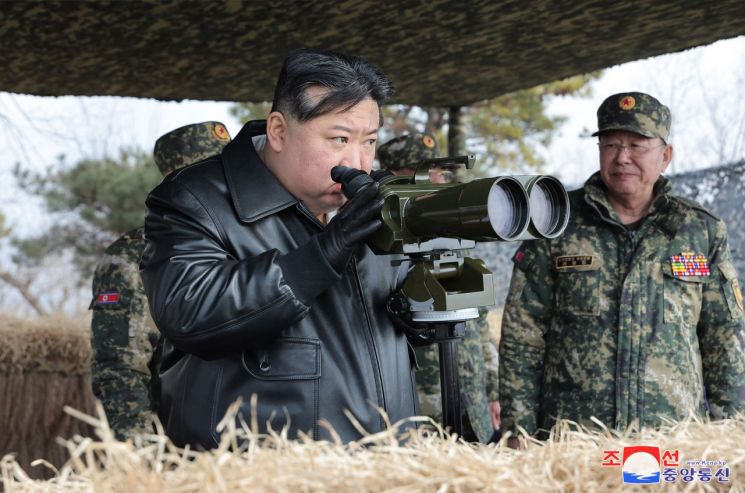
If you draw a 1500 km line from Pyongyang towards Alseom, the final impact point would reach the northernmost point of Hokkaido, Japan. If North Korea's claim is true, the missile would have landed on the Japanese mainland or, considering some margin of error, flown to the La Perouse Strait between Hokkaido and Russia's Sakhalin.
This differs significantly from the information gathered by the military and intelligence authorities of South Korea, the United States, and Japan.
First, the Joint Chiefs of Staff assessed the missile's flight distance to be around 1100 km. The Japanese government also presented a similar analysis, stating that the missile appeared to have fallen outside Japan's Exclusive Economic Zone (EEZ). If the missile had approached or reached Japanese territory, such an analysis would not have been released.
Detection and tracking of missiles are limited by the Earth's curvature, which can cause some margin of error, but even considering this, North Korea's claim lacks solid evidence. At the time of the missile launch, detection was smooth from nearby South Korea, and since the missile flew northeast as in this case, the impact point would be easier to identify from Japan.
Moreover, the trilateral cooperation system of South Korea, the United States, and Japan, which shares North Korean missile information with support from the U.S., tracks North Korean missiles together. It is nearly impossible for North Korea to evade the surveillance networks of all three countries.
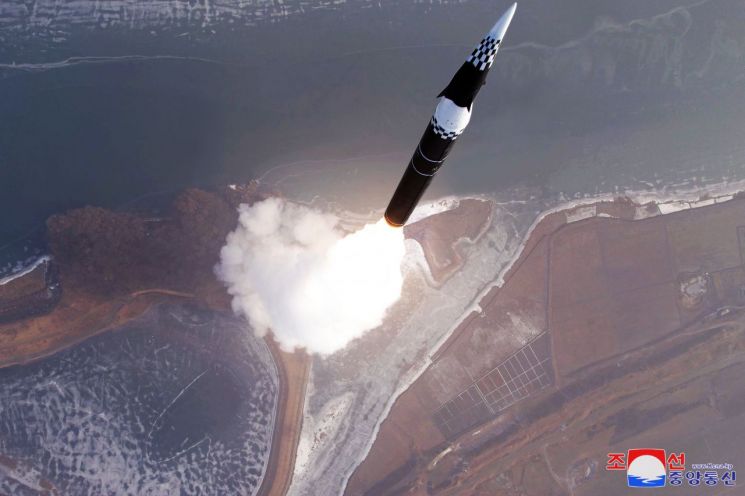 North Korea Conducts Test Launch of New Hypersonic Medium- to Long-Range Ballistic Missile Yonhap News
It is also presumed that North Korea exaggerated not only the flight distance but also the missile's flight characteristics. The day after the missile launch, North Korea announced figures of 'first peak altitude 99.8 km' and 'second peak altitude 42.5 km.' This missile is evaluated to be the same or an improved version of the hypersonic missile Hwasong-16 type fired in April last year, when North Korea claimed flight characteristics of 'first peak altitude 101.1 km' and 'second peak altitude 72.3 km.'
The fact that the missile reached peak altitudes twice means it maneuvered abnormally by changing its trajectory during flight. This aligns with the characteristics of hypersonic missiles designed to evade the opponent's missile defense systems. Furthermore, the difference between the first and second peak altitudes was about 29 km during the April launch last year, but this time it widened to about 57 km. North Korea's claim suggests that its abnormal maneuvering capability has improved.
However, our military authorities dismissed the existence of a second peak altitude this time as well, just like last year. In other words, the abnormal maneuvering capability claimed by North Korea has not yet been achieved.
© The Asia Business Daily(www.asiae.co.kr). All rights reserved.


















