Increase in Application Rejections Due to Unmet Requirements
'Worker Haepsalron' Rejection Rate at 24%... 'Haepsalron15' at 13%
Total Supply Amount by Product Also Decreases
Assembly Member Kim Hyunjung: "Review Criteria Must Be Improved to Enhance Accessibility for Vulnerable Groups"
As vulnerable groups face increasing difficulties due to high interest rates and high inflation, cases of rejection for applications to low-income financial products are on the rise due to reasons such as failure to meet requirements. Concerns are being raised that the purpose of supporting vulnerable groups financially may be undermined as the rejection rate for low-income financial products surges.
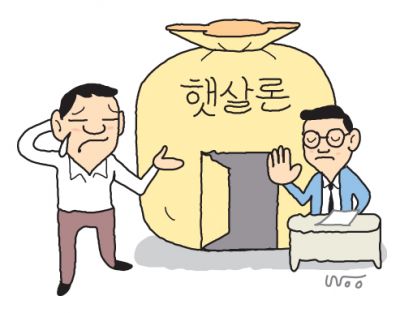
According to data received on the 8th by the office of Kim Hyun-jung, a member of the National Assembly's Political Affairs Committee from the Democratic Party of Korea, from the Korea Inclusive Finance Agency, the rejection rate for major low-income financial products handled by the agency last year increased significantly compared to the previous year. For the 'Hetsalron Youth' product aimed at young people aged 34 and under, 23,799 out of 85,400 applications from January to November last year were rejected, accounting for 27.8%. The rejection rate, which was 11.5% in 2021, rose to 15.0% in 2022 and 21.5% in 2023, showing a sharp upward trend.
In particular, for the Worker Hetsalron product targeting low-credit and low-income workers, 97,922 out of 407,922 applications by November last year were rejected, resulting in a rejection rate of 24.0%. Although this rate is slightly lower than the previous year's 25.6%, it is significantly higher compared to 11.0% in 2020, 15.6% in 2021, and 19.0% in 2022.
The Hetsalron15 product, which supports the lowest credit borrowers, saw 16,865 rejections out of 130,419 applications by November last year, marking a rejection rate of 13.0%, which is four times higher than the 3.0% rate in 2023. The Hetsalron Card, designed for vulnerable groups who have difficulty obtaining credit cards, also experienced a rejection rate of 9.32% (2,095 rejections out of 22,482 applications) by November last year, nearly double the 5.44% rate in 2023.
As rejections increase even when applying for low-income financial products, the supply amount for Hetsalron Youth by November last year was 172.1 billion KRW, a 44.4% decrease compared to the total of 39.4 billion KRW in 2023. During the same period, the supply amount for Worker Hetsalron was 2.5235 trillion KRW, down 26.5% from 3.4342 trillion KRW the previous year, and Hetsalron15 was 941.7 billion KRW, a 28% decrease from 1.3086 trillion KRW the previous year.
For Hetsalron Bank, the rejection rate by November last year was 8.6% (11,534 rejections out of 134,758 applications), lower than the previous year's overall rejection rate of 16.5% (26,217 rejections out of 159,416 applications), but the supply amount decreased by 36.2%, from 1.3329 trillion KRW to 849.8 billion KRW.
The Korea Inclusive Finance Agency explained, "Rejections occur due to reasons such as insufficient employment and income verification, incorrect application information, failure to meet screening criteria, and possession of public information or credit judgment information." In response, Assemblywoman Kim Hyun-jung pointed out, "The difficulties faced by vulnerable groups are worsening day by day due to the recent economic downturn. Financial authorities must improve the screening criteria for low-income financial products in line with the original policy intent to strengthen financial accessibility for low-income and vulnerable groups, and more carefully reflect the realities of support recipients."
© The Asia Business Daily(www.asiae.co.kr). All rights reserved.

















