Direct Hit to Discretionary Consumer Goods Sector Due to Consumption Contraction
Last year, the number of bankruptcy filings by U.S. companies reached the highest level since 2010, following the aftermath of the global financial crisis. Continuous inflation and high interest rates have thinned consumers' wallets, delivering a direct blow to discretionary consumer goods sectors.
According to S&P Global Market Intelligence on the 6th (local time), at least 686 U.S. companies filed for bankruptcy protection last year, an increase of about 8% compared to 2023. This is the highest level since 2010 (828 cases) during the global financial crisis.
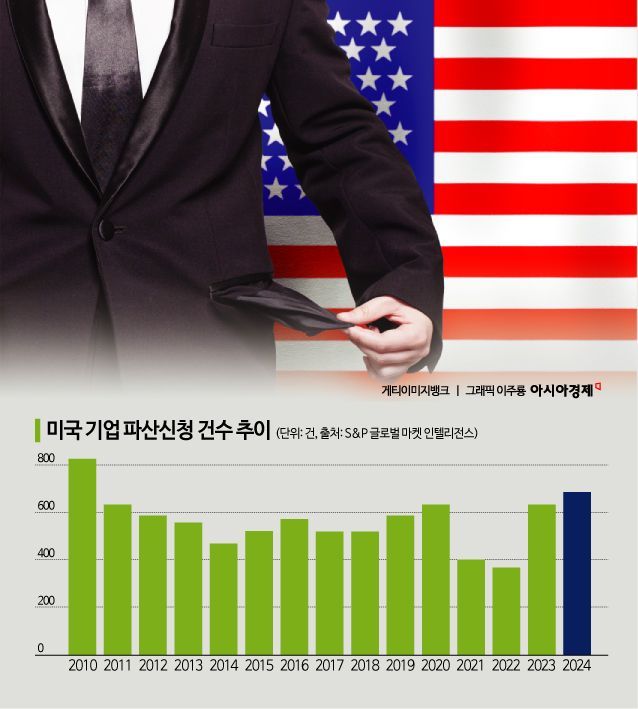
International credit rating agency Fitch reported that companies attempting to avoid bankruptcy through out-of-court workouts such as debt restructuring or reorganization saw a sharp increase last year, exceeding the number of bankruptcy filings by about twice. Creditors of companies with debts of at least $100 million have experienced the lowest recovery rates since 2016. Among the companies that filed for bankruptcy last year, at least 30 had debts of $1 billion or more at the time of filing.
The cause of this widespread bankruptcy risk was attributed to a contraction in domestic demand. As the scale and effects of economic stimulus measures have waned since the pandemic, the persistent high inflation and high interest rate environment have dealt a direct blow to companies reliant on household spending. In particular, 196 bankruptcy filings occurred in the discretionary consumer goods sector and industrial sectors such as construction and manufacturing, accounting for 28% of the total.
For example, Party City, the largest party supplies retailer in the U.S. with a 40-year history, filed for bankruptcy protection under Chapter 11 (a U.S. legal provision for corporate reorganization) last month, and plans to close 700 stores by next month. Other companies that filed for bankruptcy last year include restaurant chains TGI Fridays and Red Lobster, Spirit Airlines, and plastic container maker Tupperware.
Gregory Daco, Chief Economist at Ernst & Young (EY), said, "As the costs of goods and services continue to rise, consumer demand is under pressure. This burden particularly affects low-income households, but consumption is also becoming cautious among the middle and high-income groups."
Although the pressure on companies and consumers is somewhat easing as the Federal Reserve (Fed) enters an interest rate cut cycle, the possibility that the Fed may slow the pace of rate cuts this year is seen as a variable. Especially, with the U.S. service sector economic indicator released on the same day showing expansion exceeding expectations, market forecasts for a rate freeze are spreading. According to the Chicago Mercantile Exchange (CME) FedWatch, the federal funds futures market reflects over a 30% chance that the Fed will keep rates at the current level through the first half of this year.
Bill Adams, Chief Economist at Comerica Bank, predicted, "It is highly likely that the Fed will shift from cutting rates between September and December last year to halting rate cuts in 2025."
© The Asia Business Daily(www.asiae.co.kr). All rights reserved.

















