March-April Thaw Period Inspection... Focused Check on Ground Subsidence Occurrence
May-June Preparations for Rainy Season Including Securing Flood Control Materials
August-September Flood and Typhoon Preparedness Inspection of Drainage and Other Facilities
Gyeonggi Province announced on the 8th that it will implement systematic safety inspections this year to establish a safety culture at non-administrative office road construction sites.
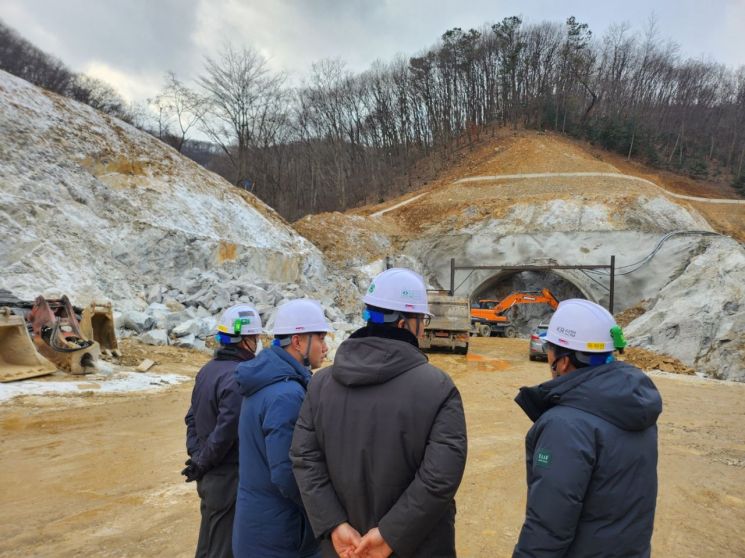 Gyeonggi Province will implement systematic safety inspections this year to establish a safety culture at non-management office road construction sites. The photo shows an inspection at the tunnel construction site between Jungri and Cheonri on Local Road No. 84. Photo by Gyeonggi Province
Non-administrative office road construction refers to projects carried out by cities, counties, public institutions, or private businesses with permission from Gyeonggi Province, rather than by the provincial road administration office. This year, there are a total of 157 non-administrative office road construction sites underway within Gyeonggi Province, and the scale of projects and road construction carried out by non-administrative offices such as private businesses is increasing annually.
In particular, non-administrative office projects are often small in scale and lack on-site construction managers, making systematic safety management at construction sites crucial. Accordingly, the province has decided to conduct systematic management by pre-setting major project risk periods.
First, in March and April, thawing season inspections will focus on construction sites that include related facilities such as cut and fill slopes, retaining walls, and stone walls, where ground weakening or structural damage is likely to occur.
From May to June, inspections will be conducted in preparation for the rainy season. The focus will be on checking the establishment of pre-planned measures such as securing flood control materials and setting up emergency contact networks, as well as on-site inspections of vulnerable areas during the rainy season, including drainage channels, sumps, sedimentation basins, and sewer pipes. Surveillance activities will be strengthened in areas prone to safety accidents, with an emphasis on removing risk factors in advance.
From August to September, inspections will be carried out to prepare for autumn typhoons. The plan includes detailed inspections and necessary measures to prevent accidents such as the overturning of construction machinery and equipment caused by strong winds, securing and checking the fastening of various facilities, sign materials, and stored items that could be blown away by strong winds, as well as preventing rockfalls and collapses in hazardous areas.
Kim Young-seop, Director of the Road Policy Division of Gyeonggi Province, stated, “Safety inspections are more than simple checks; they are an important step to establish a safety culture at construction sites and prevent accidents.” He added, “We will prioritize the safety of residents and strengthen safety by systematically conducting everything from on-site inspections to post-management.”
© The Asia Business Daily(www.asiae.co.kr). All rights reserved.
![Clutching a Stolen Dior Bag, Saying "I Hate Being Poor but Real"... The Grotesque Con of a "Human Knockoff" [Slate]](https://cwcontent.asiae.co.kr/asiaresize/183/2026021902243444107_1771435474.jpg)
















