Justin Trudeau, the Canadian Prime Minister who expressed his intention to resign, strongly dismissed the repeated claims by President-elect Donald Trump that Canada should be incorporated as the 51st state of the United States, saying "there is absolutely no possibility." Trump, who has mocked Trudeau as the "Governor of Canada," has declared that he could use "economic pressure" rather than military force against Canada.
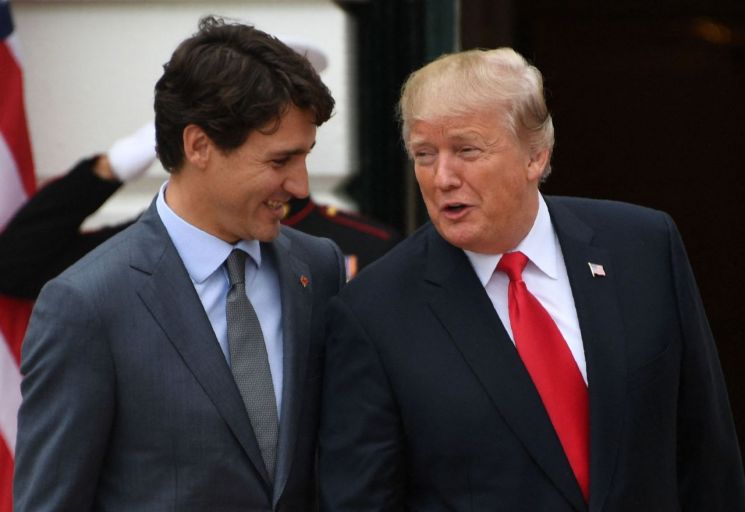 Justin Trudeau, Prime Minister of Canada (left), and Donald Trump, President-elect of the United States. Photo by AFP Yonhap News
On the afternoon of the 7th (local time), Trudeau posted on his X (formerly Twitter) account, stating, "There is absolutely no chance that Canada will become part of the United States." He emphasized the importance of the relationship between the two countries, saying, "Workers and communities in both countries benefit most when they are each other's largest trade and security partners."
Melanie Joly, Canada's Minister of Foreign Affairs and considered one of Trudeau's potential successors, also rebutted, saying, "Trump's remarks about incorporating Canada show a complete lack of understanding of what makes Canada a strong country." She added, "Our economy is strong. Our people are strong. We will never back down in the face of threats." Pierre Poilievre, leader of Canada's main opposition Conservative Party, also raised his voice, saying, "Canada will never be the 51st state (of the U.S.). We are a great and independent country."
This came after President-elect Trump, at a press conference held at his Mar-a-Lago residence in Florida on the same day, described the border between Canada and the U.S. as an "artificially drawn line" and reiterated the possibility of Canada joining the U.S. During the event, when Trump did not rule out the use of military force regarding the Panama Canal and Greenland, a Danish territory, questions about Canada followed. Trump responded, "No (we will not use military force). We will use 'economic pressure'."
The economic pressure mentioned by Trump appears to refer to the previously announced high tariffs. On the same day, he claimed, "If Canada and the U.S. come together, it would be truly great," and argued, "If we remove the artificially drawn line and see what it looks like, it would be much better for national security." As of 2023, the scale of U.S. imports is estimated at about $3.1 trillion, with Canada accounting for roughly one-third of that.
Facing the threat of high tariffs, Canada’s political uncertainty has deepened following Trudeau’s resignation announcement the day before. It is particularly analyzed that Trump’s return to the White House played a significant role in Trudeau’s decision to resign. Earlier, Trudeau rushed to Mar-a-Lago after Trump threatened to impose a 25% tariff on Canadian products, but it is reported that during a dinner, he was told to "become the 51st state of the United States."
Canada’s CTV News noted, "At the time, Canadian officials regarded Trump’s remarks as mockery, but he seems to have started taking this idea seriously afterward," adding, "Trump calls Trudeau the 'Governor' and claims Canada receives $200 billion in subsidies from the U.S., but it is unclear what this figure refers to." The New York Times (NYT) reported, "Regardless of the outcome of Canada’s political transition, Trudeau’s resignation has plunged Canadian politics into prolonged uncertainty," and "The incoming Trump is targeting Canada."
Even after Trudeau announced his resignation as party leader and prime minister the day before, Trump stated on Truth Social, "Many people in Canada would love to become the 51st state (of the U.S.)." He wrote that if Canada merges with the U.S., it would be safe from threats posed by Russian and Chinese ships, adding, "Together, what a great country we would be."
© The Asia Business Daily(www.asiae.co.kr). All rights reserved.

















