It Appears That People Feel Powerless in Resolving Legislative Conflict Issues
As the conflict between the government and the medical community over the increase in medical school admissions has continued for nearly a year, a public opinion survey revealed that the majority of the public feels fatigue and stress.
The Graduate School of Public Health at Seoul National University announced the results of the "Public Perception Survey on Health Care Reform Policies" on the 7th, which was conducted by Korea Research from the 20th to the 24th of last month, targeting 1,000 adult men and women aged 18 and over nationwide.
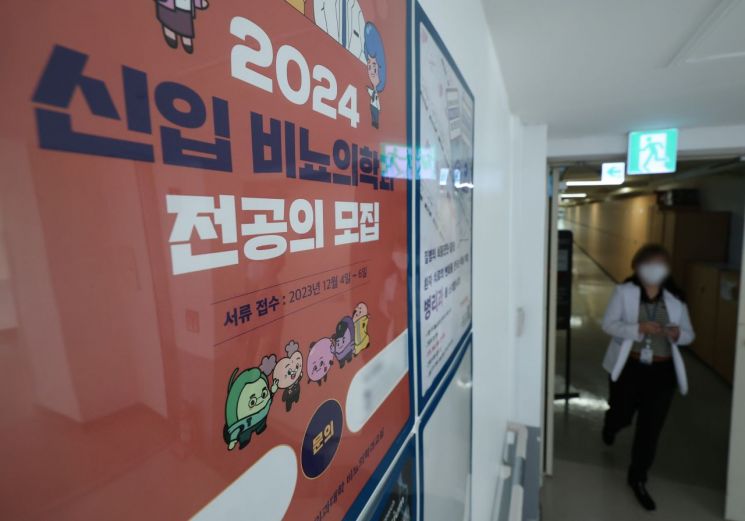 Poster announcing that the recruitment of medical residents, amid ongoing legislative conflicts, will begin on the 4th. Photo by Yonhap News
According to the survey results, 87.6% of respondents answered that "the regional and specialty distribution imbalance of doctors is a serious problem." Regarding the number of doctors in Korea, a majority of 57.7% thought it was "insufficient." Those who thought it was "adequate" accounted for 26.9%, "never thought about it/no opinion" 8.9%, and "exceeds the appropriate level" 6.5%.
Regarding the existing government plan to increase medical school admissions by 2,000 students starting from the 2025 academic year, 29.0% of respondents said they "disagree with both the timing and scale of the increase." Meanwhile, 27.2% agreed with both the timing and scale of the government plan. 34.8% agreed with either the timing or the scale.
Agreement with the government's four major health care reform tasks?▲ expansion of medical personnel (61.0%) ▲ fair compensation (63.3%) ▲ establishment of a medical accident safety net (69.0%) ▲ strengthening regional medical care (76.3%)?all showed high levels above 60%.
The majority of the public (69.0%) believed that the conflict between the government and the medical community could have been prevented. They cited "failure to realistically prepare measures to seek cooperation by assessing the trustworthiness of key stakeholders regarding the policy in advance" (61.9%) as the cause of the conflict. More than half of respondents (54.0%) said that the current situation cannot resolve the government-medical community conflict, and to resolve it, "a completely different third-party solution" (38.0%) or "a revised government plan" (35.4%) is necessary. To resolve the prolonged conflict, 45.4% responded that "the medical reform plan should be revised or its implementation postponed," while 37.7% said "medical reform should continue."
In particular, 70.0% of respondents said they felt stress or fatigue due to the government-medical community conflict. When asked whether the prolonged conflict had a negative impact on themselves, 88.0% answered "yes," and among them, 52.4% reported experiencing psychological effects such as anxiety and concern.
69.6% of respondents believed that the public’s role is important in mediating and resolving the government-medical community conflict. However, most respondents felt powerless in resolving the issue, answering that "ordinary citizens and patients are easily excluded from the government-medical community conflict" (75.1%) and "ordinary citizens and patients have no power in mediating the conflict" (74.5%).
57.5% of respondents said that "the government is not effectively communicating policies and conflict situations to the public," and to improve effective communication, they suggested enhancing "communication and feedback" (34.1%) and "the composition and attitude of communication agents" (28.7%).
Lee Tae-jin, Dean of the Graduate School of Public Health at Seoul National University, emphasized, "It is clear that many people still feel the necessity of increasing medical school admissions and health care reform," adding, "We must be cautious not to weaken the momentum for health care reform due to the current political situation."
Professor Yoo Myung-soon, who designed the survey, predicted, "Efforts to increase the participation and empowerment of the public and patients in policy will have a significant impact on the success of health care reform policies."
© The Asia Business Daily(www.asiae.co.kr). All rights reserved.
![Clutching a Stolen Dior Bag, Saying "I Hate Being Poor but Real"... The Grotesque Con of a "Human Knockoff" [Slate]](https://cwcontent.asiae.co.kr/asiaresize/183/2026021902243444107_1771435474.jpg)
















