Survey of 151 Private Universities by Sachoonghyup
48 "Increase" · 38 "Undecided"
Despite the government's tuition freeze policy, more than half of private university presidents have announced plans to raise tuition this year as universities face increasing difficulties due to high inflation.
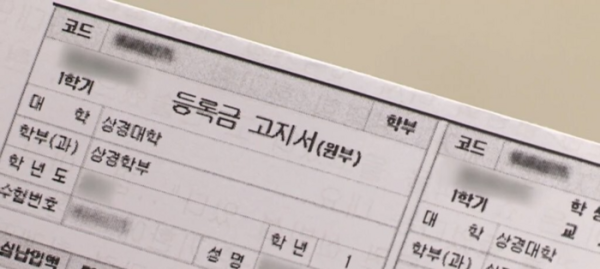
On the 7th, Yonhap News reported the results of an online and offline survey conducted in November last year targeting presidents of 151 member universities of the Korea Association of Private University Presidents (KAPUP). Ninety university presidents responded. KAPUP stated, "The 61 universities that did not respond are believed to be concerned about new student recruitment and the linkage to support under the 'National Scholarship 2' type when considering tuition increases."
Considering this, universities planning to raise tuition account for 31.8% of all private universities, while 25.2% are undecided. Combined, these two response rates total 57.0%.
When asked about university issues, 75.9% of presidents ranked tuition increases as their top priority. The second priority was improving university-related regulations, and the third was enhancing university infrastructure. Additionally, 42.2% of private university presidents said tuition increases are "still under discussion."
On the other hand, only 4.4% of universities announced plans to freeze tuition, and none considered lowering it. Based on the survey results alone, more than half of private universities may raise tuition.
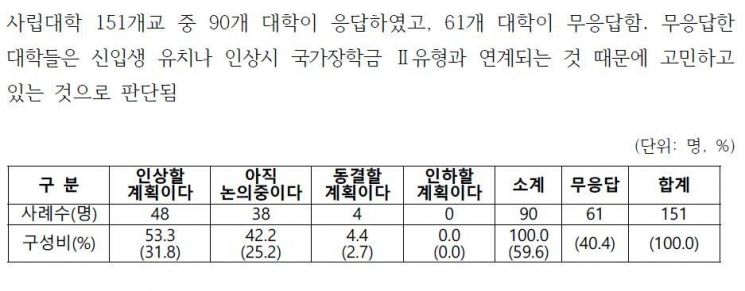 Survey on 'Tuition Fee Increase' at Domestic Private Universities. Korea Council of Private University Presidents
Regarding plans for utilizing increased tuition fees, the top priority was attracting excellent professors and hiring staff, followed by strengthening student welfare support systems and facilities, and thirdly, reorganizing academic structures and curricula to suit the digital era.
Specific difficulties caused by the 16-year tuition freeze, as revealed by the presidents, included expanding advanced experimental and practical equipment (97.8%), improving advanced educational facilities (97.7%), recruiting excellent faculty and staff (96.6%), and enhancing student welfare (94.5%).
Previously, Sogang University and Kookmin University approved tuition increases of 4.85% and 4.97%, respectively, and other private universities such as Yonsei University, Kyung Hee University, and Chung-Ang University are also reportedly discussing tuition hikes.
Hwang In-seong, Secretary General of KAPUP, told Yonhap News, "Tuition increases are an inevitable choice to improve the quality of university education and establish advanced educational environments," and argued that "a major shift in higher education policy is needed, including allowing tuition increases and expanding financial support for private universities."
The current Higher Education Act stipulates that tuition increases may not exceed 1.5 times the average consumer price inflation rate over the previous three years. The legal limit for tuition increases for the 2025 academic year is 5.49%.
© The Asia Business Daily(www.asiae.co.kr). All rights reserved.


















