Online Grocery Transaction Amount Surpasses 30 Trillion Won for the First Time Last Year
1 in 10 Consumers Purchase Groceries Online
22% Use Dawn Delivery at Least Once a Week... Tripled in 5 Years
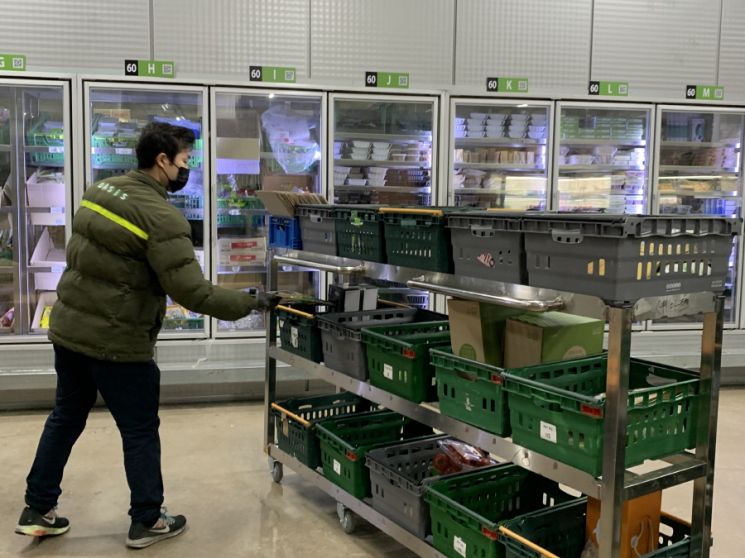
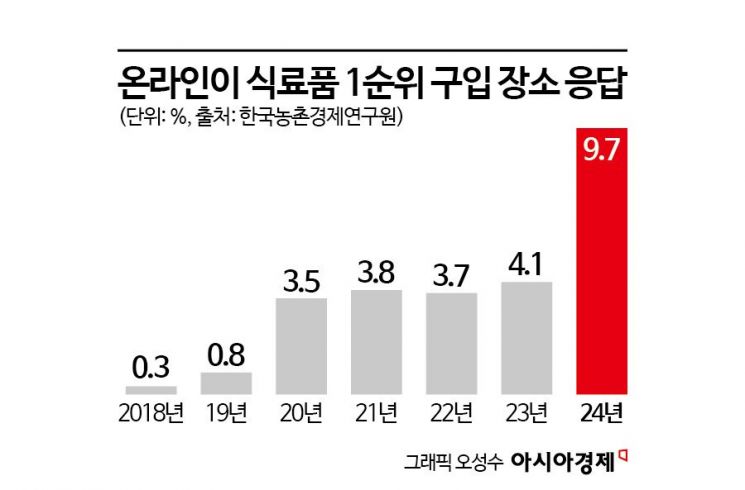
Last year, the number of consumers who used online platforms as their top priority place for purchasing food more than doubled compared to a year earlier. In recent years, as online shopping has spread across all generations and become a part of daily life following the COVID-19 pandemic, the purchasing channels for food items?which previously faced the highest resistance?also appear to be shifting toward online.
According to the 2024 Food Consumption Behavior Survey by the Korea Rural Economic Institute on the 11th, the proportion of respondents who identified online as their primary place for purchasing groceries last year was 9.7%, more than double the 4.1% recorded a year earlier. The share of online as the top grocery purchase location was around 0.3% in 2018, rose to 0.8% the following year, increased to 3.5% in 2020, and then remained steady for a few years before surging significantly last year. By age group, those in their 30s and younger had the highest rate at 23.3%, followed by those in their 40s at 13.0%, 50s at 7.8%, 60s at 1.7%, and 70 and older at 0.5%, showing a proportional relationship between age and usage rate.
As online food purchases increase, the proportion of consumers using dawn delivery services is naturally rising as well. Last year, 22.2% of respondents used dawn delivery at least once a week, up 2.9 percentage points from 19.3% the previous year. Compared to five years ago in 2019 (7.4%), this represents more than a threefold increase. The reasons for using dawn delivery have also changed; in 2019, the top reason was being able to eat fresh food at 57.0%, but last year, the most common reason was receiving deliveries early in the morning at 56.0%.
The distribution channels primarily used for online food purchases show a significant increase in comprehensive shopping malls. The share of consumers using online-only malls without offline retail operations, such as Coupang, Gmarket, and 11st, rose from 51.1% in 2019 to 74.3% last year, an increase of 23.2 percentage points. Conversely, the share of consumers using online malls operated by existing large retailers such as E-Mart, Lotte Mart, and Hyundai Department Store dropped sharply from 30.7% to 11.0% during the same period.
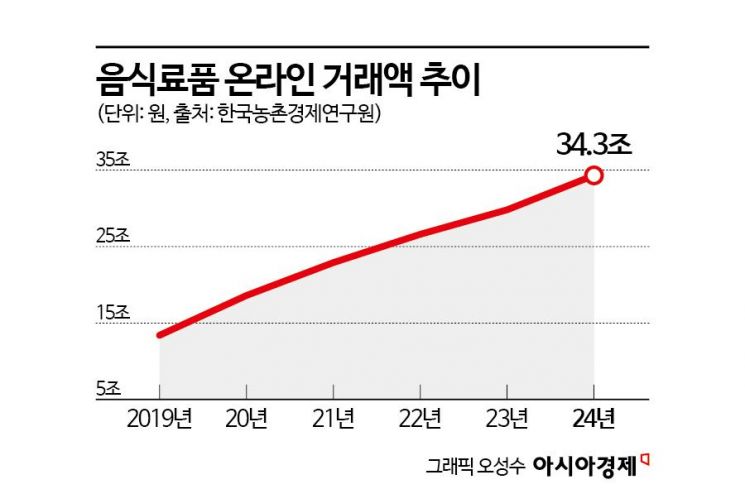
As online grocery purchases increase, the actual transaction amount for food and beverage products through online channels is also showing an upward trend. Last year, the domestic online transaction amount for food and beverage products reached 34.26 trillion KRW, surpassing the 30 trillion KRW mark for the first time. The online transaction amount for food and beverage products was about 13.45 trillion KRW in 2019, exceeded 20 trillion KRW at 22.91 trillion KRW in 2021, and steadily increased to 26.66 trillion KRW in 2022 and 29.84 trillion KRW in 2023. The transaction amount that exceeded 30 trillion KRW last year is expected to continue growing to between 37 trillion and 38 trillion KRW this year.
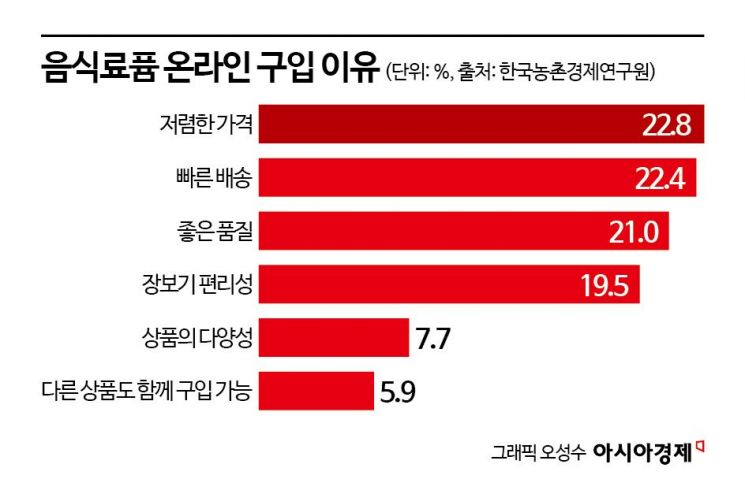
The sharp increase in online food purchases is attributed to overall improvements in conditions for purchasing groceries online, such as price and quality. In fact, the highest proportion of respondents (22.8%) chose online shopping because prices were cheaper, followed closely by fast delivery at 22.4%. Other reasons included better quality (21.0%) and ease and convenience of shopping (19.5%).
Meanwhile, among those who primarily purchase food online, more than half (52.9%) reported buying water, including bottled water and carbonated water, and the purchase rate for processed foods excluding home meal replacements (HMR) was also high at 50.6%. Additionally, the purchase rate of eggs, which was around 5.4% in 2019, increased to 22.8%, and during the same period, the purchase rates for meat (9.8% → 19.3%), seafood (9.8% → 16.1%), and vegetables (9.4% → 15.8%) also rose, indicating that resistance to purchasing fresh food online has decreased compared to before.
© The Asia Business Daily(www.asiae.co.kr). All rights reserved.



















