Agricultural Products $10 Billion · Upstream and Downstream Industries $3 Billion
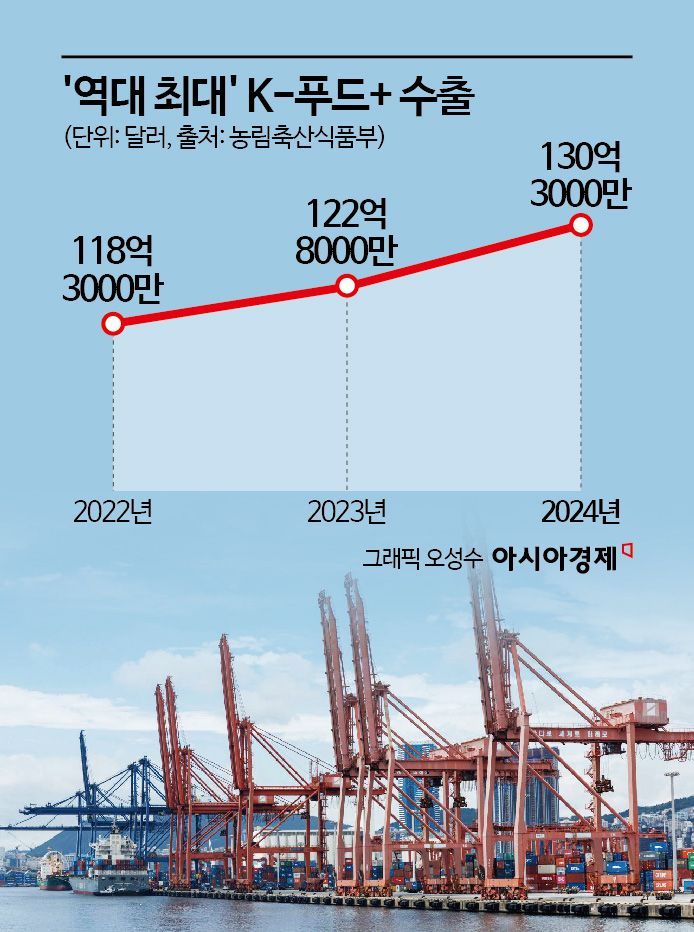
The export value of 'K-Food Plus(+)', which includes agriculture and food products, pet food, veterinary medicines, pesticides, and related upstream and downstream industries, exceeded $13 billion last year, marking a record high.
The Ministry of Agriculture, Food and Rural Affairs announced on the 7th that the provisional export value of K-Food+ in 2024 was $13.03 billion, a 6.1% increase from the previous year. Agricultural and food exports amounted to $9.98 billion, while upstream and downstream industries such as smart farms, agricultural machinery, and veterinary medicines accounted for $3.05 billion.
An official from the Ministry of Agriculture, Food and Rural Affairs explained, "The export value of K-Food+ surpassed $13 billion in 2024, setting a new record for maximum export value. Additionally, 14 items including ramen, pesticides, snacks, and pet food recorded their highest export values ever, and the K-Food+ new markets and export territories expanded."
◆ Agricultural and Food Exports Grow for the '9th Consecutive Year' = Agricultural and food exports reached $9.98 billion, a 9.0% increase compared to the previous year. This growth rate is nearly three times higher than the export growth rates of 3.9% in 2022 and 3.0% in 2023, showing continuous growth for nine consecutive years since 2015.
By product category, processed foods such as ramen ($1.2485 billion, up 31.1%) and rice processed foods ($299.2 million, up 38.4%) set record highs, driving the overall export growth. Among fresh foods, kimchi recorded its highest export value ever at $160 million.
Ramen, the top agricultural and food export item, exceeded the previous year's performance of $950 million within 10 months and reached $1.25 billion in exports by the end of the year. An official from the Ministry of Agriculture, Food and Rural Affairs stated, "Ramen has shown steady growth across regions as it is frequently featured in K-content such as dramas and movies, and the ramen-eating challenge became popular. Especially in the U.S., exports increased by more than 70% due to successful entry into large retail stores in Texas."
The rice processed foods category, which showed the highest growth among top export items, grew by 38.4% year-on-year, exporting nearly $300 million. Particularly, exports to the U.S. increased by 51%. The Ministry analyzed that the preference for gluten-free (wheat flour-free) health foods and the convenience of a quick meal contributed to this growth.
Traditional food kimchi was exported at $163.6 million, surpassing the previous record of $159.9 million set in 2021 after three years. Introducing new products such as vegan kimchi and shelf-stable kimchi in new markets like the U.S. and the Netherlands, and expanding store placements played an important role in the 5.2% export increase.
Agricultural and food exports increased in most regions including the U.S., China, ASEAN, and Europe. Especially, the U.S., which led the growth of frozen gimbap, Europe with high interest in health foods, and Latin America with rising ramen demand showed growth rates exceeding 20%. The top export countries were the U.S. in first place, China second, and Japan third.
In addition to major markets, exports to key new market countries such as the Middle East, Latin America, India, and countries pursuing export market diversification like Kazakhstan, the Philippines, and Mongolia increased by 16.4% year-on-year. The Ministry of Agriculture, Food and Rural Affairs focused on consumer experience events and identified promising buyers for consultations with Korean export companies, considering the limited availability of Korean agricultural and food products in these countries.
◆ Upstream and Downstream Industry Exports Increase Due to Strong Pet Food Performance = Agricultural industry exports amounted to $3.05 billion. Despite a slowdown in growth of major export items like agricultural machinery and smart farms, the increase in exports of promising items such as pet food, veterinary medicines, and pesticides limited the year-on-year decline to 2.4%.
Pesticide exports increased by 61.7% in 2024 due to expanded exports of finished products in South America and Southeast Asia, and veterinary medicines grew by 9% with increased demand for poultry vaccines in the Middle East. Pet food exports rose by 7.4% in 2024, supported by comprehensive assistance in overseas market research, acquisition of overseas certification standards, and product research and development through new business initiatives.
Smart farm exports and orders decreased due to the base effect from large orders in the previous year (79% of $149 million in 2023). However, the number of orders and countries entered increased compared to the previous year, expanding export territories. The Ministry of Agriculture, Food and Rural Affairs expects a bright outlook this year, considering the possibility that delayed overseas orders ($166 million) will lead to final contracts.
Kang Hyung-seok, Director of Agricultural Innovation Policy at the Ministry of Agriculture, Food and Rural Affairs, said, "The record-breaking export performance is a great achievement made by the public-private 'export one team,' combining export companies' product and technology development and marketing efforts with government support across all stages from domestic production to local promotion." He added, "Although uncertainties exist in the domestic and international trade environment this year, we will continue to expand exports by leveraging opportunities such as the popularity of Hallyu and K-Food, and growth in the agricultural machinery market."
© The Asia Business Daily(www.asiae.co.kr). All rights reserved.

















