KDCA Reports 3.6-Fold Increase in Patients Over 5 Weeks
Emphasizes Personal Hygiene Rules Such as Washing Hands with Soap
As the number of norovirus infection cases, which mainly occur in winter, has recently surged, health authorities have urged the public to follow personal hygiene rules such as proper handwashing.
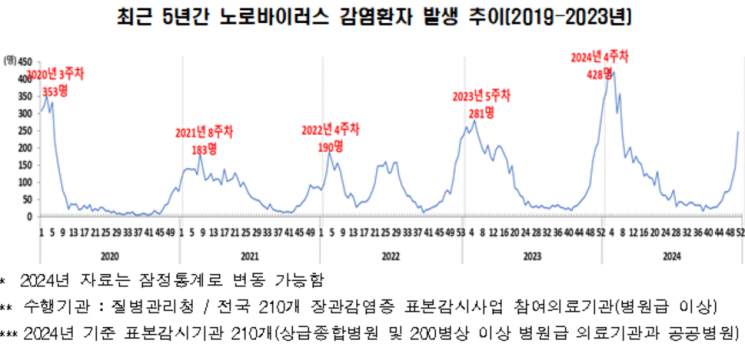
According to the Korea Disease Control and Prevention Agency on the 7th, a sentinel surveillance of gastrointestinal infections conducted on 210 hospital-level medical institutions nationwide with 200 or more beds showed that the number of norovirus patients was 291 in the 52nd week of last year (December 22?28), increasing about 3.6 times over the past five weeks.
The number of patients has been rising sharply, from 80 in the 48th week (November 24?30) of last year to 114 in the 49th week (December 1?7), 142 in the 50th week (December 8?14), and 247 in the 51st week (December 15?21). Especially in the 52nd week of last year, infants and young children aged 0?6 accounted for 58.8% of the total cases, requiring special attention from caregivers.
Norovirus is a virus that causes acute gastroenteritis, with very strong infectivity and can survive for three days even in everyday environments. Since the immunity period is short, reinfection can occur even if one has been infected before. In Korea, it mainly occurs from winter to early spring of the following year, typically between November and March. It often spreads among infants and young children who have vulnerable personal hygiene and frequently engage in group activities such as in daycare centers.
The main infection routes are consuming water (groundwater) or seafood contaminated with norovirus, but person-to-person transmission through contact with patients or infection via droplets from patient secretions is also possible. Symptoms such as vomiting and diarrhea appear within 12 to 48 hours after infection, and some people may experience abdominal pain, chills, and fever. Most recover naturally within 2 to 3 days, but infants, young children, and immunocompromised individuals should be careful as dehydration can occur if fluids are not sufficiently replenished.
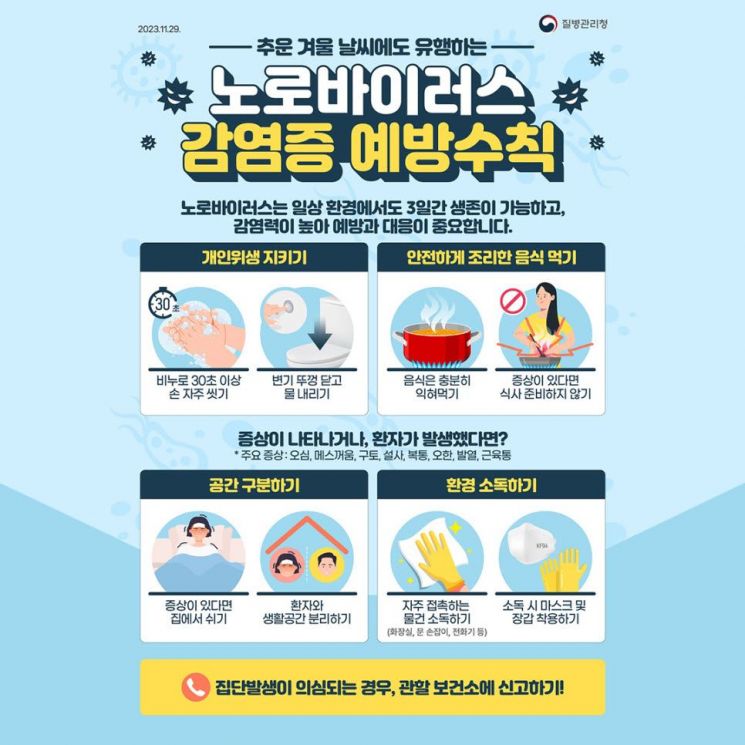
Above all, since there is no preventive vaccine for norovirus, basic hygiene management is the most important to prevent infection. It is better to wash hands with soap for more than 30 seconds rather than using hand sanitizer, wash ingredients under running water, and cook food safely and hygienically by heating it at 85℃ or higher for more than one minute.
Norovirus-infected patients are advised to refrain from attending daycare, school, or work for 48 hours after symptoms disappear and to live separately from other family members. Also, flushing the toilet with the lid closed after defecation helps prevent virus spread. Areas used by patients, bathrooms, and items contaminated with patient secretions (feces or vomit) should be disinfected by wiping with a cloth soaked in diluted commercial bleach, and when removing patient secretions, masks (KF94) and gloves must be worn to prevent infection through droplets.
Ji Young-mi, director of the Korea Disease Control and Prevention Agency, said, "To prevent norovirus infection, it is essential to follow preventive measures such as proper handwashing and consume safely prepared food," and added, "Especially in childcare facilities for infants and young children, please pay attention to refraining symptomatic individuals from attending and disinfecting spaces used by patients."
© The Asia Business Daily(www.asiae.co.kr). All rights reserved.


















